Padel rackets can crack after a collision, through accumulated damage, or because a weakness in the construction becomes exposed during use. The visible mark may appear suddenly, but the process behind it is not always immediate. A racket that develops a crack during an ordinary volley may have sustained damage earlier.
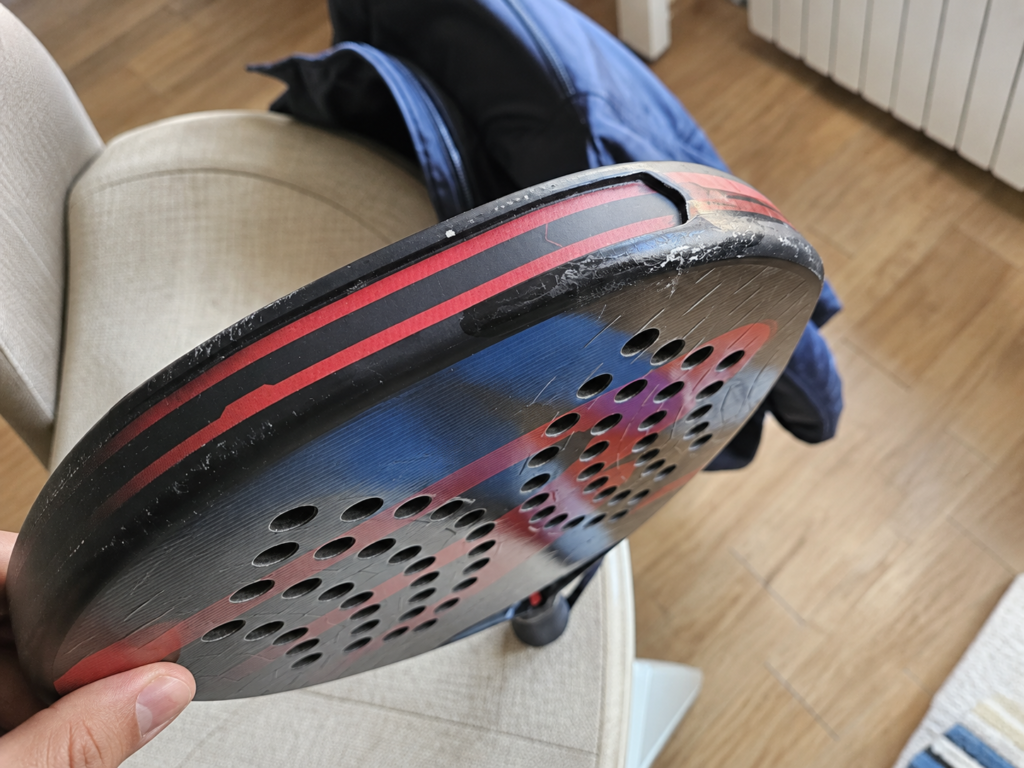
The first distinction is between a crack in the finish and damage to the load-bearing structure. Paint, primer, resin, reinforcing fibers, and bonded interfaces perform different functions. A fine line across the graphics does not automatically mean the carbon laminate has fractured. Equally, a small surface mark cannot establish that the underlying structure is intact.
Understanding the cause requires more than judging the length of a crack. Its location, depth, progression, impact history, and surrounding condition all matter. For players, this helps determine the appropriate next step. For brands and clubs, it supports better product specifications, more useful inspections, and a more informed discussion with the manufacturer.
How a Padel Racket Carries Loads
A padel racket is a composite structure. Its reinforcing fibers, resin, foam core, and frame work together to resist and distribute loads.
The fibers provide reinforcement, while the resin binds them into a usable structure and transfers loads between them. The core supports the faces, and the connections between these elements allow the assembly to behave as a racket. The exact arrangement varies with the design and manufacturing method.
Damage can therefore take several forms:
- Coating cracks: fractures in paint, clear coat, primer, or decorative layers.
- Matrix cracks: cracks within the resin surrounding the reinforcement.
- Fiber damage: broken or disrupted reinforcing fibers.
- Delamination: separation between layers of a laminate.
- Debonding: separation at an interface, such as between a face and its supporting core.
These mechanisms can occur separately or together. Technical discussion of padel racket construction identifies resin integrity and bonding as important alongside fiber selection. A visible carbon weave represents only part of the structure.
This explains why “the carbon cracked” is often an incomplete description. Before deciding what caused a failure, it is necessary to establish which part of the construction is actually damaged.
Collisions With Glass, Fencing, the Floor, or Another Racket
A collision introduces a different load from normal ball contact.
A ball deforms during impact and contacts the hitting surface over a changing area. A rigid fence element, another racket edge, or a hard floor can concentrate force into a much smaller region. The direction of that force may also differ from the loading the racket experiences during a centered shot.
Common situations include reaching for a low ball, swinging close to the enclosure, and two players attempting the same shot. The resulting damage depends on the contact location, angle, force, and construction. A collision does not need to leave a large dent to deserve attention.
Experimental research on composite laminates shows that impact can produce internal damage while leaving relatively limited visible evidence. Those studies do not predict the condition of an individual padel racket, but they explain why surface appearance alone is an incomplete assessment.
After a substantial collision, inspect the affected area before continuing. Look for a new line, exposed fibers, deformation, or movement around adjacent components. Note any unfamiliar response that appeared immediately afterward.
An impact mark is useful evidence, but its presence does not automatically explain every nearby defect. The complete condition and history still need to be considered.
Why the Racket Edge Deserves Particular Attention
The perimeter is exposed during low retrievals, shots near the glass, and accidental racket clashes. It also forms part of the structural transition between the faces and frame.
A concentrated edge impact can load several parts of the assembly together. Depending on the construction, damage may involve the coating, frame reinforcement, adjacent face layers, or their interfaces. What initially appears to be a chipped finish may require closer inspection if a line continues beyond the contact point.
Edge damage should be evaluated as a pattern rather than a single mark. Useful observations include:
- The location of the original contact.
- Whether a crack continues onto either face.
- Whether the frame profile has changed.
- Whether reinforcement is exposed.
- Whether the mark has progressed since discovery.
There is no reliable rule that a short edge crack is harmless or that every paint chip is structural. Depth and the affected material matter more than length alone.
For manufacturers, perimeter performance is a design and processing question. The geometry, reinforcement arrangement, and quality of material placement around curves need to be considered together. Simply adding cosmetic material over the edge does not establish greater structural resistance.
For owners, the practical lesson is to inspect the perimeter after a collision rather than checking only the main hitting area.
Repeated Loading Can Extend Existing Damage
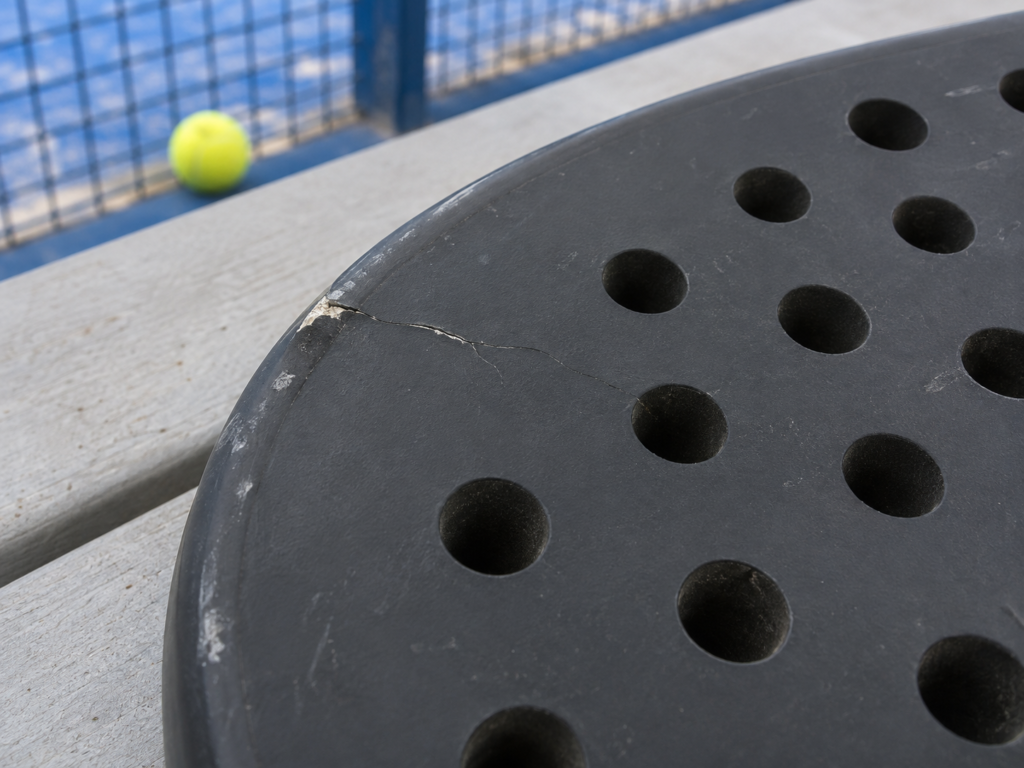
Some cracks become visible only after a period of apparently normal use.
A localized weakness may originate from an earlier collision, a manufacturing irregularity, or damage introduced during handling. Subsequent loading can make the condition more apparent. The shot during which the player notices the crack may therefore be the final event in a longer sequence.
This distinction matters when describing a failure. “It cracked while hitting a normal ball” identifies when the damage was noticed; it does not, by itself, identify the original cause.
Composite fatigue involves progressive damage under repeated loading. Its development depends on the material system, construction, loading conditions, and any existing defects or damage. Research on fiber-reinforced composites describes multiple interacting mechanisms rather than a universal number of impacts before failure.
For a practical assessment, record when the racket was last known to be undamaged, any recent collision, and whether the crack appeared suddenly or had been developing.
A photograph taken at first discovery is useful. Continuing to play until the fracture becomes unmistakable can enlarge the damage and make the initiating condition harder to identify.
Cracks Around Holes Need Careful Interpretation
Holes interrupt the continuity of the face laminate. Their arrangement and the surrounding construction must therefore be considered as part of the design.
A line beginning near a hole can have several possible explanations. It may involve the coating at the rim, damage from a nearby impact, a structural problem extending through the face, or an issue associated with machining. The location alone cannot distinguish these possibilities.
Drilling quality is a legitimate manufacturing concern. Experimental studies of composite plates show that drill geometry, feed conditions, cutting speed, and tool condition can influence delamination and hole quality. The appropriate settings depend on the material and setup; a setting from a laboratory plate should not be copied directly into racket production.
For an inspection, note whether the defect is limited to the finish, whether fibers appear lifted or broken, and whether the line connects adjacent holes or extends toward the frame.
Do not enlarge the hole or scrape away material to investigate it at home. Such intervention changes the original evidence and can introduce further damage.
For a factory, inspection should address the condition of the hole perimeter as well as its position and diameter. A visually symmetrical pattern does not establish that the surrounding laminate is undamaged.
Manufacturing Weaknesses Can Contribute to Cracking
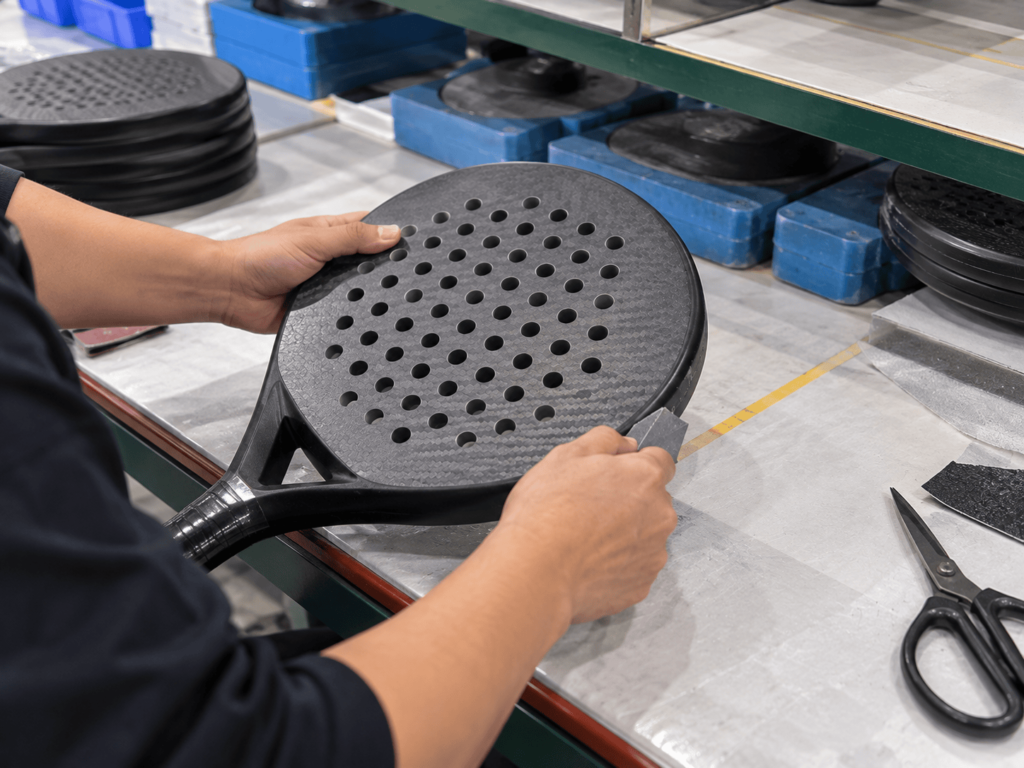
Some failures involve problems originating before the racket reaches the player.
Potential manufacturing contributors include misplaced reinforcement, inadequate impregnation, trapped air, incomplete consolidation, unsuitable processing conditions, and weak interfaces. These are possibilities to investigate, not conclusions that can be assigned to every early failure.
Research on composite manufacturing defects distinguishes abnormalities such as fiber misalignment, incomplete cure, voids, and initial interface separation. It also shows why defect size, shape, and location matter alongside their overall quantity.
For padel racket production, three areas deserve attention.
Material Placement
The reinforcement needs to follow the intended construction. Wrinkles, displacement, or poorly controlled overlaps may create local differences from the approved design.
This is especially relevant around changes in geometry. A neat visible weave does not demonstrate that every underlying layer is correctly positioned.
Resin and Consolidation
The reinforcement and resin must form a suitable composite structure. Process control should address impregnation, trapped air, material distribution, and the interfaces required by the design.
Adding more resin is not a general solution. The target is an appropriate, repeatable material system rather than maximum resin content.
Curing and Process Consistency
The cure schedule needs to match the materials and manufacturing method. Temperature, time, pressure, and handling conditions require defined controls.
A final weight check cannot verify every internal feature produced during these operations. It is one useful measurement within a broader quality system.
Heat, Moisture, and Storage Are Contributing Conditions
Environmental exposure can complicate a damage investigation, but it should not become a convenient explanation for every crack.
A racket stored in a parked vehicle, beside a heater, or in prolonged direct sunlight may experience conditions very different from normal use. A damp racket sealed inside a bag also has a different history from equipment dried and stored indoors.
Manufacturer care guidance recommends dry storage away from direct sunlight and intense heat, avoiding major temperature changes, and drying a damp racket before placing it in a protective cover.
These are sensible precautions. They do not mean a photograph of a crack can prove that heat or moisture caused it.
The more useful approach is to document exposure. Where was the racket stored? Was the bag left in a vehicle? Did the problem follow an unusual event? Were other rackets exposed to the same conditions?
Avoid applying an unsupported temperature limit to every product. Different foams, resins, adhesives, and finishes have different requirements. A storage recommendation should come from the finished product specification.
An insulated bag can help during transport, but it does not make prolonged exposure to an unsuitable environment harmless.
Paint Cracks vs Structural Cracks
This is the most important distinction for many players—and one of the easiest to oversimplify.
What Is a Paint Crack?
A coating crack is limited to the finish system. It may affect clear coat, colored paint, primer, or decorative layers without extending into the load-bearing laminate.
Possible contributors include localized contact, coating thickness, preparation, adhesion, and compatibility with the underlying surface. These factors require review if a pattern appears repeatedly across a production batch.
A coating crack can still be a product-quality issue. Calling it cosmetic describes the affected function; it does not mean that appearance is commercially unimportant.
What Is a Structural Crack?
Structural damage involves the reinforcement, resin matrix within the load-bearing composite, or an important interface.
Possible indicators include exposed or broken fibers, a developing opening, deformation, or a crack accompanied by movement or a persistent localized response change. These observations justify assessment, although they do not establish the initiating cause.
Why Photos Are Sometimes Inconclusive
Gloss, graphics, surface texture, and lighting can conceal depth. A line may cross decorative printing and appear more extensive than it is. Conversely, an opaque finish can hide the underlying laminate.
A fingernail catching on a mark only confirms a surface discontinuity. It does not establish how deep the damage extends.
Similarly, the absence of an obvious performance change does not prove that a crack is cosmetic. An owner may not detect a small structural change during ordinary play.
When the depth is uncertain, the appropriate response is to document the mark and seek assessment rather than sanding through the coating or repeatedly bending the racket.
A Practical Comparison of Visible Damage
The following observations help organize an inspection. They are not a substitute for examining the actual product.
| Observation | What it may indicate | Appropriate next step |
|---|---|---|
| Light surface scuff without a distinct opening | Abrasion of the finish | Clean gently and inspect |
| Small paint chip with apparently continuous material beneath | Local coating loss | Photograph and monitor |
| Fine line crossing graphics or clear coat | Possible coating crack; depth uncertain | Obtain assessment if unclear |
| Lifted, exposed, or broken fibers | Reinforcement damage | Remove from use |
| Crack extending between holes | Possible laminate or coating damage requiring closer review | Stop use pending assessment |
| New bulge or local separation | Possible debonding or delamination | Arrange inspection |
| Crack accompanied by handle movement | Possible structural or connection problem | Remove from use immediately |
The key is to avoid turning a single observation into a complete diagnosis. Crack width, location, and appearance should be interpreted together with history and any associated changes.
What the Crack Location Can—and Cannot—Tell You
Location helps focus the investigation.
At the outer edge, check for a contact mark and whether the damage continues onto the face. Review the frame profile and any protector covering the area.
Around a hole, inspect the rim condition, neighboring holes, and the direction of the line. Both machining-related conditions and later damage may need consideration.
Across the central face, establish whether the mark follows the finish, involves the laminate, or is associated with a localized response change.
At the throat or handle transition, check for movement, deformation, or a change in how the handle and head behave together.
These locations are inspection priorities, not automatic cause labels. A central crack does not prove a manufacturing defect. An edge crack does not prove misuse. A coating line does not become structural merely because it is located near a hole.
For a brand investigating returns, consistent location records are valuable. Several similar cases can justify a focused review of design, processing, packaging, or use conditions. The pattern raises a question; it does not answer it without further evidence.
How to Inspect a Suspected Crack Without Making It Worse
Begin by preserving the condition in which the damage was discovered.
Clean Only What Is Necessary
Remove loose dirt with a soft cloth. Avoid solvents, abrasives, or tools that could alter the finish.
Do not scrape away paint to reveal the layers underneath. That is a destructive investigation and should be reserved for an agreed assessment procedure.
Take Useful Photographs
Capture both faces, the full perimeter, and close-ups of the affected area. Include a wider image showing exactly where the mark sits.
Use good, even light. A second image with light at an angle can help show surface relief. Include a ruler beside the mark without pressing on it.
Record the History
Note the purchase date, approximate use, any recent collision, storage conditions, and when the line first appeared. State whether the information is certain or only suspected.
An honest “no collision recalled” is more useful than claiming that a collision was impossible.
Avoid Aggressive Home Tests
Do not bend the frame, hit the racket against a wall, or press hard on the face. A casual tapping test also cannot establish structural integrity; sound varies with location and construction.
Where structural damage is suspected, stop using the racket while arranging assessment. Continued play may enlarge the problem and obscure the original evidence.
Does a New Racket Crack Mean Poor Manufacturing?
An early crack deserves investigation, but product age is not a diagnosis.
A new racket can suffer collision or transport damage. A manufacturing weakness may also become visible early in use. Neither explanation should be selected simply because it is more convenient for one party.
A useful investigation separates three questions:
- What is damaged? Establish whether the issue concerns the coating, laminate, interface, or another component.
- What evidence is available? Review photographs, history, the physical racket, and relevant production records.
- What explanation best fits that evidence? Consider manufacturing, handling, transport, and service exposure without assuming one in advance.
Some cases remain uncertain. The appropriate technical conclusion may be that the cause cannot be established from photographs alone.
Warranty decisions should be handled under the applicable terms and obligations. A technical hypothesis and a commercial decision are related, but they are not identical.
For factories and brands, this approach also produces better feedback. “Cracked after two sessions” is a starting point. A documented location, construction version, batch, and inspected failure mode can support a meaningful corrective action.
Are Carbon Fiber Rackets More Likely to Crack?
Carbon fiber is not a durability rating by itself.
A racket’s behavior depends on fiber properties, orientation, layer arrangement, resin, core support, geometry, and manufacturing quality. Comparing carbon and fiberglass products often means comparing several of these variables simultaneously.
The same caution applies to 3K, 12K, and 18K descriptions. These numbers identify filament counts within a tow. They do not establish a universal ranking for crack resistance, service life, or finished-racket strength. Technical analysis of padel layups emphasizes the wider construction rather than treating K-count as a direct performance guarantee. twu.tennis-warehouse.com
For a buyer, the better question is whether a particular construction has been evaluated for the intended application.
For a brand, that means agreeing on the product requirements and evaluating representative samples. For a player, it means choosing an appropriate racket and protecting it from avoidable impacts.
A premium material description cannot make a lightweight composite structure immune to damage from a rigid collision.
Do Frame Protectors Prevent Cracks?
A frame protector can help manage some contact wear, but its capability depends on the material, thickness, coverage, and event involved.
Protection against light abrasion should not be confused with resistance to a forceful collision. A thin adhesive strip cannot be assumed to prevent structural damage simply because it protects the finish from scratches.
A protector also affects the racket setup. Added material near the head contributes weight in a location that can change handling. Suitability should therefore be evaluated alongside protection.
There is a further inspection issue: a protector may cover the original contact area. An intact outer strip does not prove an intact frame beneath it.
If a significant collision occurs, document the location and follow the supplier’s instructions for inspection. Avoid pulling firmly bonded material from a suspect area without guidance, as removal can alter the finish and evidence.
Brands supplying a protector with a racket should define its purpose accurately. Claims about preventing cracks require appropriate testing; general statements about helping protect against surface wear are a different proposition.
What a Factory Should Control to Reduce Avoidable Cracking
Manufacturing quality is built through controlled operations rather than one final inspection.
For an OEM project, the starting point is the intended user and application. A rental racket, a recreational model, and a performance-focused product may have different priorities. The selected construction should address those requirements explicitly.
A practical control plan should cover:
| Production area | Control objective |
|---|---|
| Materials | Use the approved reinforcement, resin, core, and finish systems |
| Cutting and layup | Maintain layer arrangement, orientation, and placement |
| Molding and curing | Follow defined processing conditions |
| Trimming and sanding | Avoid unintended damage to the structural laminate |
| Drilling | Control location, hole quality, tooling, and support |
| Finishing | Maintain preparation, coating compatibility, and agreed appearance |
| Inspection | Identify deviations against documented acceptance criteria |
These are general manufacturing priorities, not a claim that every racket undergoes the same test.
Padelico is a China-based padel racket manufacturer supporting OEM and ODM projects through material selection, molding, customization, and quality checks. For brands concerned about cracking, the discussion should include the construction and inspection requirements before production begins.
The objective is a repeatable product matched to its intended use. No responsible specification can promise immunity from every possible collision.
Building Crack Resistance Into a Custom Racket Project
A request to “make the racket stronger” needs to be translated into something that can be evaluated.
Which damage is the project intended to address: edge contact, repeated loading, coating cracks, machining defects, or another observed problem? What weight, balance, feel, and cost constraints must remain acceptable?
For custom padel racket development, these questions belong in the technical brief alongside materials, dimensions, appearance, and packaging.
An evaluation plan should identify the sample construction, loading or impact conditions, inspection method, and acceptance criteria. Testing several samples is more informative than relying on one favorable demonstration.
Changes should also be controlled. A different core, resin, reinforcement arrangement, or finish may require further review even when the graphics remain unchanged.
Padelico’s custom padel racket process includes sample development, refinement, production, and quality control. Retaining an agreed reference and documenting revisions helps connect the approved product with subsequent orders.
Field feedback then becomes more actionable. A recurring, well-documented defect can be investigated against a known specification instead of prompting an undefined request for extra material.
Can a Cracked Padel Racket Be Repaired?
Repairability depends on the damaged material, location, extent, and intended use.
A superficial finish repair and a structural composite repair are different operations. Paint can conceal a line without restoring damaged reinforcement or bonding.
A structural repair may require removing damaged material and rebuilding part of the laminate. That can change weight, balance, stiffness, and appearance. An acceptable-looking repair does not demonstrate that the original properties have been restored.
Do not inject adhesive into an unidentified crack as a diagnostic step. It alters the evidence and may make further assessment more difficult.
Before arranging repair, document the condition and discuss it with the seller or manufacturer. Any warranty implications depend on the relevant terms rather than a universal rule.
For clubs, the return-to-service decision deserves particular care because the next user may know nothing about the damage. The assessment should address whether the racket is suitable for its intended role, not merely whether the line has disappeared.
Where the structural condition cannot be established with reasonable confidence, replacement may be the more practical decision.
FAQ
Why did my padel racket crack without hitting a wall?
Wall contact is only one possible cause. Earlier impacts, handling damage, accumulated loading, or a manufacturing weakness may also be relevant. The shot during which a crack becomes visible does not necessarily identify when the underlying damage began. Assessment requires the condition, history, and affected construction.
Can I keep playing with a hairline crack?
“Hairline” describes appearance, not depth. A narrow line may be limited to the coating or involve structural material. If its depth is uncertain, obtain assessment before continuing. Exposed fibers, progression, deformation, or movement are reasons to remove the racket from use.
How can I tell whether a crack is only in the paint?
Careful inspection may help, but photographs and home checks are not always conclusive. Do not sand through the finish to investigate it. Record the mark under good lighting and seek an assessment when its depth is unclear. Normal playing feel alone does not confirm that the structure is intact.
Are cracks between holes always structural?
They warrant attention, but location alone does not establish depth or cause. The line could involve the coating, laminate, or both. The condition of the hole edges, surrounding reinforcement, and any associated impact or response change should be reviewed.
Can hitting the ball hard crack a good racket?
Normal ball contact is part of the intended use. A failure during a hard shot still needs investigation because construction, loading history, and earlier damage may be involved. It is not sound practice to assign the cause solely to the player’s power or solely to manufacturing.
Does hot weather cause padel rackets to crack?
Hot playing conditions and prolonged exposure to intense heat are different situations. Storage beside a heat source or inside a parked vehicle should be avoided. However, heat exposure cannot be diagnosed as the cause of a particular crack from its appearance alone.
Does a thicker or heavier racket resist cracking better?
Thickness and mass alone cannot establish damage resistance. Their location, material arrangement, geometry, and processing matter. Adding weight without understanding the failure mechanism may change handling without resolving the original problem. Compare complete constructions against defined requirements.
What should I send to the manufacturer when reporting a crack?
Provide clear photographs of the entire racket and close-ups of the damage, purchase or order information, any batch identifier, approximate use, and a factual account of how the problem appeared. Mention collisions or unusual storage exposure if known. Preserve the condition before attempting repairs.