Choosing padel rackets for a brand starts with understanding the players who will buy them. A recreational player learning basic strokes needs a different product from a technically confident attacker. Both may ask for “control and power,” but they experience those qualities differently.
For a brand owner, the task is to turn those expectations into a clear product specification. Shape, weight, balance, face construction, and core firmness need to support the same intended use. Selecting each feature independently can produce a racket that looks convincing on paper but feels inconsistent with its positioning.
A well-planned collection gives each model a distinct purpose. Customers should be able to understand who it suits, how it feels, and why they would choose it over another model in the range.
Start With the Player Profile Behind Each Product
Before selecting a mould or carbon finish, define the intended customer.
Playing level matters, but it is only part of the brief. Consider playing frequency, preferred style, physical capabilities, and the amount of effort the player can comfortably apply throughout a session.
For development discussions, describe the response you want in practical terms:
- A beginner should be able to return slower balls without forcing the swing.
- A defensive player may prioritise quick preparation and predictable blocks.
- An all-round player may want manageable handling across both defensive and attacking situations.
- An experienced attacker may prefer a firmer sensation when accelerating through an overhead.
These descriptions give a manufacturer more direction than broad requests such as “professional quality” or “maximum performance.”
They also help prevent unnecessary overlap. Two models with different graphics should offer a clear reason for existing within the same collection.
Choose Shape According to the Intended Playing Response
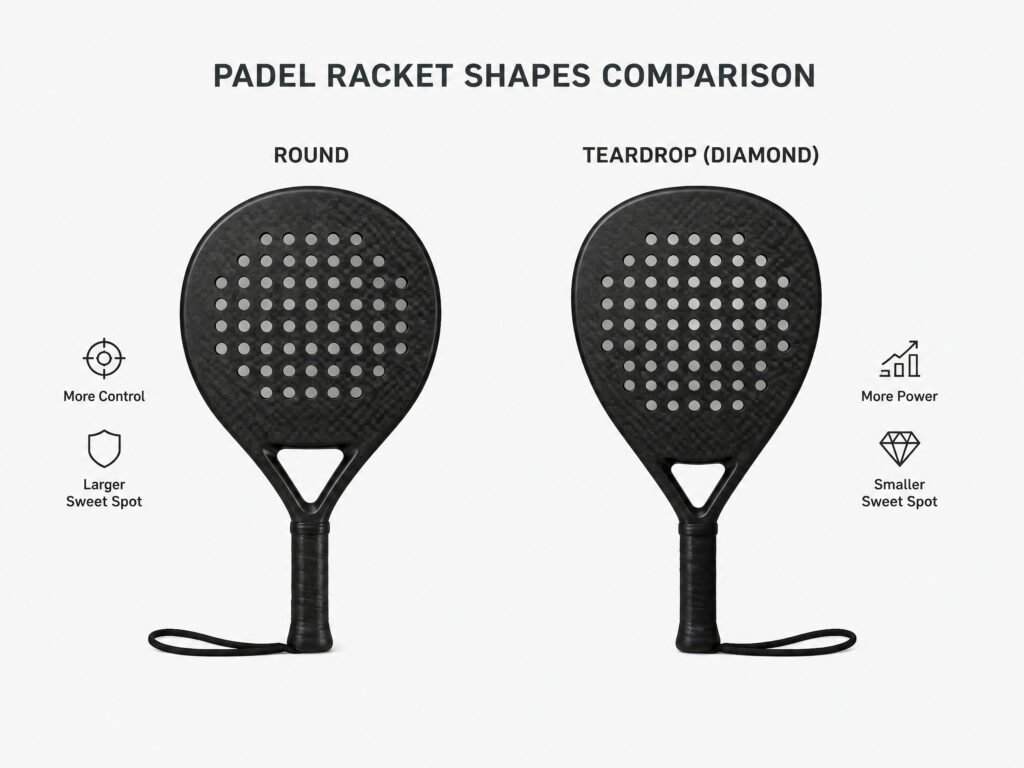
Round, teardrop, and diamond shapes provide useful starting points for product positioning. They are commonly associated with different balance characteristics and preferred hitting areas.
| Shape | Common design tendency | Potential role in a collection |
|---|---|---|
| Round | More central, forgiving hitting area; often lower balance | Accessible recreational models and control-oriented rackets |
| Teardrop or hybrid | A compromise between handling and attacking response | Versatile models for developing and all-round players |
| Diamond | Higher preferred contact area; often more head-focused weight distribution | Attack-oriented models for players with consistent timing |
These are general tendencies, not fixed performance guarantees. A round racket can be firm and demanding, while a carefully specified hybrid can remain accessible.
For a brand, shape should establish the initial direction. Weight distribution, face construction, and core selection then need to reinforce that direction.
A control model, for example, should be assessed during blocks, defensive returns, and placement shots. Its positioning cannot be established by the outline alone.
Specify Weight and Balance Together
Weight is easy to communicate, which makes it a common purchasing shortcut. However, two rackets with the same total weight can feel noticeably different in motion.
Swingweight describes resistance to rotation around an axis near the handle. It helps explain why a racket carrying more mass toward the head may require greater effort to accelerate. Resistance to twisting also influences stability during off-centre contact.
For initial sampling, approximately 340–360 grams can be a useful range to explore for lighter, maneuverability-focused adult products. More substantial constructions may suit players who prefer additional mass at contact. These are development starting points rather than universal player categories.
Avoid making a very heavy specification the default for every advanced model. A player’s technique, strength, preparation, and preferred timing remain relevant.
Define the Measurement Conditions
A production specification should state what the quoted weight includes.
Does it include the factory grip and wrist cord? Is an edge protector fitted? Will the retail product include additional accessories that affect handling?
Record the balance measurement method as well. A numerical balance point measured from the butt of the handle is more useful for development than an unexplained “medium balance” label.
Agree on target values and acceptable variation before approving production. This gives the brand and manufacturer a shared reference when comparing samples and finished units.
Match Core Firmness to the Product’s Purpose
The internal core contributes to compression, recovery, and impact feel. EVA is available in different formulations and firmness levels, so “EVA core” alone is not a complete performance specification.
Softer Cores
A softer construction is worth exploring for products intended to offer comfortable contact and accessible ball output during slower strokes.
This can suit beginners, recreational players, and customers who prefer a cushioned sensation. During development, assess whether the response remains predictable when the pace increases.
Firmer Cores
A firmer core can provide more direct feedback, which some technically confident players prefer during fast exchanges and attacking shots.
Firmness alone does not establish superior power or precision. The face construction and player’s swing also affect the result. A harder core should therefore serve a defined product requirement rather than simply indicate a higher price tier.
Evaluate the Core Within the Complete Racket
Compare core options while keeping other specifications as consistent as practical. If the core, face construction, weight, and balance all change simultaneously, identifying the reason for a different feel becomes difficult.
Padelico’s padel racket manufacturing options include multiple EVA firmness levels and layered core configurations, allowing the intended response to be discussed during product development.
Select Face Materials Beyond the Marketing Label
Fiberglass is commonly associated with a more flexible, approachable response. It is a practical material to consider for accessible models where comfortable contact and ease of use are priorities.
Carbon fiber provides additional scope to adjust stiffness and structural performance. However, a carbon face does not automatically make a racket suitable for advanced players, nor does it guarantee a particular impact sensation.
The finished response depends on the construction.
For OEM discussions, distinguish between the frame material and the hitting-face material. Then clarify the relevant laminate details with the manufacturer rather than relying on a general “full carbon” description.
Do Not Use K Count as a Performance Ranking
A 3K or 12K designation describes the approximate filament count in a carbon-fiber tow. It does not directly describe the stiffness of the finished racket.
Different fiber grades can have different mechanical properties despite sharing a tow size. The same grade may also be available in several tow sizes.
For a brand collection, specify the required feel and assess the finished sample. The visible weave can support the product’s appearance, but it should not replace a clear construction brief.
Give Each Model a Distinct Role
A focused collection is easier to explain when the differences are meaningful.
The following is an example of how a brand could organise an initial range. These are suggested development directions, not fixed Padelico product specifications.
| Collection role | Suggested development direction | Main sample-approval question |
|---|---|---|
| Accessible control | Round shape, manageable balance, comfortable face-and-core combination | Can the intended player generate controlled depth with a compact swing? |
| Versatile progression | Round or teardrop shape, balanced handling, defined but approachable feedback | Does it remain predictable across defensive and attacking shots? |
| Technical attack | Teardrop or diamond shape, firmer response, deliberately selected weight distribution | Can the target player use its attacking response without compromising preparation? |
There is no requirement to launch all three categories at once. A brand serving clubs and new players may benefit from concentrating on accessible products. A specialist performance brand may need a narrower selection with more detailed differences in feel.
The range should reflect the actual sales channel and customer base.
Assess Grip, Finish, and Appearance as Part of the Product
Handle dimensions and grip construction affect how the racket feels in the player’s hand. Include grip circumference, handle length, and the intended factory grip in sample approval.
Surface finish also deserves a defined purpose. If a textured face is part of the brief, assess its appearance, consistency, and playing response on the finished sample. Avoid promising a specific spin improvement without supporting evidence.
Graphics, coatings, and accessories should be reviewed on the production-intent configuration. A sample approved before final finishing may not represent the exact weight or handling of the retail product.
For the same reason, reference samples should be clearly identified and retained alongside the approved specification.
Approve Samples Through Representative Play
A promising sample needs to work for its intended player profile.
For an accessible control model, include slower returns, defensive lobs, blocks, and slightly off-centre contact. For an attacking model, include overheads and fast volleys, while still checking preparation and defensive handling.
Compare samples under similar conditions and use consistent questions:
- How easily can the player prepare the racket?
- Is the response predictable at different swing speeds?
- Does the racket remain manageable during extended play?
- Does the observed feel match the intended product description?
Separate player feedback from measurable specifications. “Too demanding” is useful feedback, but it should lead to a discussion about weight distribution, firmness, or another identifiable feature.
Before production, document the approved construction, dimensions, weight, balance, finish, branding, packaging, and agreed inspection criteria. This makes the approved sample a usable production reference.
Develop Your Padel Racket Range With Padelico
Padelico is a China-based padel racket manufacturer supporting brands, wholesalers, and sports companies with OEM/ODM production and custom development. Services include material selection, design, manufacturing, and quality inspection.
Through our custom padel racket process, brands can develop shape, face construction, EVA core, weight, balance, surface finish, graphics, grip, and packaging. Prototype development and sample refinement provide an opportunity to assess these choices together.
To begin a project, share your intended customer, collection structure, target price positioning, reference samples, and preferred playing characteristics. A clear brief helps turn a general product idea into specifications that can be sampled, reviewed, and manufactured.
Contact Padelico to discuss the padel rackets you want to develop for your brand.
Frequently Asked Questions
Which racket shape should a brand choose for a beginner model?
A round shape is a sensible starting point. It should be combined with manageable weight distribution and an approachable face-and-core construction. Shape alone does not establish beginner suitability.
Should advanced rackets always be heavier and harder?
No. Advanced players have different physical capabilities and playing preferences. Weight and firmness should support a specific response rather than serve as automatic indicators of product level.
Is carbon fiber always better than fiberglass?
Neither material is universally better. Fiberglass can suit flexible, comfortable constructions, while carbon fiber offers different structural possibilities. Selection should follow the intended feel, performance requirements, and price positioning.
Can soft EVA prevent elbow discomfort?
A softer construction may feel more comfortable to some players, but a brand should not promise that a core prevents injury. Avoid presenting subjective comfort as a medical benefit.
What information should a brand provide before requesting samples?
Provide the target player profile, preferred shape, intended weight and balance, desired impact feel, material preferences, surface finish, branding requirements, and target price positioning. A reference racket can also help explain the response you want.
Can Padelico support private-label padel racket development?
Yes. Padelico provides OEM/ODM manufacturing and customization, including product specifications, graphics, branding, and packaging. Project details can be discussed through the custom development process.