A racket can look convincing on a product page and disappoint within the first few games. The weight feels different from the demo. Defensive blocks come off the face less predictably. A finish that looked excellent in photographs turns out to be uneven around the edge. None of these questions can be answered by the country printed on the label.
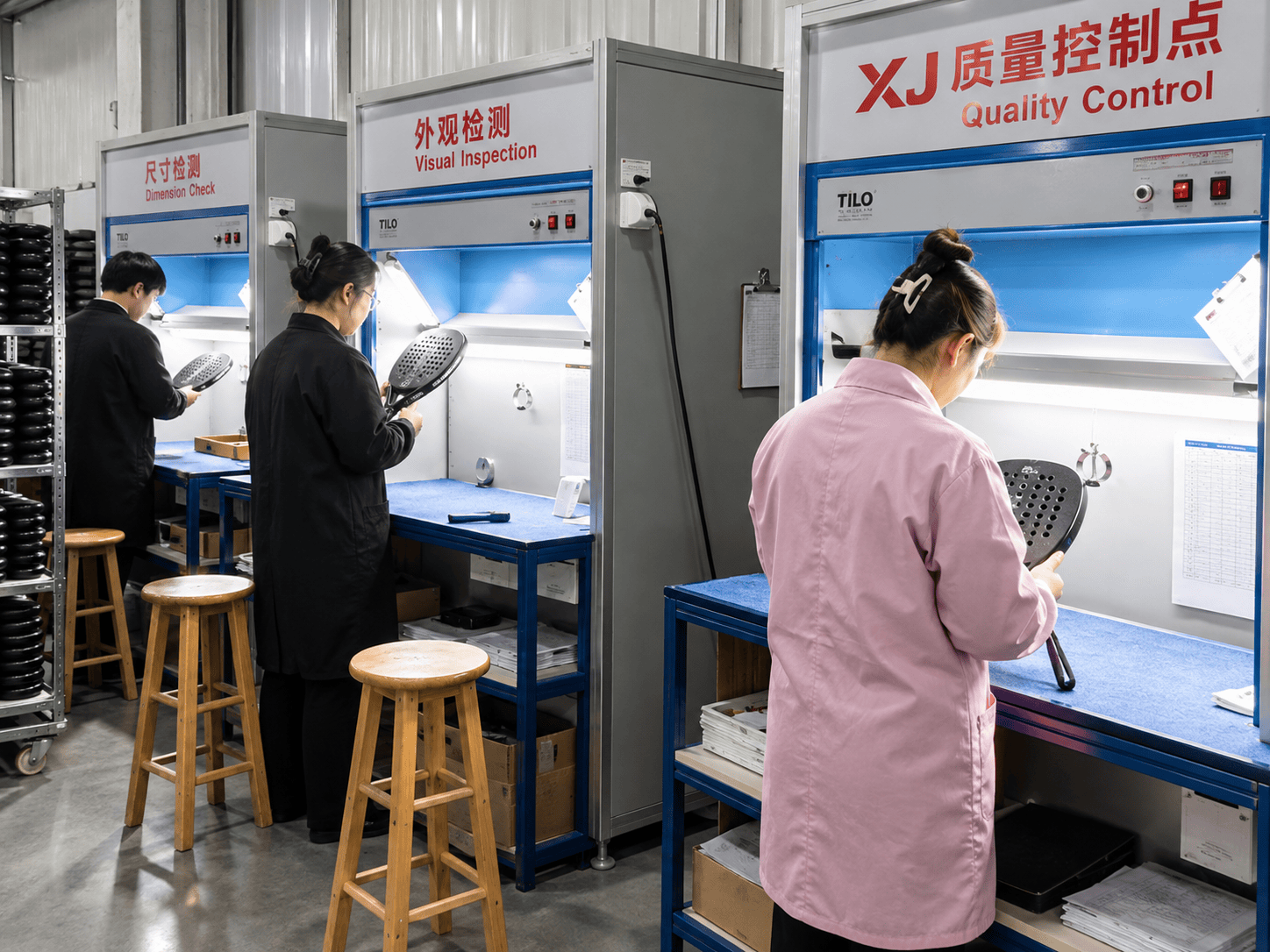
For anyone asking where the finest padel rackets are made, China deserves a place in the discussion. At Padelico, our manufacturing base is in Guangdong, where we support custom racket projects for brands, wholesalers, and sports companies. Our work brings together product development, material selection, molding, finishing, and inspection.
But location is only the starting point. A factory earns a buyer’s confidence through the racket it develops and its ability to deliver the agreed product repeatedly. From our perspective as a manufacturer, that is where a useful discussion about quality begins.
What “Best” Means Before Production Starts
There is no useful manufacturing specification called “the best padel racket.” A factory needs to know who will play with it, what the player should feel, and where the product will sit in the market.
A recreational player who spends most rallies defending may value manageable handling and an accessible response. A more experienced player may prefer a firmer impact sensation and accept a more demanding racket. A club buying rental equipment will also consider ease of replacement, presentation after repeated use, and the practical cost of maintaining stock.
Those requirements lead to different development decisions. A specification that works for one group should not automatically become the flagship model for another.
This is why we recommend beginning a project with a short product brief before discussing carbon patterns or artwork. Explain the intended player, the expected retail position, and what an existing reference racket does well or poorly. “Easier to prepare during quick exchanges” gives a development team more direction than “premium performance.”
The brief should also identify priorities. If low finished weight is essential, that requirement needs to remain visible when selecting coatings, grips, and protective components. If the appearance is central to the launch, the sample plan should include the actual finish. Development becomes more efficient when the team knows which compromises are acceptable and which are not.
Why China Is a Relevant Place to Develop a Quality Racket
For a brand sourcing from China, the useful question is what the manufacturing partner contributes beyond a price quotation.
Can the team translate a playing requirement into a proposed construction? Can it explain the difference between adapting an available model and developing new tooling? Will the quotation identify the materials, sample scope, and inspection requirements clearly enough for the buyer to compare alternatives?
At Padelico, we offer OEM and ODM support covering racket development and customization. That allows the project discussion to include structure and playing specifications alongside graphics and packaging. The appropriate route depends on how much development the product needs.
An available mold may be a sensible starting point when its geometry suits the intended player. A new mold may be justified when the proposed head, bridge, or other structural features cannot be achieved through the existing options. Paying for new tooling should solve a defined product requirement.
We encourage buyers to make that decision before commissioning detailed artwork. It is expensive to become attached to the appearance of a concept before confirming that its structure, production route, and target cost make sense.
Quality Starts Inside the Racket
The visible carbon pattern is only part of the construction. A padel racket also depends on the reinforcement beneath the surface, the frame, the foam core, and the resin holding the composite together. Each needs to be considered in relation to the others.
Carbon fiber can provide stiffness at a relatively low weight. Fiberglass can be useful where a more flexible response is wanted. Neither description establishes the full behavior of a finished racket. The arrangement and quantity of reinforcement matter, as do the core and overall geometry.
The same caution applies to 3K, 12K, and 18K carbon labels. These numbers describe the thousands of filaments in a fiber bundle. They do not provide a complete specification for the laminate, and they should not be treated as a simple ranking of racket quality.
For a custom project, the more useful conversation is about the intended construction: which materials are used in the face and frame, how the reinforcement is arranged, and what the finished sample demonstrates. A familiar carbon label can help describe a product, but it cannot replace that discussion.
The core deserves equal attention. EVA is a foam material used inside many padel rackets, with different grades offering different compression characteristics. A core should be evaluated as part of the assembled racket rather than selected solely because a description calls it soft, medium, or hard.
For example, if a sample feels too firm, requesting a softer core may be one development option. It should remain a hypothesis to test. The face construction may also contribute to that sensation, and changing several variables at once makes the cause of an improvement harder to identify.
In practical development, it is often better to compare a small number of clearly defined alternatives. Record what changed between samples. Otherwise, a player may prefer one racket without the team being able to explain which construction should enter production.
Shape and Weight Need to Work Together
A round, teardrop, or diamond outline gives a buyer an initial way to discuss a racket. It does not describe the complete playing experience. Head geometry, mass distribution, face construction, and core response still need to work together.
Weight is particularly easy to misunderstand. A specification such as 365 grams appears precise, but it is incomplete unless both parties agree what is included. Is that the finished racket with its grip and wrist strap? Does it include a frame protector? Was it weighed before or after the final coating?
Consider a hypothetical development project in which two finished samples both weigh 365 grams. One may carry more of that mass toward the head. A player could find it more demanding to prepare during a fast exchange even though the scale shows the same number. The relevant follow-up is to examine weight distribution rather than simply request a lighter racket.
Static balance helps describe that distribution, although it does not capture every aspect of how a racket moves. The practical lesson is to measure weight and balance consistently and confirm the result through play testing.
The handle should be included in that evaluation. Grip thickness, handle length, and wrapping affect how the player holds and controls the racket. A technically promising head construction can still receive poor feedback if the test sample’s grip makes comparison uncomfortable or unfamiliar.
For a brand developing more than one model, these decisions should create a difference that players can recognize. A range is easier to sell when a coach can explain why one model suits a particular player. Different colors and carbon labels alone may leave that explanation unclear.
What Happens Between Material Preparation and the Finished Frame
At Padelico, our published manufacturing process includes fiber cutting, molding, trimming, surface preparation, coating, drilling, and assembly. These operations need to be treated as connected stages. A problem introduced early can remain hidden beneath an attractive finish.
During material preparation, the production team needs an agreed construction to follow. Cutting patterns and reinforcement placement should correspond to the intended racket. If the approved structure is left open to interpretation, comparing the finished order with a development sample becomes difficult.
Molding then turns the prepared materials into the racket structure. Temperature, pressure, and curing conditions must suit the actual material system and tooling. There is no responsible universal recipe that can be applied to every racket simply because it uses carbon fiber.
For buyers, the important issue is whether the manufacturer can explain how the proposed structure will move from development into controlled production. Machine specifications alone do not answer that question. The tooling, materials, operating instructions, and checks need to support the same product definition.
Once the frame is removed from the mold, trimming and preparation deserve care. Later operations should produce the intended appearance without using cosmetic work to conceal a structural concern. A smooth painted surface is a finish characteristic; it is not evidence of everything beneath it.
Drilling and hole finishing also need their own review. Buyers should examine the physical sample around the holes and edges, rather than approving only photographs of the front face. A product page rarely gives those areas the same attention that a player will give them in hand.
Finishing Is Part of the Product Specification
A racket’s finish affects how customers first judge it, but approval should go beyond whether the design looks attractive on a screen.
Graphics must work around a three-dimensional frame and a perforated face. Small lettering can become difficult to read. A logo close to the edge may look different when viewed at an angle. A color selected from a digital mockup may need adjustment when applied over the actual surface.
For that reason, a finished physical sample is a valuable approval reference. Review both faces, the edge, bridge, handle, and end cap. Check the relationship between the artwork and hole pattern, along with the texture and gloss level. These are easier to resolve before an order than after cartons have been packed.
Surface texture also needs a clear description. Terms such as rough or matte leave room for interpretation. Where the finish matters to the product identity, an approved reference gives both parties something more concrete to assess.
Avoid assuming that a more aggressive texture guarantees a better result for every player. It should be evaluated with the intended audience and alongside the rest of the racket. Any specific performance claim should be supported by suitable testing.
Packaging completes this part of the development work. It should protect the product and communicate the correct model information. If several variants are being launched, labels and carton identification need to make receiving and stock allocation straightforward. A well-made racket loses some of its commercial value if the wrong model reaches the customer.
How to Judge the Sample Before Approving an Order
Sample evaluation should answer a defined question: does this racket deliver the experience intended for this player at this market position?
A useful trial includes the shots and situations the target customer actually encounters. Ask testers to assess defensive blocks, slower placement shots, preparation at the net, and overheads. Record specific observations. “The ball comes off too quickly on short blocks” is more useful than a general score for control.
Keep comparison conditions reasonably consistent. Changing balls, adding a different protector, or altering the grip between samples can complicate the interpretation of feedback. Record those differences when they cannot be avoided.
Include representative players. A strong competitive player may adapt to a demanding prototype and evaluate it positively, while the recreational customer for whom it was designed may struggle with it. Technical ability is useful in a tester, but relevance to the target audience matters too.
It is also worth separating playing approval from visual approval. A sample can be acceptable in structure but still require artwork revisions. Another may look ready for sale while needing further work on handling. Keeping those decisions explicit helps prevent a cosmetic approval from being mistaken for complete production approval.
When a revision is requested, identify it clearly and evaluate the revised sample. Phrases such as “slightly softer” or “a little lighter” should eventually become an agreed specification. The aim is to finish development with a product the buyer can approve and the factory can reproduce.
The Real Test Comes with the Production Order
For a brand, the strongest sample is of limited value if the delivered rackets vary beyond the agreed requirements. Production approval therefore needs to establish what will be checked, how it will be measured, and what will happen when a result is outside the specification.
Weight and balance tolerances should be agreed before production. So should the acceptable finish, component requirements, and inspection method. A physical reference sample helps communicate the intended product, while written requirements resolve details that a sample cannot explain on its own.
Durability claims deserve particular care. A statement that a racket has been impact tested is incomplete without information about the method and acceptance criteria. Development tests, periodic production checks, and shipment inspections can serve different purposes. Buyers should discuss the evidence relevant to their project rather than assume that one test result answers every question.
Repeat orders need the same attention. If a grip, foam grade, coating, or other component changes, the buyer should understand whether that change affects the approved product. Maintaining a recognizable model over time means keeping control of what sits behind its name.
This is a commercial issue as much as a technical one. Players who recommend a racket are recommending the product they used. Their confidence is easier to retain when the next unit provides the expected experience.
Developing Your Racket with Padelico
At Padelico, we support custom padel racket projects from an initial idea or reference sample through development and production. Customization can cover shape, materials, core, weight, balance, surface finish, graphics, grips, and packaging.
For a productive first discussion, tell us who the racket is for and what you want it to do differently. Include the intended market, approximate order quantity, preferred launch timing, and any reference samples. If some specifications are undecided, identify them as development questions rather than fixing them prematurely.
We can then discuss an appropriate starting point through our custom padel racket process. The project may call for an existing platform with carefully selected specifications, or more extensive structural and tooling development. The decision should follow the product’s purpose.
So, where are the finest padel rackets made? For a buyer considering Padelico, the answer starts in Guangdong, China. The decision to approve a racket should then rest on something tangible: a convincing sample, a clear specification, and an agreed plan for production quality.
Bring us your product brief, and let us discuss how to turn it into a racket your customers will want to keep playing with.