Late padel racket deliveries can cause missed selling seasons, empty inventory, delayed launches, and unhappy distributors. Fast, reliable delivery protects both sales opportunities and brand reputation.
Fast delivery helps padel racket brands reduce inventory pressure, react faster to market demand, launch new products on schedule, and improve cash flow. The real advantage comes from combining speed with stable quality, production planning, and dependable factory communication.
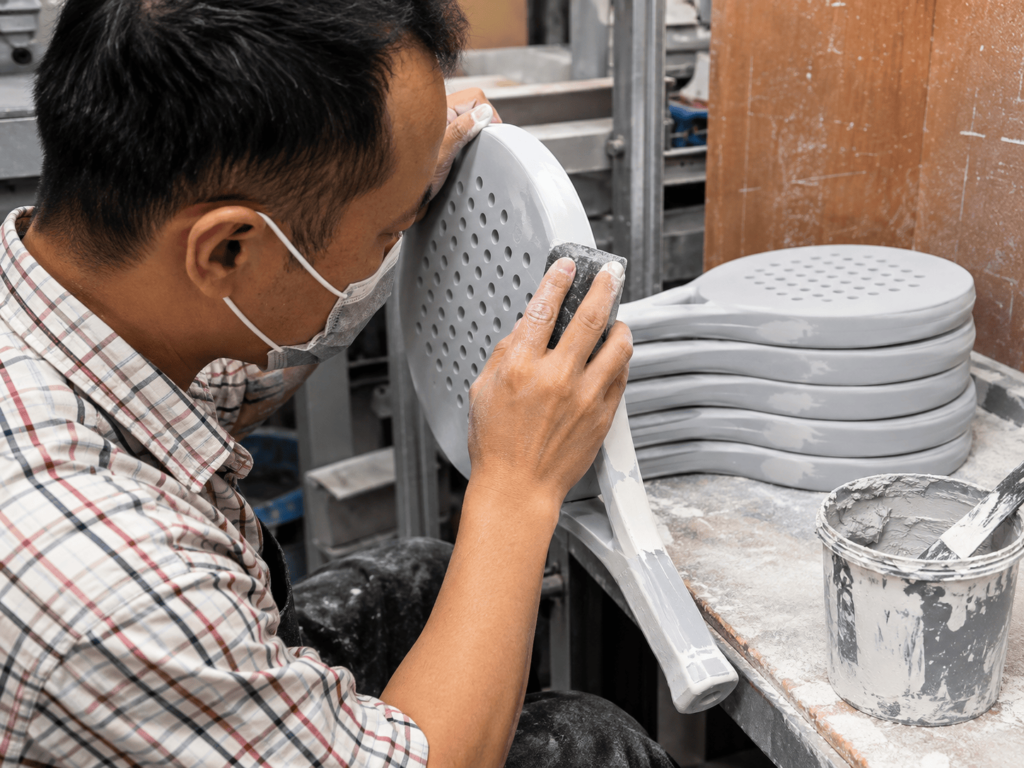
Delivery speed has become an important factor when selecting a custom padel racket manufacturing partner. Brand owners, distributors, club operators, and purchasing teams often spend significant time comparing carbon specifications, EVA hardness, surface textures, and prices. However, even an excellent racket can create commercial problems when production arrives after the planned selling period. A professional factory therefore needs to manage not only product quality but also material preparation, production scheduling, quality inspection, packaging, and shipment coordination.
Why Does Fast Delivery Matter So Much in the Padel Racket Market?
Padel racket demand can change quickly. A product that sells well during one month may need urgent replenishment before stock runs out. Slow production can turn strong demand into lost sales.
Fast delivery allows brands and distributors to respond to market changes more efficiently while reducing the risk of missing important sales periods.
The commercial value of delivery speed becomes clear in several situations:
| Business Situation | Risk of Slow Delivery | Benefit of Faster Delivery |
|---|---|---|
| New Product Launch | Launch date missed | Product reaches market on schedule |
| Best-Selling Model | Inventory runs out | Faster stock replenishment |
| Seasonal Promotion | Promotion period missed | Inventory available before campaign |
| Distributor Order | Customer waits too long | Better distributor confidence |
| Tournament or Club Event | Products arrive too late | Products ready for event sales |
For racket brands, delivery performance affects much more than logistics.
A delayed shipment may create a chain reaction. Marketing campaigns may need to be changed. Distributors may cancel orders. Retailers may move shelf space to competing products. Customers waiting for new models may choose another brand.
This is why production lead time should be discussed during supplier selection.
A professional custom racket factory should have in-house production planning rather than depending entirely on several outside suppliers. Internal coordination between design, R&D, production, sales, and quality control can make it easier to identify delays early and adjust production schedules.
Fast delivery should never mean skipping important manufacturing steps. The goal is efficient production, not rushed production.
How Can Fast Delivery Help Brands Avoid Missing Sales Seasons?
Sports equipment sales often follow seasonal patterns, promotions, club activities, tournaments, and new product launches. Missing the correct timing can reduce the value of an entire production order.
Reliable lead times allow racket brands to prepare inventory before demand begins instead of receiving products after the opportunity has passed.
A common purchasing problem occurs when an order is placed with enough time according to the quotation, but unexpected production delays continue to appear.
Possible causes include:
- Carbon material shortages
- EVA core delays
- Mold scheduling problems
- Artwork confirmation delays
- Paint and printing bottlenecks
- Quality problems requiring rework
- Poor production planning
- Slow communication
These problems are particularly damaging when products have fixed launch dates.
For example, a distributor preparing a new racket collection for the beginning of a club season cannot simply move the season. Products need to arrive before the market opportunity.
A well-managed factory should therefore work backward from the required shipment date.
Material preparation, molding, drilling, surface finishing, graphics, quality control, and packing should all have planned production windows.
This approach provides more realistic delivery control.
Factories with experience handling OEM and ODM projects for established brands generally understand that delivery time is part of the product specification. A technically excellent racket that arrives several weeks late may still be considered a failed project.
How Does Fast Delivery Reduce Inventory Pressure?
Large inventory can protect against stock shortages, but it also ties up cash and increases storage risk. Long manufacturing lead times often force companies to place larger orders earlier than necessary.
Faster and more reliable production can allow brands and distributors to manage inventory with greater flexibility and place replenishment orders closer to actual market demand.
Inventory management is especially important for racket businesses with several models.
A product collection may include:
- Round rackets
- Teardrop rackets
- Diamond rackets
- Soft EVA models
- Hard EVA models
- 3K carbon models
- 12K or 18K carbon models
- Multiple colors and graphics
Holding large quantities of every model can create financial pressure.
Slow production encourages over-ordering because purchasing teams worry about future shortages. However, this increases the risk of unsold inventory when customer preferences change.
Faster production creates a different approach.
Smaller initial orders can test market response. Strong models can then be replenished more quickly.
| Supply Model | Commercial Effect |
|---|---|
| Long Lead Time | Larger safety inventory required |
| Unpredictable Lead Time | Higher stock shortage risk |
| Stable Fast Lead Time | Easier replenishment planning |
| Flexible Production | Better response to sales data |
For manufacturers, achieving this flexibility requires production organization.
Raw materials need to be managed carefully. Common carbon materials, EVA specifications, accessories, and packaging components need reliable supply channels.
In-house production also reduces the number of external handoffs that can create unexpected delays.
Why Does Delivery Speed Matter for New Padel Racket Launches?
A new racket launch usually involves more than manufacturing. Product photography, distributor presentations, advertising, influencer cooperation, catalog updates, and sales campaigns may all depend on one production schedule.
When rackets arrive late, the complete launch plan can be disrupted.
Custom racket projects normally pass through several stages:
| Stage | Main Work |
|---|---|
| Product Concept | Define player and market position |
| Design | Shape, graphics, materials |
| Sampling | Produce prototype |
| Testing | Evaluate performance |
| Revision | Adjust structure or appearance |
| Production | Manufacture approved version |
| Inspection | Confirm quality |
| Shipment | Deliver commercial order |
The sample development stage is particularly important.
Fast delivery does not begin when mass production starts. It begins during product development.
If sample revisions take several weeks each time, a project can already be months behind before a production order is confirmed.
A manufacturer with in-house design and R&D teams can reduce unnecessary communication steps. Structural issues can be discussed directly with engineers. Artwork changes can reach designers quickly. Production feasibility can be checked before final approval.
This is one reason direct cooperation with a factory can improve launch efficiency compared with working through several intermediaries.
How Can Fast Factory Communication Shorten Delivery Time?
Production delays are not always caused by machines. Many delays begin with unanswered questions, unclear specifications, and slow approval processes.
Efficient communication between sales, engineering, production, and purchasing can shorten development and manufacturing time without reducing product quality.
Common communication delays include:
- Unclear carbon specification
- Incorrect artwork files
- Unconfirmed racket weight
- Missing packaging information
- EVA hardness changes
- Balance changes after sample approval
- Unclear shipping requirements
A factory with internal departments can handle these issues more efficiently.
For example, when a sample feels too head-heavy, the sales team should not simply send a message through several different suppliers. R&D and production engineers should be able to review the structure directly.
The same applies to appearance problems.
When a logo position, surface finish, or paint effect needs adjustment, an in-house design team can make changes and coordinate with production quickly.
For international buyers, communication quality is therefore closely connected with delivery reliability.
Fast replies alone are not enough. Technical accuracy matters more.
A supplier that replies immediately but provides incorrect information can create larger delays later. Effective communication means clear specifications, realistic production dates, and early notice when problems appear.
Does Faster Delivery Mean Lower Quality?
Fast delivery can create concern because rushed production sometimes leads to quality problems. However, speed and quality do not need to conflict when manufacturing processes are properly organized.
Reliable fast delivery comes from efficient planning, experienced workers, stable processes, and strong quality control rather than eliminating inspection or shortening necessary curing processes.
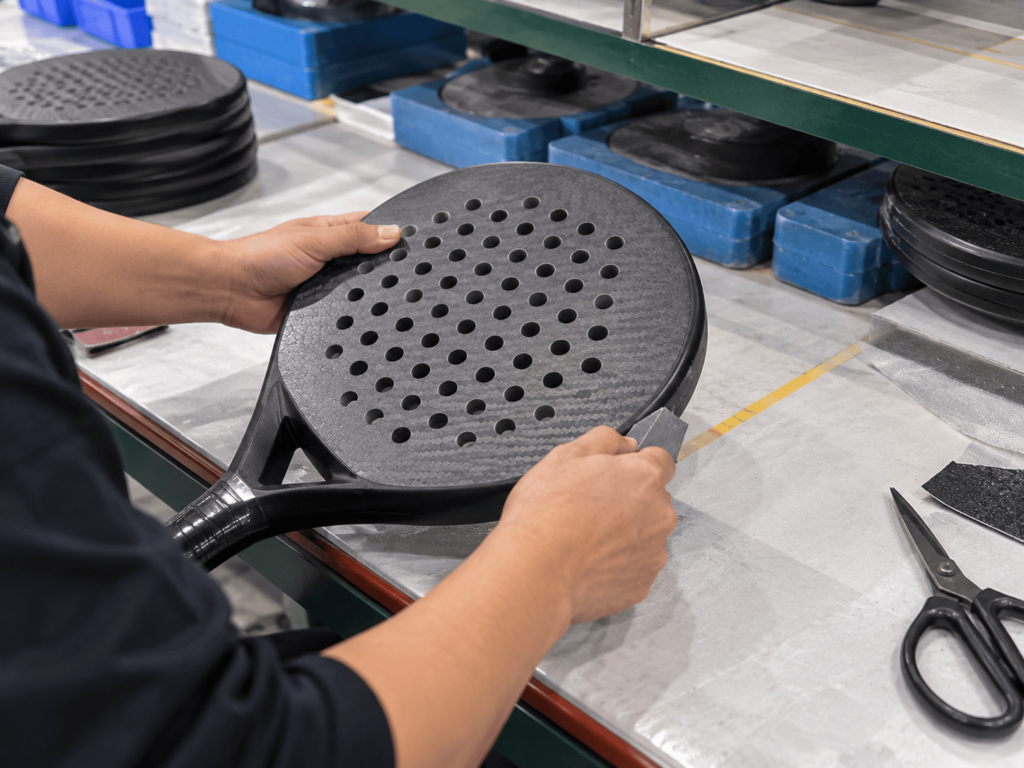
Carbon fiber padel racket manufacturing includes processes that cannot simply be rushed.
These may include:
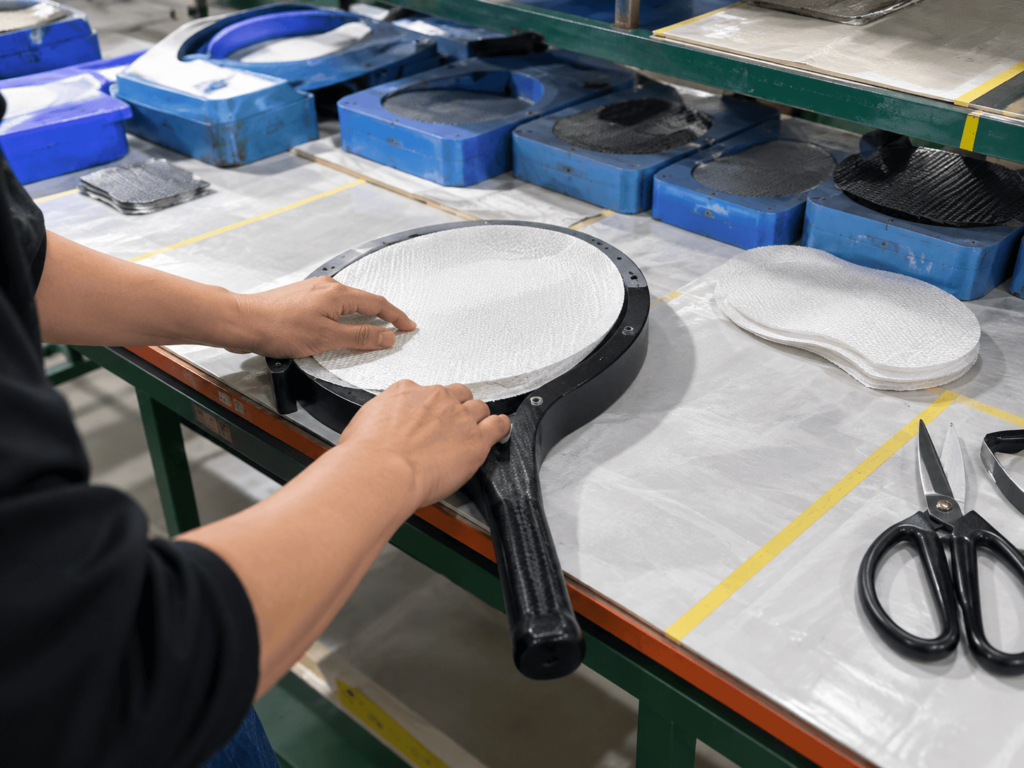
- Carbon preparation
- EVA preparation
- Layup
- Molding and curing
- Cooling
- Drilling
- Surface finishing
- Painting and printing
- Final inspection
Reducing required curing time simply to ship faster can create structural problems.
Skipping inspection may allow incorrect weights, surface defects, or balance problems to enter the shipment.
A professional manufacturer therefore improves delivery time by removing inefficient waiting periods rather than removing necessary manufacturing processes.
Better Production Planning
Orders can be scheduled based on material availability and production capacity.
Stable Raw Material Supply
Reliable carbon fiber, EVA, resin, and accessory suppliers reduce unexpected shortages.
In-House Quality Control
Problems can be identified earlier instead of being discovered only before shipment.
Standardized Processes
Experienced production teams can repeat approved specifications more efficiently.
This combination makes fast delivery sustainable.
How Does Fast Delivery Improve Cash Flow?
Manufacturing lead time affects how long money remains tied up before products can be sold. Longer production and transportation cycles increase the time between paying suppliers and receiving revenue from customers.
Shorter, predictable lead times can improve inventory turnover and make purchasing budgets easier to manage.
Consider a racket brand ordering several product models.
When production is unpredictable, purchasing teams may need to place orders far in advance and keep additional safety stock.
That means more capital remains inside inventory.
Faster replenishment can provide more flexibility.
A brand may launch a moderate quantity first and monitor customer response. Popular models can then receive larger repeat orders.
This is especially valuable when testing:
- New carbon structures
- New colors
- New shapes
- New EVA combinations
- New price positions
- New regional markets
The ability to reorder efficiently lowers the commercial risk of testing new ideas.
For distributors, faster replenishment also means fewer situations where sales teams receive orders but cannot provide products.
Delivery speed therefore becomes part of financial efficiency, not simply a shipping issue.
What Should Buyers Check Before Trusting a Fast Delivery Promise?
A very short lead time can look attractive in a quotation, but unrealistic promises can create more problems than conservative schedules.
A reliable manufacturer should be able to explain how the stated lead time is achieved and which factors may change the schedule.
Important questions include:
| Question | Reason |
|---|---|
| Are rackets produced in-house? | Confirms production control |
| Are common materials regularly stocked? | Reduces sourcing delays |
| Is mold production internal? | Improves development control |
| How long does sample development take? | Shows development efficiency |
| How is production capacity scheduled? | Tests planning ability |
| Is inspection included in lead time? | Prevents quality shortcuts |
| How are delays communicated? | Shows project management quality |
| Can repeat orders be produced faster? | Important for replenishment |
A factory visit, production video, sample process, or detailed manufacturing discussion can provide useful evidence.
Price and lead time should also be evaluated together with quality.
A very low quotation with an extremely fast delivery promise may require closer inspection.
Experienced manufacturers should provide realistic schedules based on order quantity, customization level, material availability, and production workload.
For custom racket projects, transparency is usually more valuable than an unrealistic promise.
How Does Direct Factory Cooperation Improve Delivery Reliability?
Every additional layer between the buyer and the production line can increase communication time. Direct factory cooperation reduces unnecessary handoffs and creates clearer responsibility for production schedules.
A manufacturer with design, R&D, production, sales, and quality control in-house can respond more quickly when product or scheduling changes occur.
Direct cooperation becomes especially useful during custom projects.
A new racket may require changes to:
- Carbon fiber specification
- EVA hardness
- Racket shape
- Balance
- Weight
- Surface finish
- 3D texture
- Graphics
- Packaging
When these decisions pass through multiple intermediaries, each change can add time.
A factory structure allows departments to work together more directly.
Padelico operates as a custom carbon fiber racket manufacturing factory with in-house design, R&D, production, and sales capabilities. OEM and ODM experience with established brands has also created practical experience with sample development, quality consistency, delivery planning, and international orders.
The goal of factory-direct cooperation is not simply to produce rackets faster. It is to make the whole project more predictable.
Predictability allows purchasing teams to plan launches, logistics, promotions, and repeat orders with greater confidence.
Conclusion
Fast delivery helps padel racket brands protect sales seasons, reduce inventory pressure, improve cash flow, and replenish successful products faster. The strongest manufacturing partner combines speed with stable quality, clear communication, and reliable production planning. Send an inquiry and leave contact details to discuss custom carbon fiber padel racket production and delivery requirements.