Choosing the wrong padel racket supplier can cause unstable quality, delayed delivery, poor communication, and lost sales opportunities. A reliable manufacturer should reduce these risks, not create them.
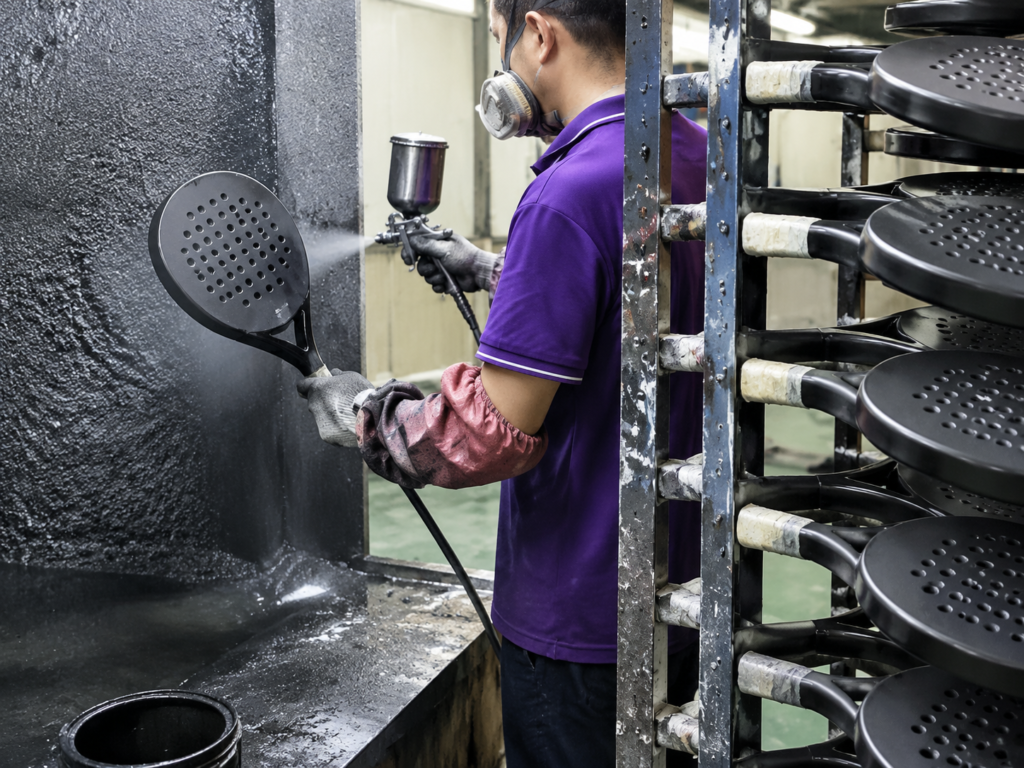
A reliable custom padel racket manufacturer should have real production capability, in-house design and R&D teams, stable quality control, clear communication, OEM and ODM experience, and the ability to support product development from sample to mass production.
For brand owners, distributors, club suppliers, and purchasing teams, choosing a manufacturer is one of the most important decisions in a racket project. Price matters, but price alone cannot show whether a supplier can deliver stable carbon fiber rackets, communicate efficiently, control production, and solve problems after an order starts. A dependable factory should understand both the product and the commercial pressure behind the project. That includes launch dates, quality expectations, packaging, logistics, repeat orders, and customer complaints.
How Can Buyers Confirm Whether a Supplier Is a Real Padel Racket Factory?
Many suppliers can provide product photos and quotations, but not every supplier controls production directly. This difference matters when quality, delivery, and customization problems appear.
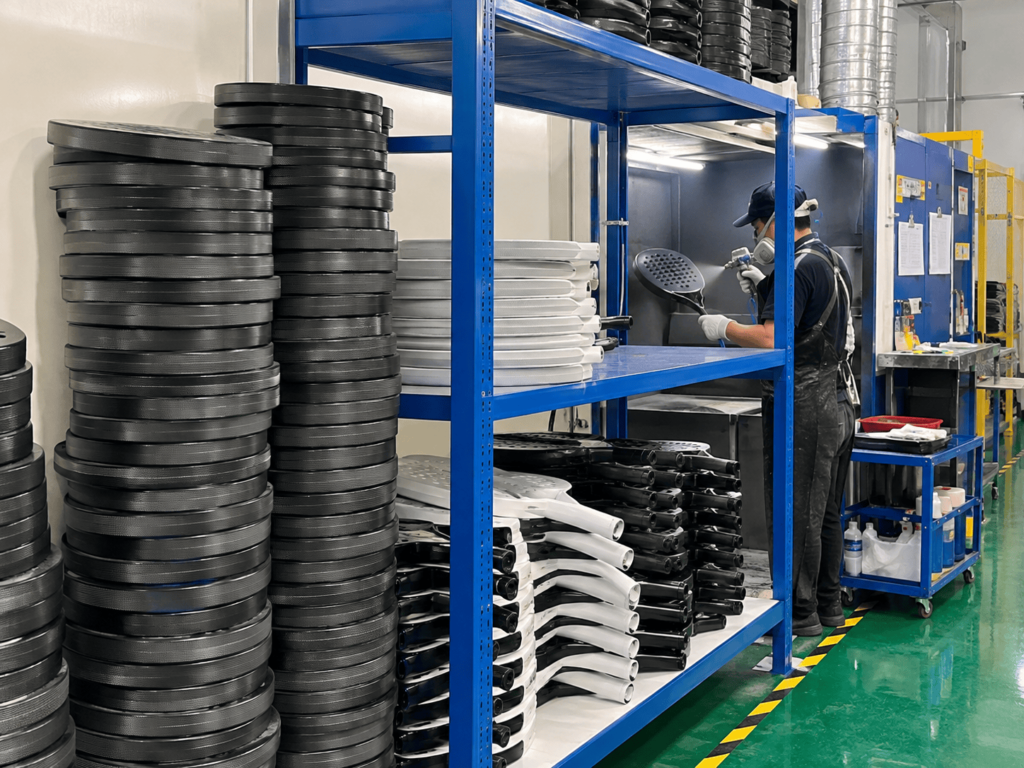
A real custom padel racket factory should be able to explain its production process, material control, mold development, lamination, pressing, drilling, finishing, painting, inspection, and packaging.
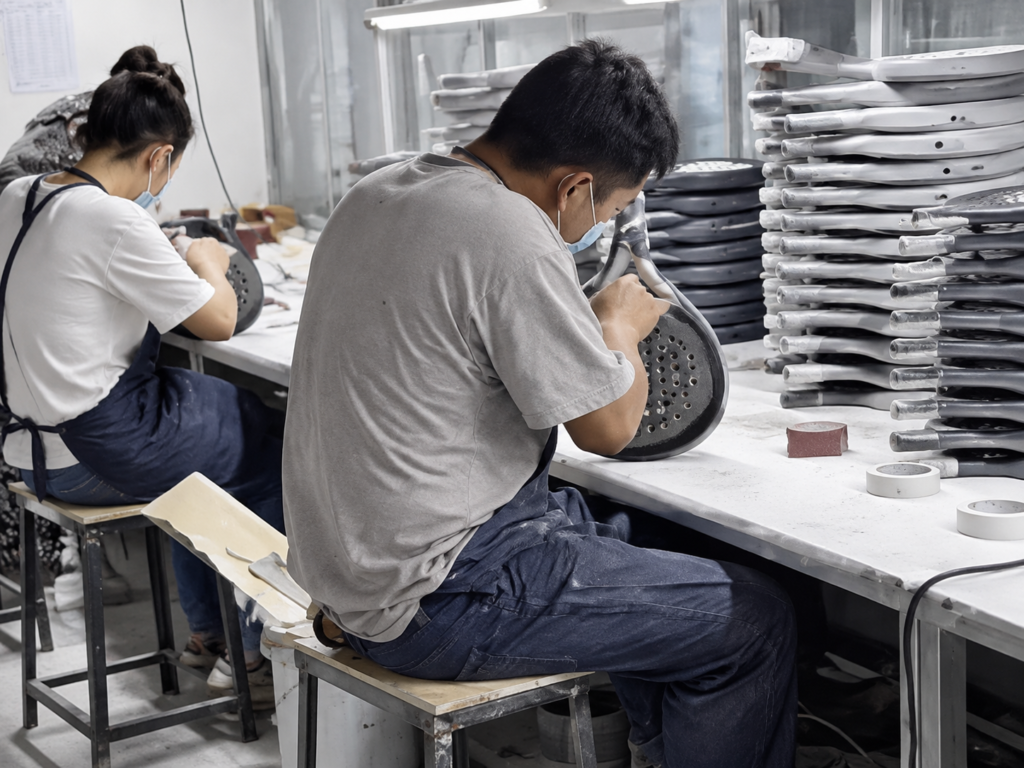
A practical factory evaluation should include more than a company introduction.
| Factory Check | What It Can Reveal |
|---|---|
| Production equipment | Whether key processes are controlled internally |
| Carbon material storage | Whether materials are managed properly |
| Mold area | Whether structural customization is possible |
| Pressing process | Whether temperature and pressure are controlled |
| Painting and finishing | Whether appearance quality is managed |
| QC area | Whether finished rackets are actually inspected |
Direct factory control becomes especially important for custom carbon fiber rackets. Small differences in layup, resin amount, curing conditions, weight distribution, or EVA core can change the final playing feel.
A supplier that depends heavily on outside factories may need more time to answer technical questions or solve production issues.
A manufacturer with in-house design, R&D, production, and sales teams can usually move information faster. Technical questions can reach engineers directly, and production feedback can return to the sales team without passing through several companies.
For custom racket projects, this structure helps reduce communication errors and gives brands more control over development.
Why Is In-House Design and R&D Important for Custom Padel Rackets?
A factory that only copies existing rackets may be able to produce products, but it may struggle when a brand needs a clear performance direction.
Strong design and R&D capabilities help turn market ideas into practical racket specifications.
Custom development can involve:
- Racket shape
- Carbon fiber structure
- EVA hardness
- Frame reinforcement
- Weight range
- Balance point
- Surface texture
- Graphic design
- Packaging
These elements should not be chosen independently.
For example, a brand may request a hard 18K carbon face, diamond shape, and high balance because the product is intended for attacking players. That structure may create strong power, but comfort and handling still need to be tested.
Another project may target clubs and intermediate players. In that case, a teardrop shape, medium EVA, and balanced carbon layup may be more suitable.
An in-house R&D team can evaluate these relationships before mass production.
For brands without deep racket engineering knowledge, this technical support is valuable. The factory should be able to explain why one structure may fit the target market better than another.
Experienced OEM and ODM manufacturers that have worked with established brands are also more familiar with product development cycles, sample revisions, testing requirements, and commercial launch schedules.
What Quality Control Should a Reliable Manufacturer Provide?
A good sample does not guarantee a good production order. One of the biggest risks in custom racket sourcing is inconsistency between approved samples and mass production.
A reliable factory needs quality control at several stages, not only final inspection.
padel racket quality control inspection
Important checks include:
| Production Stage | Quality Focus |
|---|---|
| Incoming Materials | Carbon fiber, EVA, resin, accessories |
| Lamination | Layer position and structural consistency |
| Pressing | Temperature, pressure, curing time |
| Drilling | Hole position and finish |
| Weight Check | Finished racket tolerance |
| Balance Check | Consistent playing feel |
| Surface Inspection | Paint, graphics, texture |
| Final Inspection | Complete product condition |
For carbon fiber rackets, weight and balance are particularly important.
Two rackets can use the same materials but feel different if the weight distribution changes. This can become a serious problem for premium brands because experienced players notice these differences quickly.
Surface quality also matters. Matte, glossy, exposed carbon, and 3D texture finishes each require stable production control. Uneven coating, paint defects, poor logo positioning, or rough edges can reduce the perceived value of the product.
A reliable factory should have clear internal standards and should be able to discuss acceptable tolerances before production.
For repeat orders, records are also important. Stable specifications make it easier to reproduce similar products across different production batches.
How Should Buyers Evaluate Sample Development Ability?
Sample development is one of the best ways to understand a manufacturer’s real capability. A professional factory should not treat samples as simple sales pieces.
The sample stage should be used to test structure, appearance, performance, and production feasibility.
custom padel racket sample development
A strong sample process normally includes:
Specification Confirmation
The target player, shape, materials, EVA hardness, weight, balance, surface finish, and graphics should be confirmed clearly.
Prototype Production
The factory should produce a sample based on those requirements rather than choosing a random existing racket.
Testing and Feedback
Sample feedback may include:
- Too hard
- Too soft
- Too head-heavy
- Not enough power
- Sweet spot too small
- Surface too smooth
- Weight outside target
Revision
The factory should be able to explain which structural changes can solve each issue.
This stage reveals whether the supplier has technical depth.
A sales company may only respond with a new catalog option. A factory with engineering support can adjust carbon layup, EVA, balance, frame structure, or other details.
For purchasing teams, sample responsiveness also provides information about future cooperation. Slow communication during sample development may become a larger problem when a production order faces urgent changes.
Why Does Communication Efficiency Matter So Much?
Poor communication can damage a project even when the factory has good production equipment. Buyers need clear answers, fast technical feedback, and reliable order updates.
Communication becomes especially important when orders involve custom specifications, multiple racket models, packaging, artwork, or strict launch dates.
custom padel racket supplier communication
A reliable manufacturer should communicate clearly about:
| Topic | Why It Matters |
|---|---|
| Material options | Prevents incorrect specifications |
| Sample status | Keeps development on schedule |
| Production progress | Helps plan launches and logistics |
| Quality issues | Allows faster problem solving |
| Delivery timing | Reduces missed selling seasons |
| Packaging details | Prevents shipment errors |
Efficient communication does not mean sending many messages. It means giving accurate answers.
A professional factory with in-house sales, design, R&D, and production teams has an advantage because different departments can cooperate directly.
For international buyers, this becomes especially valuable when technical questions need fast confirmation.
Delayed delivery can cause much more damage than a small unit-price difference. Missing a seasonal sales window, product launch, tournament event, or distributor promotion can affect the entire commercial plan.
Supplier reliability should therefore include both production capacity and communication discipline.
How Important Is OEM and ODM Experience?
OEM and ODM experience shows whether a manufacturer understands different levels of customization and brand requirements.
A reliable factory should be able to support both established product specifications and new product development.
OEM ODM custom padel racket manufacturer
OEM projects are often suitable when a brand already has clear specifications, structure, artwork, and performance requirements.
ODM projects are useful when more factory support is needed for:
- Product concepts
- Material selection
- Racket structure
- Prototype development
- Graphic design
- Product line planning
Experience working with established brands can also improve project management.
Large or experienced brands usually care about repeatability, deadlines, packaging standards, intellectual property, documentation, and after-sales responsibility.
A factory familiar with these expectations is more likely to understand that customization is not simply placing a logo on a standard racket.
For new brands, this experience can shorten the learning process. For established brands, it can reduce the workload required to explain basic manufacturing expectations.
The strongest manufacturing relationship is usually one where the factory understands both technical requirements and commercial goals.
What Should Buyers Ask Before Placing a Custom Padel Racket Order?
A quotation should not be the final basis for choosing a supplier. Buyers should ask questions that reveal production capability, technical knowledge, quality control, and project management.
The answers often show more than the quoted price.
custom padel racket manufacturer supplier checklist
Useful questions include:
| Question | What It Helps Confirm |
|---|---|
| Which production steps are done in-house? | Real factory capability |
| Can carbon layup and EVA be customized? | Technical flexibility |
| How is weight controlled? | Production consistency |
| How is balance measured? | Performance control |
| Can molds be customized? | Structural development ability |
| What happens if samples fail testing? | R&D responsiveness |
| How are defects handled? | After-sales responsibility |
| Can packaging be customized? | Complete project support |
| How are production deadlines managed? | Delivery reliability |
Buyers should also pay attention to how the supplier answers.
Clear technical explanations usually indicate deeper product understanding. Vague answers or constant changes in specifications may signal future communication risks.
For long-term cooperation, supplier selection should consider total project value rather than unit price alone.
A slightly cheaper racket can become expensive when poor quality causes returns, delayed delivery creates lost sales, or weak after-sales support requires repeated replacement orders.
Why Is Direct Factory Cooperation Valuable for Long-Term Brand Growth?
A reliable manufacturer should support more than one production order. Strong long-term cooperation makes future products easier to develop and improves consistency across a brand’s racket collection.
Direct factory cooperation creates a shared product history.
long term padel racket factory partnership
Once a manufacturer understands a brand’s target players, performance preferences, price levels, and design language, future development becomes more efficient.
The factory can support:
- New carbon structures
- New EVA combinations
- Round, teardrop, and diamond models
- Updated surface textures
- New graphics
- Weight and balance adjustments
- Packaging upgrades
- New market requirements
A manufacturer with internal design and R&D also allows successful models to evolve instead of being replaced randomly.
This is particularly useful for distributors and private-label brands that need a stable product line across several seasons.
A factory with experience supplying established brands through OEM and ODM projects understands that trust is built through repeatable quality, realistic deadlines, clear communication, and responsible problem solving.
The right factory becomes part of product development rather than remaining only a purchase source.
Conclusion
A reliable custom padel racket manufacturer should combine real factory production, in-house design and R&D, stable quality control, efficient communication, and proven OEM and ODM experience. Send an inquiry and leave contact details to discuss custom carbon fiber padel racket development.