Padel racket manufacturing brings together composite materials, structural design, molding, finishing, and quality control. For brands developing custom, OEM, or private-label rackets, understanding this process helps turn a product concept into clear specifications and a consistent finished product.
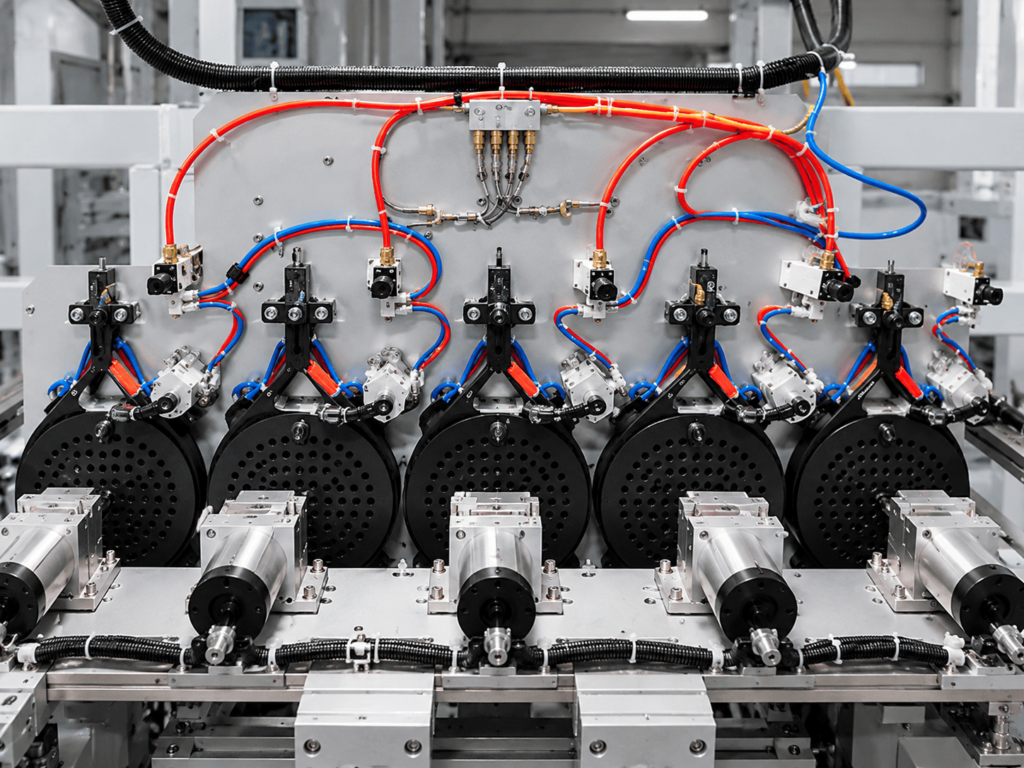
A racket’s performance depends on how its components work together. Shape, reinforcement layers, foam core, resin system, weight distribution, and hole pattern influence feel and handling. Paint, surface texture, and graphics also require careful specification to achieve the intended appearance and finish.
This guide explains the main materials and production stages involved in making a padel racket, from design and sample development to final inspection. It also outlines what to evaluate when choosing a manufacturing partner and preparing your product for bulk production.
Key Materials and Components of a Padel Racket
A padel racket combines a reinforced composite shell with a foam core. These components work together to shape its impact feel, structural strength, weight, and balance.
The main elements include:
- Face reinforcement: Carbon fiber, fiberglass, or hybrid layers that influence stiffness and response.
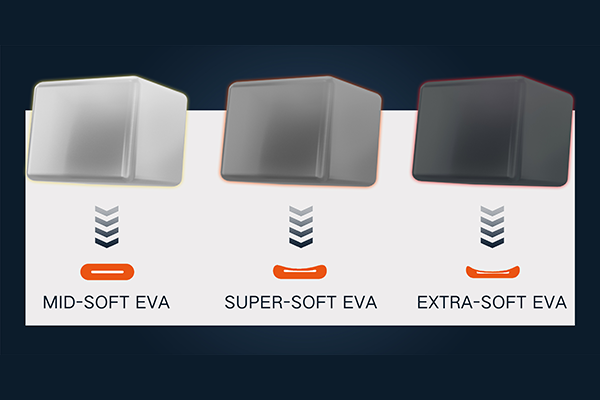
- Foam core: Commonly EVA, selected to achieve the intended firmness and rebound.
- Composite frame: Reinforcement around the perimeter and through the throat and handle.
- Resin system: Binds the reinforcement into a cohesive structure.
- Paint and surface finish: Provide the desired appearance and playing-surface texture.
- Hole pattern: Specified as part of the racket’s structural and playing design.
- Grip and wrist strap: Complete the handle assembly.
- Graphics and branding: Establish the product’s visual identity.
Material selection should match the target player and product positioning. The finished racket’s performance depends on the complete construction rather than any single material label.
Choosing Materials for Custom Padel Rackets
Material selection should begin with the target player, desired response, and product price range. Reinforcement fibers, foam, resin, and coatings work together, so no single specification can define the finished racket’s performance.
For OEM and ODM projects, confirm the complete construction through samples before approving materials for production.
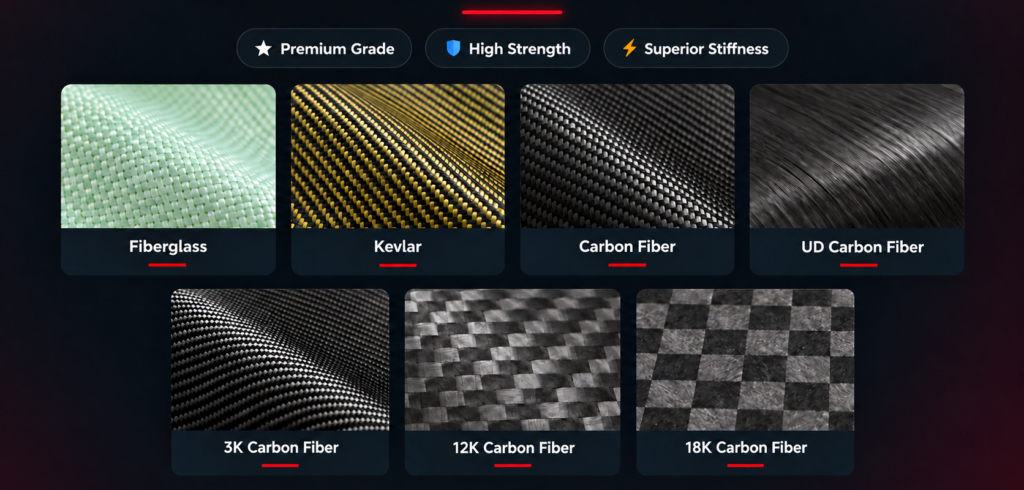
Carbon Fiber: Tow Size and Fabric Construction
Carbon fiber provides useful stiffness and strength-to-weight properties. Its effect depends on the fiber grade, fabric weight, layer orientation, resin content, and overall laminate design.
Common fabric descriptions include 3K, 12K, and 18K. These numbers refer to the approximate number of filaments in each tow:
| Carbon Designation | Filaments per Tow | What It Tells You |
|---|---|---|
| 3K | 3,000 | Tow size, rather than a finished-racket performance rating |
| 12K | 12,000 | A larger tow that can produce a different fabric appearance |
| 18K | 18,000 | A larger tow used in various fabric constructions |
A higher K number does not automatically mean greater stiffness, better durability, or superior quality. Compare the actual fabric and laminate specifications.
Plain weave typically has a regular over-under pattern, while twill weave produces diagonal lines. Weave selection affects appearance and handling during manufacturing, but should be evaluated alongside the complete reinforcement structure.
Fiberglass and Hybrid Reinforcement
Fiberglass generally offers lower stiffness than carbon fiber and can support more flexible racket constructions. It is useful for designs targeting a particular combination of feel, structural performance, and cost.
Hybrid layups combine carbon fiber and fiberglass in selected layers. Their response depends on where each material is placed, its orientation, and the surrounding construction—not simply the proportion of carbon advertised.
EVA Foam Core
EVA foam supports the face layers and contributes to impact feel and rebound. Suppliers may describe options as soft, medium, or hard, but these labels are not necessarily comparable between manufacturers.
- Soft EVA: Can support a more cushioned impact response.
- Medium EVA: Offers a starting point for balancing firmness and comfort.
- Hard EVA: Can support a firmer, more direct feel.
Specify measurable foam properties where available, including density, hardness, and the test method used. Evaluate the core within the finished racket, since face stiffness, geometry, and weight distribution also affect the result.
Resin and Bonding System
Resin forms the matrix that holds the reinforcement fibers together. Epoxy systems are one option used in composite construction, with processing requirements that must suit the fibers, core, and molding cycle.
For production, confirm the resin system, mixing requirements where applicable, working time, and curing conditions. Consistent fiber wet-out and controlled resin content help reduce defects such as dry areas, voids, and resin-rich sections.
Paint and Graphics
The coating system should deliver the approved appearance while remaining compatible with the composite substrate. Depending on the design, production may include surface preparation, primer, base color, graphics, and a protective clear coat.
Confirm color references, artwork placement, adhesion requirements, and acceptable cosmetic tolerances. Coating thickness and consistency also deserve attention because finishing adds weight to the racket.
Final Surface Finish
Specify the final finish as part of the product brief rather than leaving it to the last production stage.
| Finish | Main Characteristic |
|---|---|
| Matte | Low-reflection appearance |
| Gloss | Reflective surface with greater visual depth |
| High-gloss | Highly polished appearance |
| Textured | A deliberately rough or patterned contact surface |
Gloss level and playing-surface texture are separate specifications. A matte appearance alone does not establish roughness or spin performance.
Approve a finished sample that combines the intended materials, graphics, and surface treatment. Keep it alongside the written specifications so production can be checked against a clear reference.
Padel Racket Construction: Shape, Weight, Balance, and Hole Design
A padel racket’s performance comes from its complete structure. Shape, mass distribution, reinforcement layers, core, and hole layout interact to influence handling and impact response.
For OEM and ODM development, define these specifications together, then evaluate them through finished samples. Changing one parameter may require adjustments elsewhere to maintain the intended feel and production consistency.
Choosing the Racket Shape
Shape provides a starting geometry rather than a guaranteed playing profile.
| Shape | Common Design Direction | What to Evaluate |
|---|---|---|
| Round | Often used for control-oriented designs | Central hitting response and maneuverability |
| Teardrop | Often used for all-round designs | Balance between handling and attacking response |
| Diamond | Often paired with higher-balance, attacking designs | Swing effort and response toward the upper face |
A round racket is not automatically forgiving, nor is a diamond racket necessarily powerful. Core firmness, face construction, and mass distribution can substantially change either design.
Specifying Weight and Balance
Finished weight includes the composite shell, foam core, resin, coatings, grip, strap, and other fitted components. Define the target weight range and specify the condition in which it is measured—for example, with the standard grip and strap installed.
Balance describes the racket’s center of mass. Moving weight toward the head can increase swing effort and momentum, while moving it toward the handle can support easier repositioning.
Total weight and balance should be assessed together. Where practical, swing-weight measurements provide an additional reference because rackets with similar weight and balance can still handle differently.
Developing the Hole Pattern
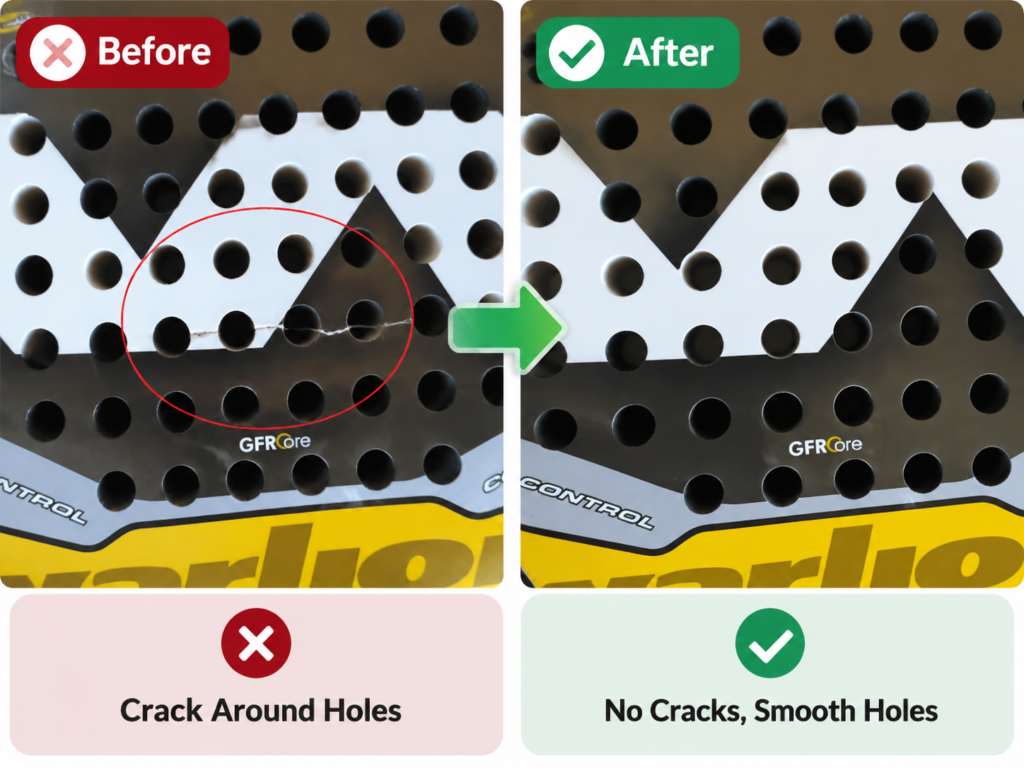
Hole diameter, spacing, quantity, and position form part of the structural design. Drilling removes material and can influence local stiffness, mass distribution, and stress around the openings.
For custom projects, confirm:
- Hole dimensions and locations
- Spacing between holes and proximity to the frame
- Drilling accuracy and edge-finish requirements
- Compatibility with the laminate and applicable equipment rules
Review changes through engineering assessment and sample testing rather than treating a new pattern as artwork alone.
Validate the Complete Construction
A change in shape may alter balance, while a new laminate or coating can shift finished weight. Hole-pattern changes may also require adjustments to reinforcement or drilling procedures.
Approve the complete racket through handling, impact, and consistency checks. Record the final dimensions, weight range, balance reference, layup, core specification, and hole drawing as a coordinated production standard.
How Are Padel Rackets Manufactured?
-
01 — Material Preparation
Select and Prepare Materials
Verify the specified reinforcement fabrics, foam core, resin system, and supporting components. Prepare materials according to the approved construction and processing requirements.
-
02 — Composite Layup
Arrange the Reinforcement Layers
Cut and position the reinforcement according to the laminate schedule. Control layer orientation, overlap, and placement around the face, frame, throat, and handle.
-
03 — Core Preparation
Shape and Position the EVA Core
Prepare the EVA core to the required geometry and check its fit within the assembly. Confirm the specified foam properties before molding.
-
04 — Molding
Mold and Cure the Assembly
Form the prepared assembly in the designated tooling using controlled processing conditions. Temperature, pressure, and curing time must suit the selected materials and construction.
-
05 — Demolding
Release and Inspect the Molded Racket
Remove the racket after the required curing and cooling cycle. Inspect its shape, surface, and visible structural areas before further processing.
-
06 — Trimming and Deburring
Remove Excess Material
Trim molding flash and smooth unwanted edges while preserving the specified profile and structural reinforcement.
-
07 — Surface Preparation
Prepare the Composite Surface
Sand and clean the surface to create a suitable base for subsequent coatings. Control material removal to avoid damaging reinforcement layers.
-
08 — Surface Correction
Correct Minor Cosmetic Imperfections
Apply compatible filler where permitted, then smooth and inspect the repaired areas. Cosmetic filling must not substitute for resolving structural defects.
-
09 — Painting
Apply Primer and Base Colors
Apply the specified coating system and approved colors. Control coverage, curing, and coating buildup to maintain finish consistency and weight targets.
-
10 — Drilling
Produce the Approved Hole Pattern
Drill using the approved layout and suitable fixtures. Check hole dimensions, positioning, and edge condition for manufacturing defects.
-
11 — Cleaning
Clean Holes and Finished Surfaces
Remove drilling debris, dust, and processing residue. Check the prepared surfaces before applying graphics and protective finishes.
-
12 — Graphics and Branding
Apply the Approved Artwork
Add logos, model names, and graphics using the selected application method. Verify placement, color, alignment, and artwork accuracy.
-
13 — Finishing and Assembly
Complete the Finish and Handle
Apply the specified protective coating and surface texture, then fit the grip, wrist strap, and other required components. Allow finishes to cure before final handling.
-
14 — Quality Control
Inspect Before Packaging
Check finished dimensions, weight, balance, appearance, hole quality, and fitted components against the approved specifications. Complete the agreed functional checks and packaging inspection before release.
Production sequence may vary by construction and coating system. Core preparation can precede or overlap layup, and drilling may take place before painting. Quality checks should occur throughout production as well as at final inspection.
Quality Control: From Materials to Finished Rackets
Reliable quality control begins before molding and continues through assembly, finishing, and packaging. Final inspection confirms the result, but cannot replace checks during production.
The goal is to reproduce the approved specification consistently across the order—not simply produce one successful sample.
| Inspection Area | Key Checks |
|---|---|
| Materials and construction | Reinforcement, core properties, layup, and processing records |
| Dimensions and handling | Overall dimensions, finished weight, and balance |
| Drilling and edges | Hole position, diameter, edge condition, and trimming quality |
| Surface and branding | Coating consistency, texture, color, and artwork placement |
| Final assembly | Grip, wrist strap, and fitted components |
| Packaging | Protection, labels, accessories, and order accuracy |
Before production, agree on measurement methods, acceptance tolerances, inspection sampling, and defect-handling procedures. Keep the approved racket and written specifications as the reference, with agreed structural or performance tests supporting visual inspection.
Developing a Custom Padel Racket
Custom development turns a brand concept into a defined, manufacturable product. A clear brief and documented sample revisions help prevent misunderstandings before bulk production.
Define the Product Brief
Establish the target player, intended retail price, order quantity, and desired playing response. Include branding, packaging, and delivery requirements from the outset.
Specify the Construction
Select the shape, reinforcement layers, EVA core, target weight, and balance as a coordinated design. Confirm the hole layout and surface treatment alongside these choices rather than treating them as separate cosmetic decisions.
Develop Graphics and Packaging
Translate the brand identity into approved artwork, colors, logo placement, and packaging specifications. Distinguish visual references from measurable production requirements.
Produce and Evaluate Samples
Assess handling, impact feel, finish quality, and specification consistency. Record feedback and revisions clearly, then evaluate the revised sample where changes affect construction or performance.
Approve and Release Production
Confirm the final sample, specification sheet, tolerances, and inspection requirements before production. Further changes should be reviewed and documented so the factory and brand continue working from the same approved reference.
How to Choose a Padel Racket Manufacturer
Choose a manufacturing partner by its ability to meet your specifications consistently—not unit price alone. Review technical capability, sample quality, and production controls before committing to an order.
Technical Capability and Materials
Ask how the supplier handles your proposed reinforcement, foam core, resin system, and molding requirements. Confirm which operations are completed in-house and which involve external partners.
Customization and Sampling
Clarify the difference between modifying an existing platform and developing a new racket. Shape changes, new tooling, alternative layups, and custom hole patterns can carry different costs and lead times.
Request samples that reflect the intended production construction, graphics, and finish. Record revisions and establish a clear approval process.
Quality Control and Communication
Review inspection methods, production tolerances, and procedures for handling defects. The supplier should document technical decisions and confirm design changes before implementation.
Capacity and Delivery
Discuss realistic production capacity, material availability, and lead times. Confirm how repeat orders will be managed and how potential delays or specification changes will be communicated.
Why Production Consistency Matters
An approved sample establishes the target; repeatable production delivers it. Variations in layup, resin content, core properties, coatings, or assembly can change finished weight, balance, appearance, and response.
Consistency requires measurable specifications and controlled processes throughout production. Retain the approved sample, document acceptable tolerances, and agree on inspection requirements before manufacturing begins.
For brands, this helps maintain a dependable player experience, manage customer expectations, and reduce avoidable product discrepancies.
Discuss Your Custom Racket Project With padelico
A clear product brief is the starting point for a productive manufacturing discussion. Share your target player, price positioning, preferred construction, order quantity, and branding requirements with padelico.
Your project brief can cover racket shape, reinforcement materials, EVA core, weight, balance, hole layout, surface finish, graphics, and packaging. Confirm available customization options, sampling arrangements, and production requirements before approving the final design.
Final Thoughts
A well-made padel racket comes from a coordinated design and a controlled manufacturing process. Reinforcement materials, foam core, geometry, molding, drilling, and finishing all contribute to its feel, appearance, and reliability.
For brands, choosing a manufacturer means evaluating development capability, sample quality, communication, and production consistency alongside price. Clear specifications and agreed inspection criteria help turn an approved concept into a repeatable commercial product.
Whether launching your first collection or expanding an existing range, start with a defined product brief. Contact padelico to discuss your custom padel racket requirements and the next steps for your project.