A padel racket does not have a fixed expiry date. Its useful life depends on how often it is played, the loads and impacts it experiences, how it is manufactured, and the conditions in which it is stored. Two rackets purchased on the same day can reach very different replacement points, even when their specifications appear similar.
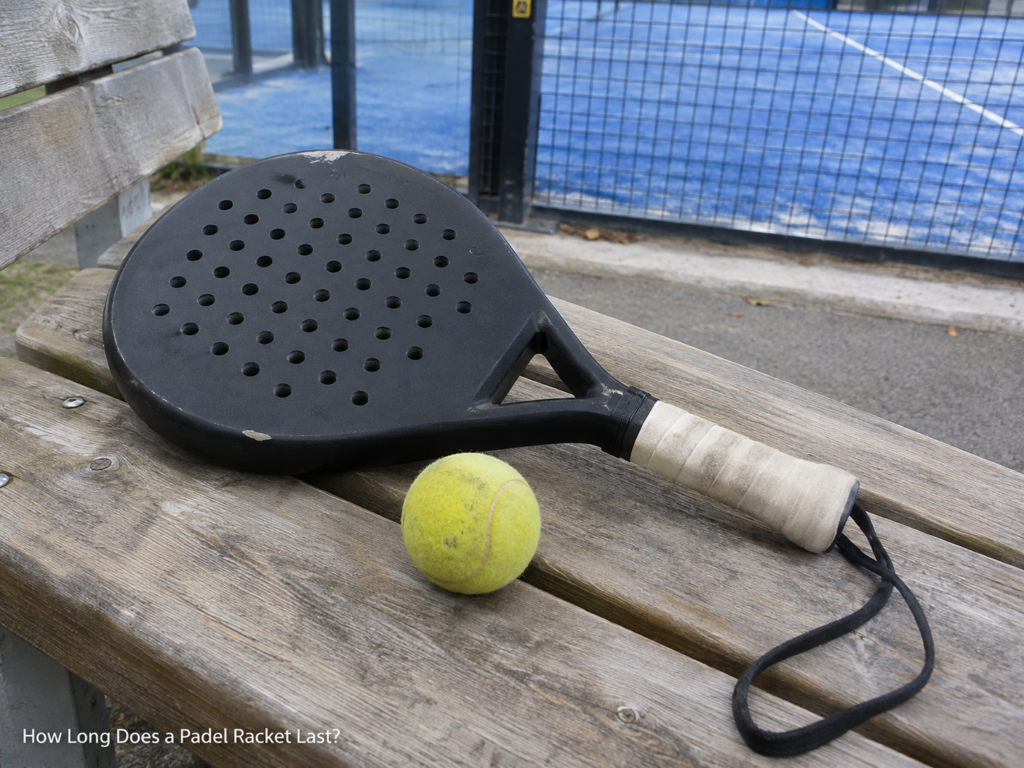
The more useful question is whether the racket remains structurally sound and delivers a consistent response. Worn graphics, a polished hitting surface, or an old grip do not necessarily mean the racket needs replacing. A developing frame crack, a loose handle, or a persistent change in rebound deserves a different response.
For players, understanding these differences helps avoid replacing a serviceable racket or continuing with a damaged one. For clubs and brands, it also improves product selection, maintenance planning, and communication with a manufacturing partner. Racket longevity begins with the construction, but its service life is shaped by everything that happens after production.
What Does “Racket Lifespan” Actually Mean?
A racket can reach the end of its useful life in several ways. These should be separated before discussing how long it lasts.
Structural life concerns the integrity of the frame, face, handle, and connections between components. A racket with damaged structural fibers, significant separation between layers, or an unstable handle requires assessment, regardless of its age.
Performance life concerns whether the racket still provides an acceptable, repeatable response. A player may notice an unfamiliar rebound, inconsistent contact in a particular area, or a substantial change in feel. These observations matter, although they do not identify the cause by themselves.
Cosmetic life is different. Paint scuffs, faded graphics, and surface abrasion can make a racket look old while its structure remains serviceable.
There is also suitability. A player may outgrow a racket’s weight, balance, or response without wearing it out. Replacing equipment for a different playing requirement is a legitimate decision, but it should not be described as material failure.
Keeping these categories separate makes lifespan advice more accurate. Appearance, playing preference, and structural condition are related, but they are not interchangeable.
Why a Universal Replacement Schedule Is Misleading
A recommendation to replace every six months or every year assumes that calendar time represents exposure. In practice, it tells only part of the story.
Consider two players who each own a racket for twelve months. One plays occasionally indoors and stores the racket at home. The other trains several times a week, plays outdoors, and frequently makes contact with the court or enclosure. Their rackets have accumulated different loading histories.
Even counting matches is incomplete. Match length, training drills, hitting intensity, and accidental impacts vary. A coaching racket used throughout a working day has a different service pattern from a privately owned racket used for one weekly session.
Published lifespan guidance therefore needs context. A useful estimate would identify the product, user group, playing exposure, storage conditions, and criteria used to define failure. Without those details, a month-based figure is a rough planning assumption rather than a reliable prediction.
Condition should remain the deciding factor. Age can prompt a closer inspection, but it cannot establish that a racket is either worn out or fit for continued use. Current lifespan guidance similarly emphasizes use, impact history, storage, and observable replacement signals rather than one universal deadline.
How Playing Frequency Changes the Assessment
More playing time creates more opportunities for repeated loading, abrasion, and accidental damage. That does not mean every hour causes the same amount of deterioration.
For practical purposes, players and clubs can organize inspection around exposure:
| Usage pattern | Main consideration | Practical approach |
|---|---|---|
| Occasional recreational play | Storage conditions and isolated impacts may be especially important | Inspect before returning after a long break |
| Regular weekly play | Gradual changes can become difficult to recognize | Check condition regularly and record unusual changes |
| Frequent training and competitive play | High accumulated exposure and repeated demanding contact | Use closer inspection intervals and retain a comparison reference |
| Coaching or shared rental use | Multiple users and incomplete impact histories | Maintain individual racket records and clear withdrawal criteria |
These are maintenance categories, not promised lifespans.
A simple record can be more useful than a purchase date alone. Note the approximate weekly playing hours, any significant collision, changes in accessories, and when an unfamiliar response first appeared.
There is no need to count every ball strike. The purpose is to establish enough context to distinguish a sudden event from a gradual trend. For a shared club fleet, this also prevents a damaged racket from repeatedly returning to circulation without anyone recognizing its history.
Playing Intensity and Accidental Impacts Are Different Loads
Normal ball contact and collision damage should not be treated as the same mechanism.
Ball impacts are part of the racket’s intended use. Contact with glass, fencing, another racket, or the floor can introduce concentrated loads in locations and directions that differ considerably from ordinary hitting.
An edge collision may leave an obvious mark. Other damage can be less apparent. In composite structures, the visible surface does not always reveal the full extent of impact damage; internal separation may require more than a visual check to assess. This is a general composite-material principle, not a method for predicting the remaining life of a particular racket.
After a substantial collision, check the affected area before continuing. Look for a new crack, deformation, exposed fibers, or movement around the handle and frame. Do not keep hitting hard simply to see whether the racket breaks.
A racket that fails after a severe collision has a different history from one that develops a problem under ordinary use without an identifiable incident. This distinction matters when evaluating durability, discussing a claim, or comparing products. The timing of failure alone cannot establish its cause.
How Manufacturing Structure Influences Durability
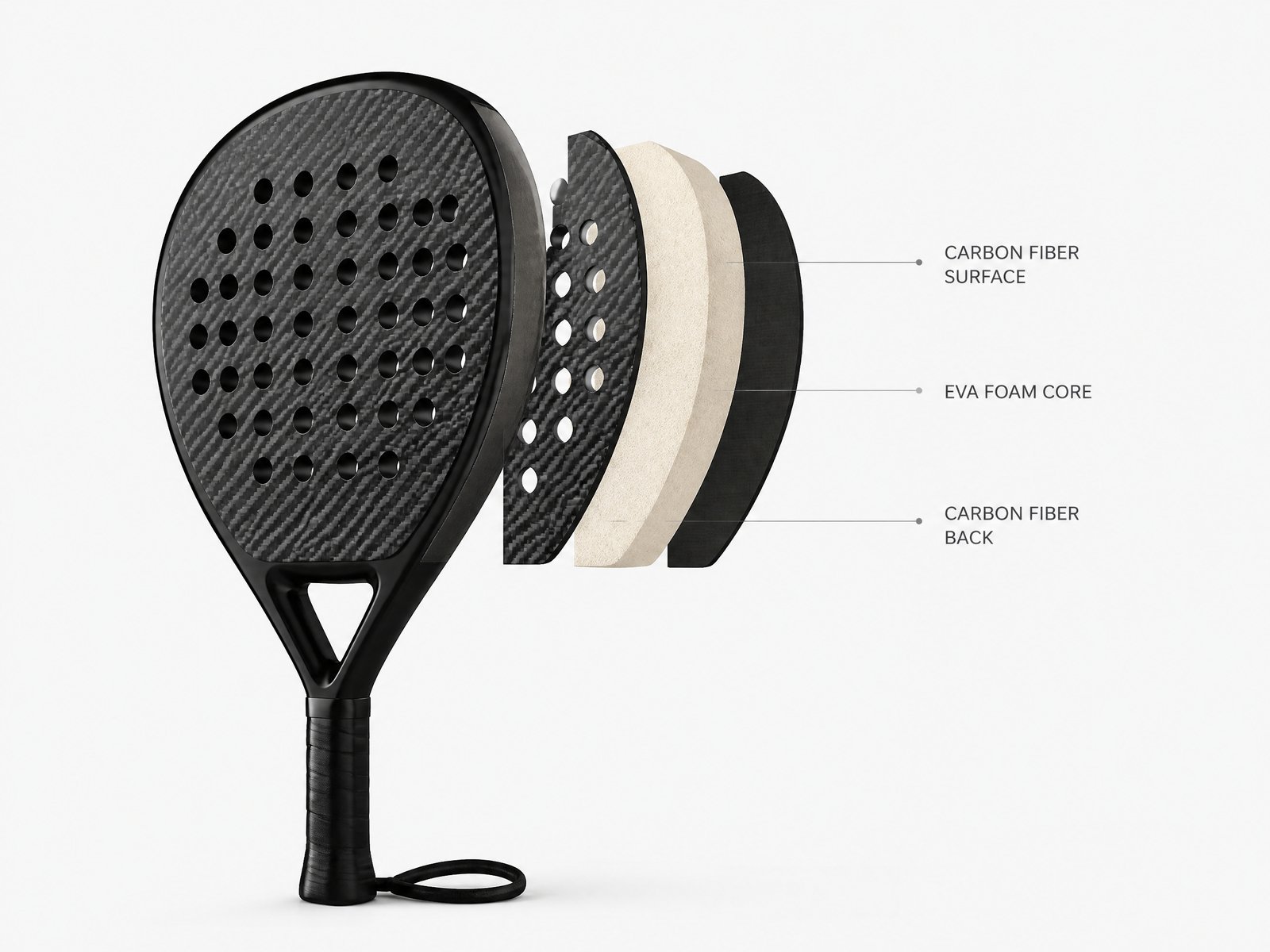
A padel racket works as an assembled composite structure. The face, frame, foam core, and bonded interfaces must function together.
Fiber type is only one part of that structure. Layer arrangement, fiber orientation, resin distribution, consolidation, and the quality of interfaces also influence the finished product. Carbon labels such as 3K, 12K, or 18K describe filament counts within a tow; they are not service-life ratings. Technical discussion of racket layups likewise treats K-count as one manufacturing variable within a much larger system.
The resin system is important because it holds the reinforcement together and helps transfer loads between constituents. Bonding and processing deserve attention alongside the visible fabric. A premium-looking weave does not, by itself, demonstrate sound internal construction.
As a China-based padel racket manufacturer, Padelico supports OEM and ODM development involving materials, molding, surface finishing, and production quality checks. For a durability-focused project, those decisions need to be considered as a complete specification.
The useful manufacturing question is therefore specific: what construction has been selected for the intended users, and how will the agreed characteristics be checked? “More carbon” or “harder foam” is not a sufficient answer.
Does Carbon Fiber Last Longer Than Fiberglass?
There is no dependable material-only ranking that tells a buyer how long a complete racket will last.
Carbon fiber and fiberglass allow different design approaches, but the finished construction determines how those materials are used. A comparison between two rackets may also involve different thicknesses, layer counts, cores, geometries, weights, and manufacturing processes.
For that reason, a carbon-faced racket should not automatically be assigned a longer lifespan than a fiberglass-faced alternative. Nor should flexibility be interpreted as proof that a racket is weak.
For brands, the better approach is to compare samples against the same requirements. Define the intended player, expected use, target weight, and acceptable performance. Then evaluate representative products under consistent conditions.
For players, material descriptions can help explain positioning and feel, but they should not replace inspection or care. An expensive carbon model can still be damaged by a collision or unsuitable storage.
Price also includes factors beyond durability, including design, finishing, distribution, and commercial positioning. A higher retail price is not a measurable guarantee of longer service.
What Can Happen to the Core Over Time?
The foam core is frequently blamed whenever a racket starts to feel different. Sometimes the concern is justified, but the expression “dead core” is too broad to serve as a diagnosis.
A change at impact could involve the core, the face, their connection, the frame, or something outside the racket entirely. Balls, temperature, grip condition, fatigue, and contact quality can also affect what the player experiences.
The practical question is whether the change persists under reasonably comparable conditions.
If the racket feels unusually unresponsive, first check the balls and grip. Consider whether the weather is significantly different from previous sessions. Compare normal, controlled shots rather than relying on one mishit or an unfamiliar impact sound.
A persistent localized difference is more informative than a general impression that the racket feels slower. Record where it occurs and whether it followed a collision.
Pressing the face forcefully with a thumb, bending the frame, or striking it against a hard object will not provide a reliable home assessment of core condition. These actions may introduce further damage. Where a meaningful change remains unexplained, a qualified inspection is more useful than trying to prove the problem through increasingly aggressive tests.
Storage Conditions Can Shorten Useful Life
Storage is one of the few factors an owner can control consistently.
A racket spends considerably more time off court than in play. Where it sits between sessions therefore deserves attention, especially when it is routinely transported in a vehicle or left in a damp equipment bag.
Manufacturer care guidance recommends dry storage, protection from direct sunlight and intense heat, avoidance of major temperature changes, and careful drying before putting a damp racket into its cover.
The practical application is straightforward: bring the racket indoors after play and keep it in a stable, dry location. Avoid placing it beside heaters or leaving it exposed on a sunny balcony.
A protective or insulated bag is useful during transport, but it does not make unsuitable storage harmless. It cannot maintain a safe internal environment indefinitely inside a hot parked vehicle.
Cold-weather handling also deserves some patience. If a racket has been stored in an unusually cold location, move it to normal playing conditions without using a heater or hot water to accelerate the process.
There is no universal storage-temperature threshold that can be applied confidently to every racket construction. Follow the instructions supplied for the particular product rather than borrowing a limit from an unrelated foam or resin.
Moisture, Cleaning, and Drying
Moisture management is mostly a matter of avoiding prolonged damp storage.
After a wet or humid session, wipe the racket and check the grip and cover before packing everything away. A dry face placed inside a damp bag has not been returned to dry storage.
Use a soft cloth for routine cleaning. If additional cleaning is necessary, follow the product instructions and use as little moisture as required. Avoid soaking the racket, directing water into openings, or using a pressure washer.
Do not scrape the hitting surface with abrasive tools to remove dirt. Strong solvents and unapproved chemicals may affect finishes or adhesives, even when the underlying racket still appears intact.
Existing chips and cracks should receive closer attention after moisture exposure. They may change how the structure is protected, although a wet session alone does not establish internal damage.
Drying should be gradual. A radiator, hair dryer, or direct heat source is not a substitute for ventilation.
For clubs, drying covers and separating wet accessories from stored rackets can be incorporated into closing procedures. A small, repeatable routine is easier to maintain than occasional intensive cleaning after equipment has remained damp for several days.
Cosmetic Wear or Structural Damage?
The first inspection task is classification.
A superficial paint mark and a crack involving reinforcement can look similar in a photograph. Their implications are different, so uncertain damage should not be judged from appearance alone.
| Observation | Possible significance | Sensible next step |
|---|---|---|
| Light scuff on paint or graphics | Cosmetic abrasion | Photograph and monitor the area |
| Worn overgrip | Consumable wear | Replace the overgrip and reassess handling |
| Reduced surface texture | Finish wear | Evaluate whether it affects the intended use |
| Crack that becomes longer or wider | Potential progressing damage | Withdraw the racket pending assessment |
| Exposed or broken structural fibers | Structural damage | Stop using the racket and arrange assessment |
| New movement in the handle | Possible connection or component problem | Remove from use until checked |
| Localized rebound change with visible damage | Possible internal or structural issue | Seek assessment rather than continuing to test aggressively |
A mark should be documented with both a close-up and a wider photograph showing its location. Consistent lighting helps when comparing it later.
Do not cover a suspicious area with new paint or adhesive tape before it has been assessed. Concealing the mark makes it harder to observe progression and may complicate a product investigation.
Replacement Signals That Deserve Attention
Several changes justify closer inspection. None should be interpreted without context.
A Developing Frame or Face Crack
A crack that extends, opens, or involves broken fibers deserves prompt attention. Continuing to use the racket can make the original condition harder to assess.
A photograph taken immediately after discovery is particularly valuable. Include any associated impact mark and note when the problem first appeared.
A Persistent Localized Rebound Difference
An area that repeatedly responds differently under comparable contact may indicate a problem. Ball condition and contact location should be checked before reaching that conclusion.
A single short return or mishit does not establish failure. A repeatable change in the same area is a stronger reason to seek assessment.
New Movement or Instability
Movement in the handle, bottom cap, or another attachment should be investigated. A loose replaceable component may require a different remedy from damage to the load-bearing structure.
The owner should not assume which component has failed simply from the sensation during play.
A New Internal Rattle
An internal sound is a reason to inspect, not an automatic verdict that the whole racket is unusable. The source and any accompanying change in performance matter.
For player guidance, a new rattle, dead spot, crack, or unfamiliar vibration is best treated as an observation to investigate rather than proof of one specific failure mechanism.
A Practical Condition Check Before Replacing a Racket
A consistent assessment reduces unnecessary replacement and improves the quality of information supplied to a seller or manufacturer.
Start with the history. Record the approximate use, any recent collision, unusual storage exposure, and when the change began. Distinguish a sudden problem from something noticed gradually.
Inspect the accessories. Check the grip, protector, bottom cap, and wrist cord. Worn or loose accessories can change handling and sound. Damage involving the safety attachment also requires attention before further play.
Examine the structure in good light. Inspect the face, perimeter, throat, and handle area. Look for progression, exposed reinforcement, deformation, or unexpected movement.
Check the playing conditions. Use serviceable balls and consider temperature, fatigue, and recent changes in setup. Comparing a racket with several new accessories against its original specification can be misleading.
Compare only when appropriate. If there is no visible structural concern, a familiar, sound reference racket may help establish whether the response has changed. Do not continue play-testing a visibly damaged racket.
Finally, document the result. Clear photographs and a brief factual description are more useful than “the racket has died.” State what changed, where it is noticeable, and whether it follows a known event.
Factory Controls That Support Consistent Service Life
A factory cannot guarantee how every owner will use a racket. It can work to reduce avoidable variation in the product supplied.
For an OEM project, durability discussions should begin with the intended application. A rental fleet, a lightweight recreational model, and a performance-focused retail racket may have different priorities. Those priorities need to be resolved before the sample becomes the production reference.
Useful specification controls include:
- Identified face and frame constructions.
- Agreed core material and relevant properties.
- Defined finished-weight and balance conditions.
- Controlled processing instructions.
- Clear criteria for trimming, drilling, and finishing.
- Approval procedures for material or process changes.
The purpose is repeatability. A production racket should not differ materially from the approved construction because an undocumented substitution was made.
Composite research identifies voids as one manufacturing feature capable of affecting mechanical properties and fatigue behavior. That supports attention to process quality, but it does not allow a factory to calculate a consumer lifespan from appearance or final weight alone.
Padelico’s custom padel racket development includes material and specification discussions, sample evaluation, branding, and production coordination. Durability requirements are most useful when included in that brief from the beginning.
What Durability Testing Can—and Cannot—Prove
A test result is meaningful only when its conditions are understood.
“Passed an impact test” leaves important questions unanswered. Where was the racket struck? What load or impact energy was used? How was it supported? How many samples were tested? What counted as failure?
A sensible evaluation plan separates several objectives:
| Evaluation | Main question |
|---|---|
| Repeated-loading assessment | Does the construction retain the required behavior under the chosen loading sequence? |
| Controlled impact assessment | How does the racket respond to a defined impact event? |
| Environmental conditioning | Does the selected exposure affect appearance, integrity, or measured response? |
| Field evaluation | Does the product remain suitable during representative use? |
| Production sampling | Is the supplied batch consistent with the agreed reference? |
These tests provide different evidence. Passing one does not answer all the others.
An accelerated test also cannot automatically be translated into months of play. That conversion requires a validated relationship between the test and actual field exposure.
Brands should therefore avoid turning a cycle count into a lifespan promise without supporting evidence. Test reports are better used to compare constructions, identify weaknesses, and verify agreed requirements.
This distinction allows a manufacturer to discuss durability confidently while keeping claims tied to what was actually measured.
How Clubs and Brands Can Manage Racket Longevity
Shared equipment needs a system because no single user knows its complete history.
Assign each racket an identifier and keep a short record of inspections, incidents, and accessory replacements. Staff should know which findings require immediate withdrawal and who is responsible for deciding whether a racket returns to use.
A damaged racket should be physically separated from the available fleet. A note in a spreadsheet is insufficient if the same item can still be handed to a customer.
For brands, service records can also improve the next product revision. Track recurring locations and symptoms, approximate exposure, batch information, and any available inspection findings.
Avoid treating every complaint as the same failure. A chipped finish, loose accessory, collision fracture, and unexplained face problem require different investigations.
The custom padel racket manufacturing process connects product development, sample refinement, production, and quality control. Field information becomes more useful when it can be traced back to a defined product version.
This is where a factory relationship can add lasting value: translating documented use experience into a specific design or process review, rather than responding with a general request to make the next batch “stronger.”
Repair, Replacement, and Value
The correct response depends on which part has deteriorated.
An overgrip, protector, or cover can often be replaced independently. Routine accessory wear should not force retirement of an otherwise serviceable racket.
Structural repair is a different matter. Adding resin or reinforcement may change mass distribution and stiffness, and an improved appearance does not prove that the original properties have been restored. The location and extent of damage need assessment before a repair decision.
For a brand or club, repairability should also be considered alongside replacement cost, inspection confidence, and the intended user. Returning uncertain equipment to a shared fleet creates a different management problem from repairing an item for non-playing display.
Value is best judged against useful service, not purchase price alone. A modestly priced racket that performs consistently for its intended users may offer better value than a more expensive model poorly matched to the application.
Keep warranty coverage separate from lifespan expectations. A warranty addresses defined obligations and conditions; it is not a schedule telling every player when the product will wear out. Any claim should be assessed under the applicable terms and evidence.
FAQ
How long does a padel racket last with regular use?
There is no reliable universal number of months. Regular use can mean one short session a week or several demanding training sessions. Assess accumulated exposure, impact history, storage, structural condition, and consistency of response together. An inspection routine is more useful than replacing solely because a calendar deadline has arrived.
Can a padel racket last for several years?
It is possible for a lightly used, well-stored racket to remain serviceable for several years. That possibility is not a promise for every construction or owner. Inspect it before returning after a long break, especially if its storage history is uncertain. Low playing hours do not cancel damage from a collision or unsuitable storage.
Does a padel racket lose power as it gets older?
A racket can develop a changed response, but age alone does not prove a loss of power. Balls, temperature, grip condition, fatigue, and contact quality may also affect the result. A persistent change under comparable conditions deserves investigation, particularly when it is localized or accompanied by visible damage.
Should I replace a racket with scratched paint?
Light paint scratches alone do not necessarily justify replacement. Check whether the mark is superficial or involves the underlying structure. Progression, exposed fibers, deformation, or a nearby performance change makes assessment more important. If the depth is uncertain, avoid assuming that a small-looking mark is harmless.
Does a harder EVA core last longer?
Core hardness alone cannot establish the lifespan of the assembled racket. The core specification, surrounding construction, processing, use, and storage all matter. Brands comparing options should evaluate complete samples against the same requirements rather than assigning a longer life simply because one foam feels firmer.
Do frame protectors prevent racket damage?
A protector may reduce some contact wear in the area it covers, but it does not make the racket impact-proof. Protection depends on its design, coverage, and the event involved. It also adds weight. Inspect the underlying frame when appropriate rather than assuming an intact protector means an undamaged structure.
Can I leave my racket in its bag inside the car?
A bag does not make a parked vehicle suitable for routine racket storage. Bring the equipment indoors and keep it dry, away from direct sunlight and heat sources. Protective or insulated compartments can help during transport, but they cannot control the surrounding temperature indefinitely.
When should I stop using a racket immediately?
Stop and arrange assessment when you find exposed or broken structural fibers, a significant or progressing crack, deformation, an unstable handle, or a compromised safety attachment. A sudden unexplained change after a substantial collision also deserves inspection. Continuing to hit hard is not an appropriate way to confirm whether damage is serious.