Requesting a “3K carbon padel racket” identifies tow size, but leaves much of the construction undefined. Suppliers may quote different fiber grades, fabric weights, weave patterns, and layer arrangements under the same description, making prices difficult to compare.
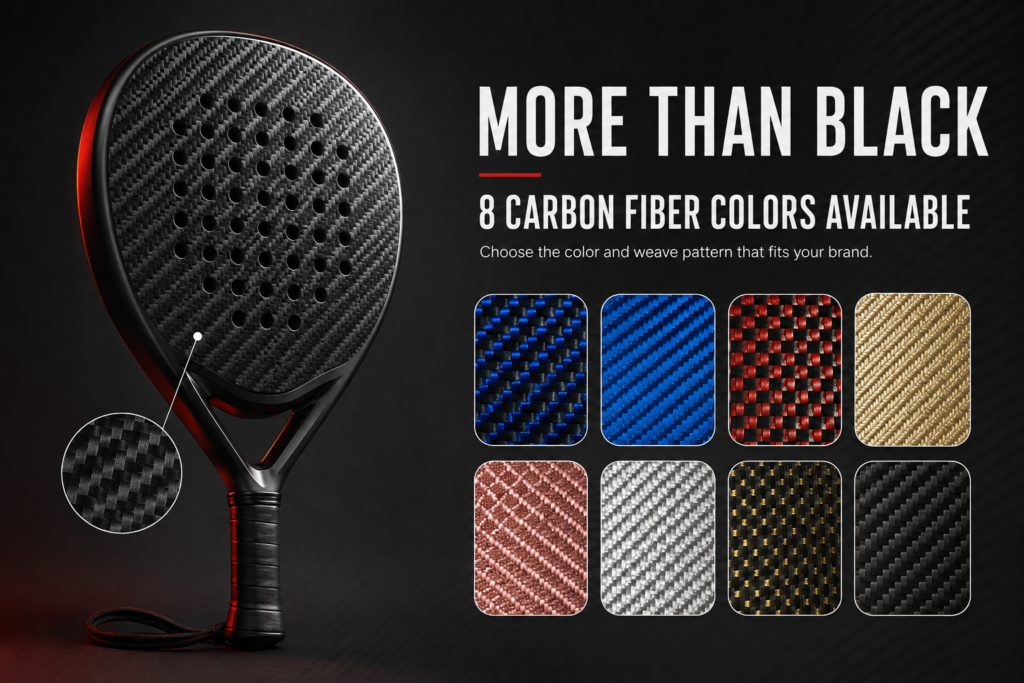
A useful RFQ separates carbon fabric specifications from laminate and finished-racket requirements. The fabric description should identify the reinforcement being purchased, while the layup, resin system, core, and processing requirements define how it will be incorporated into the racket.
This guide explains which carbon fabric details to include in an OEM padel racket RFQ, what supporting information to request, and how to document acceptable alternatives. A clear specification helps brands compare proposals, evaluate samples, and establish a consistent reference for production.
Why “3K Carbon” Is Not a Complete Specification
3K describes a tow containing approximately 3,000 carbon filaments. It does not identify the fiber grade, fabric weight, laminate stiffness, or finished-racket quality. Those characteristics depend on additional material and construction details.
For example, one supplier may propose a visible 3K face over fiberglass reinforcement, while another proposes several carbon layers. Both may describe the product as “3K carbon,” but the quotations cover different constructions.
Separate the specification into three levels:
| Specification Level | What It Defines |
|---|---|
| Carbon reinforcement | Fiber grade, tow size, fabric architecture, and areal weight |
| Laminate construction | Layer placement, orientation, resin system, and local reinforcement |
| Finished racket | Core, geometry, weight, balance, finish, and acceptance requirements |
This separation helps buyers identify whether price differences reflect material choices, construction changes, or genuinely comparable offers.
Specify the Reinforcement and Supply Form
Ask the supplier to identify the proposed material clearly enough to support purchasing, sample approval, and repeat production.
The specification should cover:
- Fiber manufacturer and grade, or an identifiable approved reference
- Tow size, where applicable
- Fabric architecture, such as plain weave or 2×2 twill
- Areal weight in grams per square meter, with an agreed tolerance
- Dry reinforcement or prepreg supply form
- Material supplier and substitution-approval requirements
- Intended location and function within the racket
Unidirectional and biaxial reinforcements should not automatically be described as weave patterns. Identify their actual construction, including fiber directions and any stitching or backing.
If thickness is important, define its measurement method and condition. Dry fabric, uncured prepreg, and cured laminate thickness are different quantities and should not be used interchangeably.
Areal Weight and Visible Appearance
Areal weight describes mass per unit area. For dry carbon fabric, it generally refers to the reinforcement; for prepreg, clarify whether the quoted value represents fiber weight or total material weight including resin.
A more useful description than “3K carbon” might be:
“3K carbon fiber, 2×2 twill, nominal dry-fabric areal weight of 200 g/m², for the visible outer face.”
This remains a material description—not a complete performance specification.
For exposed-carbon designs, also establish weave alignment, acceptable distortion, and visual reference samples. Treat matte, gloss, paint coverage, and surface texture as separate finishing requirements.
Define Resin and Prepreg Requirements
The resin matrix binds the reinforcement and contributes to the cured composite’s properties. Material approval should therefore consider the reinforcement and resin together.
For Prepreg Materials
Request the resin-system reference, nominal resin content, its basis of measurement, and permitted variation. Confirm storage conditions, shelf life, allowable handling time outside storage, and the applicable cure requirements.
The factory should demonstrate that its molding process is compatible with the selected material rather than applying a generic cure cycle.
For Dry-Fabric Processes
Ask the supplier to identify the proposed resin system and relevant processing controls. Depending on the method, these may include mixing ratio, working time, wet-out, resin quantity, and curing conditions.
The purpose is to establish repeatability without unnecessarily prescribing proprietary factory procedures.
Traceability and Substitutions
Agree on which records are required, such as technical data sheets, certificates of conformity, incoming-batch identification, and links to production lots.
Documents support material verification; they do not prove finished-racket performance. Any proposed substitution should be assessed against defined technical and visual requirements and approved before use.
For a project discussed with padelico, include these documentation expectations in the initial RFQ so their availability and cost can be confirmed.
Identify Where the Carbon Is Used
An exact fabric description is still incomplete if its location is unclear. State whether it applies to the hitting faces, frame, throat, perimeter, or selected reinforcement zones.
Request a construction summary that distinguishes the visible layer from the underlying reinforcement. A visible face layer may contribute structurally even when appearance is a primary reason for selecting it.
Avoid undefined descriptions such as “full carbon.” Clarify which components and reinforcement layers the claim covers.
Layer Count and Fiber Orientation
Layer count, orientation, coverage, and sequence influence the laminate. More layers do not automatically produce a better racket; they can also change weight, balance, stiffness, and processing requirements.
Define the orientation reference—for example, the racket’s longitudinal axis—so descriptions such as 0°, 90°, and ±45° are meaningful.
Where detailed layups are confidential, agree on enough controlled information to identify the approved construction and prevent unreviewed changes.
Separate Development Targets From Acceptance Criteria
An RFQ can request a particular visible fabric while inviting the manufacturer to propose the supporting laminate. However, terms such as “medium-firm response” or “medium EVA” need clarification through samples and measurable specifications where practical.
Evaluate the proposed construction within the complete racket: core properties, mold geometry, hole layout, finished weight, balance, and coating all matter.
Approve a representative sample, document the final construction, and record the agreed tests and tolerances. This creates a stronger production reference than a carbon label alone.
Translate Material Choices Into Finished-Racket Targets
A carbon specification becomes useful when it supports a defined product outcome. Terms such as “powerful,” “comfortable,” or “professional” describe intentions, but do not establish measurable acceptance criteria.
Combine physical specifications, reference samples, and agreed testing methods. Identify which characteristics are essential and which remain open to development.
| Product Target | What to Specify |
|---|---|
| Finished weight | Target range and whether the grip, wrist strap, protector, and other accessories are included |
| Balance | Acceptable range, reference point, measurement method, and accessory configuration |
| Geometry | Mold reference, outline, thickness, and hole layout |
| Core properties | Material reference, relevant hardness or density requirements, and test method |
| Impact response | Reference racket, evaluation procedure, and stiffness or deflection criteria where appropriate |
| Surface | Texture requirements, gloss level, and approved appearance references |
| Durability | Applicable tests, loading conditions, sample quantity, and pass/fail criteria |
| Workmanship | Limits for visible defects, artwork placement, color variation, and edge condition |
Keep texture and gloss separate: a matte appearance does not establish surface roughness. Likewise, foam density and hardness describe different properties and should not be treated as interchangeable.
If a reference racket is supplied, explain what should be retained or changed. Ask the manufacturer to report prototype results and identify any trade-offs between weight, balance, response, appearance, and cost.
Include Sampling and Validation in the RFQ
The RFQ should establish how the proposed construction will be evaluated before production—not simply request a price.
Identify Every Prototype Revision
Assign each sample a unique identifier linked to its material and construction records. Document what changed between versions so play-test feedback and measured results can be attributed correctly.
Evaluate dimensions, weight, balance, appearance, and handling alongside suitable structural tests. Sound may provide comparative feedback, but should not be used alone to confirm internal quality.
Approve a Production-Representative Sample
The pre-production sample should use the intended materials, artwork, coatings, grip, strap, and packaging. Record its approval alongside the specification rather than relying on the physical sample alone.
Retain matching reference samples at the buyer and factory, with their configuration and condition documented.
Agree on Inspection Requirements
Define incoming-material checks, in-process controls, final inspection, and performance-test sampling. Specify defect classifications, acceptance criteria, reporting, and corrective-action procedures.
An inspection level or sampling plan does not define acceptable workmanship by itself. Inspectors still need clear measurements, visual references, and test instructions.
Control Changes After Approval
Require review before changes that could affect the approved product, including substitutions involving:
- Fiber grade, fabric supplier, tow size, weave, or areal weight
- Resin system, reinforcement layers, or core material
- Layup sequence, orientation, or coverage
- Molding and curing conditions outside the approved process range
- Coatings, accessories, or packaging that affect product requirements
The change request should explain the reason, anticipated effects, and proposed validation. Update the controlled specification after approval, particularly for repeat orders placed months apart.
Compare Supplier Proposals on the Same Basis
Ask each supplier to identify deviations, assumptions, and exclusions rather than quoting a similar catalog product without explanation.
Confirm whether the price includes tooling, development samples, artwork setup, finishing, accessories, packaging, testing, and documentation. Request separate minimums and lead times for each model or configuration where relevant.
A higher quotation may reflect additional materials, tighter controls, or more extensive testing—but it does not automatically represent better value. Compare the documented construction and included scope, then use samples and supporting evidence to assess the proposal.
A Practical Carbon Fabric RFQ Template
Start with the intended product and player, then separate mandatory requirements from items the manufacturer should propose. This gives the supplier room to develop a suitable construction while keeping alternatives visible and subject to approval.
The following example is a discussion template—not a validated racket specification.
| RFQ Item | Example Requirement |
|---|---|
| Product concept | Teardrop padel racket for intermediate-to-advanced players; supplier to review feasibility |
| Outer face fabric | 3K carbon, 2×2 twill, nominal dry-fabric weight of 200 g/m²; supplier to identify fiber grade, material source, and available tolerance |
| Laminate | Supplier to propose layer sequence, orientation, and coverage; identify all carbon, fiberglass, and local reinforcement |
| Resin and supply form | State dry fabric or prepreg, resin-system reference, and relevant processing controls; define resin-content basis where applicable |
| Core | EVA option proposed against the approved response reference; provide material identification and relevant measured properties |
| Finished targets | Nominal weight of 365 g with an agreed tolerance, defined balance range, and nominal thickness of 38 mm |
| Impact response | Medium-firm development target, evaluated against an identified reference and agreed test procedure |
| Appearance | Matte clear finish with visible weave; texture, alignment, and cosmetic limits defined separately |
| Validation | Engineering samples followed by production-representative sample approval; report agreed measurements and test results |
| Traceability | Link incoming material batches and construction revisions to production lots |
| Change control | Written approval required for substitutions or changes affecting the approved specification |
| Commercial scope | Itemize tooling, samples, unit prices, packaging, testing, documentation, minimum quantities, and lead times |
Complete unresolved fields before production approval. Phrases such as “agreed tolerance” and “defined balance range” are placeholders, not acceptance criteria.
Include Initial and Forecast Quantities
State the initial order by model, artwork, and configuration. Provide estimated repeat or annual demand separately, identifying forecasts as nonbinding unless otherwise agreed.
This helps suppliers assess material purchasing, production scheduling, and the practicality of custom fabrics, tooling, or packaging. Ask them to explain any minimum-order constraints rather than assuming one quantity applies to the entire project.
Choose an Appropriate Development Route
An existing mold with a revised laminate may reduce tooling expenditure, provided it supports the intended geometry and product goals. A new mold may be justified when existing platforms cannot meet the required design.
Neither route removes the need for sampling. Confirm development responsibilities, tooling ownership, revision charges, and approval milestones before committing.
For a project with padelico, submit the completed brief and request confirmation of available material options, sampling arrangements, and quotation scope.
Conclusion
A useful carbon fabric RFQ connects identifiable materials to a documented construction and measurable finished-racket requirements. Tow size is only one element; fabric architecture, resin, core, processing, inspection, and change control also need clear definitions.
Use the same specification when comparing suppliers, require deviations to be disclosed, and approve representative samples before production. Contact padelico to discuss your target product, budget, and order plan, and confirm the next steps for your OEM or ODM project.