Racket weight alone cannot explain handling. Poor balance can make a reasonable-weight padel racket feel slow, tiring, unstable, or difficult to control.
Padel racket balance describes where weight is concentrated between the handle and racket head. Low balance favors maneuverability and control, high balance supports stronger attacking leverage, while medium balance provides a more versatile combination.
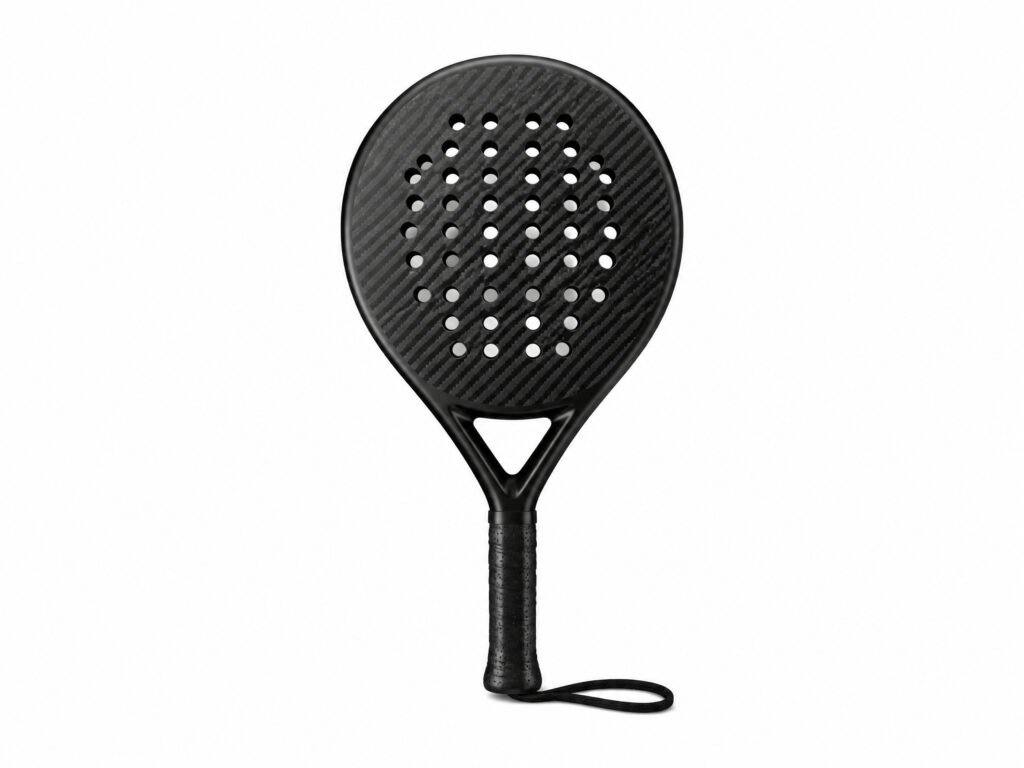
Balance is one of the most important but misunderstood padel racket specifications. Many product pages emphasize 3K carbon, 12K carbon, EVA hardness, and total weight while giving little information about weight distribution. Market feedback shows why this can become a problem: two rackets with almost identical total weight may feel completely different during fast volleys, defensive recoveries, and overhead shots. For brands, distributors, clubs, and purchasing teams, balance should therefore become part of product development and product communication, not an afterthought.
What Does Padel Racket Balance Actually Mean?
A racket may meet the expected weight specification and still feel surprisingly heavy during play. The reason is often weight distribution rather than total weight.
Padel racket balance describes how mass is distributed from the handle toward the head. Low, medium, and high balance create different handling characteristics even when finished racket weights are similar.
Balance is normally discussed according to the position of the racket's center of mass. More mass toward the handle creates a lower balance. More mass toward the head creates a higher balance.
| Balance Type | General Feeling | Common Performance Direction |
|---|---|---|
| Low Balance | Easier to move | Control and maneuverability |
| Medium Balance | Neutral and versatile | Balanced performance |
| High Balance | More weight felt at the head | Power and attacking leverage |
This distinction matters because static weight does not describe swing behavior.
A racket around a familiar weight range can feel fast when the balance is low, yet demanding when the balance is higher. During repeated volleys, defensive blocks, bandejas, and overhead movements, that difference becomes much easier to notice.
Balance is also connected with other specifications. Racket shape, frame construction, EVA density, carbon layup, edge protection, grip materials, and surface structure can all shift weight distribution.
This means balance cannot be treated as an isolated specification.
A custom manufacturing factory should control total weight and balance together. In-house R&D can define a target balance range during sample development, while production and quality teams check whether mass-produced rackets remain close to the approved reference.
For commercial product sheets, adding weight range, balance range, touch feeling, sweet spot level, and recommended player level gives buyers much more useful information than listing carbon type alone.
How Does Low Balance Affect Control and Maneuverability?
Fast reactions near the net become difficult when too much mass sits toward the racket head. A lower balance can reduce that problem and make handling more comfortable.
Low-balance padel rackets concentrate relatively more mass toward the handle. This generally supports quicker movement, easier positioning, and better control during defensive shots and fast exchanges.
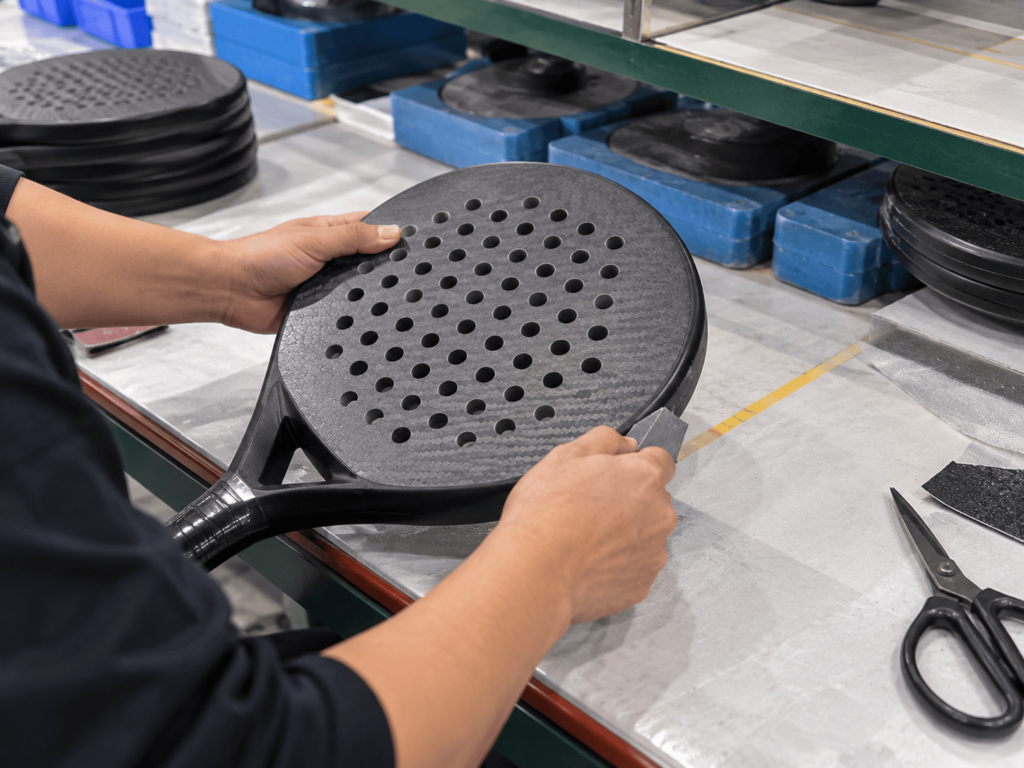
Low balance is especially useful in products developed for players who value fast racket preparation.
The racket can feel easier to reposition during:
- Quick volleys
- Defensive blocks
- Rapid exchanges near the net
- Low-ball recoveries
- Long training sessions
A lower balance is also a useful development direction for beginner-friendly and comfort-focused carbon rackets.
Industry feedback often connects demanding rackets with combinations such as high sweet spots, small sweet spots, hard faces, and difficult balance. A carbon racket does not need to be designed only for advanced attacking players. A lower-balance structure can help create a more forgiving carbon product.
Low Balance Does Not Mean Low Performance
A common product-positioning mistake is treating control-oriented rackets as basic products.
Low balance can also be used in premium rackets. Carbon fiber, optimized EVA, reinforced frames, 3D textures, and advanced graphics can remain part of the design while the handling stays manageable.
For a custom factory, development may involve moving weight away from the upper frame, adjusting reinforcement placement, controlling protective components, or modifying the internal structure.
Padelico develops carbon fiber rackets through factory-controlled design, R&D, production, and sales coordination. This type of structure allows balance targets to be discussed during engineering rather than discovered only after finished samples arrive.
For brands targeting club players, defensive players, comfort-focused customers, or players seeking easier handling, low balance can become a clear product advantage.
How Does Medium Balance Create an All-Round Padel Racket?
Some product lines fail because they are too specialized. Excessive head weight may reduce comfort, while very low balance may not provide the attacking feel expected by experienced players.
Medium balance places the racket between control-focused and power-focused designs. It can provide enough maneuverability for defense while retaining useful stability and attacking performance.
Medium balance is often suitable for brands needing a racket that can serve a broad player group.
It works particularly well when paired with a teardrop shape or another versatile frame concept. However, shape alone does not determine balance. The final weight distribution still needs to be engineered and measured.
| Development Element | Possible Medium-Balance Direction |
|---|---|
| Shape | Round or teardrop depending on target |
| EVA | Soft-medium or medium |
| Carbon | Selected according to target feel |
| Sweet Spot | Central or moderately elevated |
| Playing Position | All-round |
| Target Level | Intermediate to advanced recreational |
Medium balance can also reduce product-selection confusion.
Market feedback repeatedly shows that customers struggle when product pages only say "power," "control," "12K," or "professional." Those descriptions do not explain how the racket will actually move.
A stronger specification system can describe:
Feel: Soft / Medium / Crisp
Balance: Low / Medium / High
Sweet Spot: Large / Medium / Compact
Control: Comfort / All-Round / Precision
Recommended Level: Beginner / Intermediate / Advanced
This approach is particularly useful for private-label collections. Instead of launching several rackets that look different but feel almost identical, each model can occupy a clear position.
A factory with in-house design and R&D can create this separation during prototype development. OEM and ODM experience with established brands also helps translate commercial positioning into practical material and structural choices.
How Does High Balance Affect Power and Attacking Performance?
More attacking power sounds attractive on a product page, but a head-heavy racket can become difficult when the target customer lacks the technique or physical strength required to handle it.
High-balance padel rackets place relatively more mass toward the head. This can increase leverage during attacking shots, but it can also make the racket feel slower and more demanding.
High balance is commonly associated with offensive racket concepts, especially diamond-shaped or performance-oriented models.
Extra mass toward the top can support powerful movements during smashes and aggressive overhead shots. Advanced players with good preparation and strong technique may benefit from this type of response.
However, power should not be discussed without the trade-offs.
Possible Advantages
- Stronger attacking leverage
- More solid feeling through overhead shots
- Suitable positioning for advanced offensive models
- Clear differentiation in a performance racket collection
Possible Challenges
- Slower maneuverability
- Greater physical demand during long matches
- More difficult handling for inexperienced players
- Higher risk of mismatch when combined with hard EVA and a small sweet spot
Market insights show that high sweet spots and power-oriented rackets do not work equally well for every player. Some users report that difficult balance, hard feeling, and small sweet spots make a racket demanding rather than enjoyable.
That creates an important lesson for brands: a high-balance racket should be clearly positioned.
Product pages, packaging, sales material, and distributor catalogs should explain the recommended player level and playing style. Selling an aggressive model simply as "premium carbon" can create unnecessary returns and negative feedback.
During custom development, a factory can adjust carbon layup, EVA hardness, frame reinforcement, and mass distribution to keep a high-balance racket powerful without making it unnecessarily difficult.
Why Can Two Padel Rackets With the Same Weight Feel Completely Different?
Comparing two rackets only by grams can be misleading. Similar total weight does not guarantee similar swing speed, fatigue level, stability, or overall playing feel.
Weight measures how heavy the complete racket is, while balance describes where that weight sits. Both specifications need to be controlled together for consistent performance.
Consider two rackets with similar finished weights.
One may place more mass around the handle and throat. Another may concentrate more material around the upper frame and head.
Although a scale may show nearly the same number, the second racket can feel significantly heavier during movement.
This is one reason product specifications should not stop at a statement such as "360–365 g."
A stronger specification may include:
| Specification | Why It Matters |
|---|---|
| Finished Weight Range | Controls overall product mass |
| Balance Range | Describes weight distribution |
| EVA Feeling | Influences comfort and response |
| Carbon Structure | Influences face behavior |
| Sweet Spot Position | Affects forgiveness and shot response |
| Player Level | Reduces incorrect purchasing |
Weight tolerance also needs attention during mass production.
A prototype can feel excellent, but the commercial order may become inconsistent when manufacturing controls only total weight without checking balance.
Small changes in resin, carbon layers, protective tape, paint, grip materials, and finishing components can change weight distribution.
A professional factory should therefore compare production samples with the approved reference.
For purchasing teams, requesting both weight and balance information creates a much clearer quality standard. It also makes conversations with manufacturing partners more technical and less dependent on vague descriptions such as "light feeling" or "professional power."
How Do Racket Shape, EVA, and Carbon Fiber Change Balance Performance?
Balance alone cannot predict the complete playing experience. A low-balance hard racket and a low-balance soft racket may have very different comfort, rebound, and control characteristics.
The best racket structure combines balance with shape, EVA hardness, carbon layup, sweet spot position, and target player requirements.
Shape is often the first structural factor connected with balance.
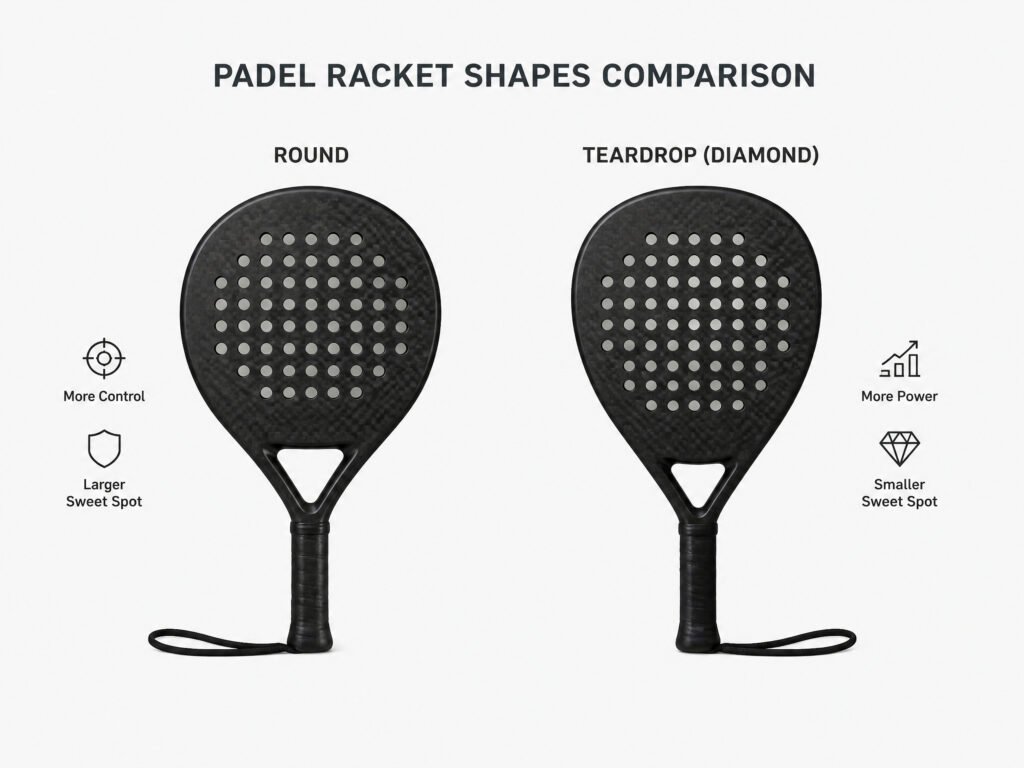
Round rackets frequently support control-oriented concepts, while diamond designs are commonly associated with more attacking configurations. Teardrop shapes often sit between these directions.
These relationships are useful, but they are not absolute.
A round racket can still be made relatively head-heavy, and a diamond racket can be engineered to reduce excessive head weight.
EVA also changes the perception of the racket.
A hard EVA core with a high balance and firm carbon face may create a very demanding product. That combination can suit advanced players but may be unsuitable for a broad recreational market.
A softer core can improve comfort, while a larger sweet spot can provide more forgiveness.
A More Useful Product Development Matrix
| Product Goal | Balance Direction | Core Direction | Sweet Spot Direction |
|---|---|---|---|
| Comfort / Beginner | Low | Soft | Large |
| Control | Low-Medium | Soft-Medium | Large-Central |
| All-Round | Medium | Medium | Medium-Large |
| Performance | Medium-High | Medium-Hard | Medium |
| Attack | High | Medium-Hard | Higher / More Focused |
These combinations are development directions, not fixed formulas.
Professional sample testing is still necessary.
An in-house R&D team can produce different prototypes and change one variable at a time. This makes it easier to identify whether an uncomfortable result comes from balance, EVA hardness, face stiffness, sweet spot position, or the interaction of several factors.
That engineering process is one of the main advantages of working directly with a specialized factory rather than purchasing generic finished rackets.
How Should Padel Brands Specify Balance During Custom Development?
Terms such as "light," "powerful," and "easy to control" are too subjective for factory development. Unclear specifications often lead to repeated samples and slower product launches.
Custom racket projects should define target weight, balance direction, touch, sweet spot, player level, and playing style before mass production begins.
A practical development brief can include:
Target Player
Beginner, intermediate, advanced, club player, defensive player, all-round player, or attacking player.
Target Feeling
Soft, medium, firm, or crisp.
Balance Direction
Low, medium, or high, followed by an agreed measurable range once samples are developed.
Sweet Spot
Large and forgiving, balanced, or smaller and performance-focused.
Weight Range
The finished production tolerance should be defined instead of relying on one nominal number.
Material Structure
Carbon fiber face, frame reinforcement, EVA specification, and surface finish should support the intended performance.
A capable manufacturing partner should also explain when requested specifications conflict.
For example, requests for very low weight, extremely high balance, maximum power, very soft feel, and maximum durability may require compromises. Technical development should identify those trade-offs before mass production.
Padelico operates as a custom processing factory rather than only a trading company. In-house design, R&D, sales, and manufacturing coordination support both OEM and ODM development, including projects serving established international brands.
That direct factory structure is valuable when sample feedback requires fast adjustments to balance, EVA, carbon construction, graphics, or production tolerances.
How Can Better Balance Information Reduce Returns and Customer Complaints?
Many racket complaints begin before the match starts: the wrong customer buys the wrong product because specifications fail to explain how the racket actually feels.
Clear balance information helps brands position rackets correctly, guide distributors, and reduce product mismatch between player level and racket characteristics.
Market feedback shows recurring complaints about rackets feeling too hard, too head-heavy, too demanding, or having sweet spots that are too small.
These issues are not always manufacturing defects. Sometimes the racket works exactly as designed but has been sold to the wrong player.
This makes product communication part of quality management.
Instead of displaying only:
12K Carbon + EVA Core + 365 g
a product page can communicate:
Weight: Defined production range
Balance: Medium
Touch: Medium
Sweet Spot: Medium-Large
Control: High
Power: Medium-High
Recommended Player: Intermediate / All-Round
This language is easier for distributors, sales teams, and end customers to understand.
It also helps create a clearer product ladder.
A comfort series can focus on lower balance, softer feeling, larger sweet spots, and reduced vibration. An all-round series can use medium balance. A performance series can move toward higher balance and firmer structures.
When these differences are designed from the factory stage, marketing claims become easier to support with real product characteristics.
That reduces the risk of relying only on carbon terminology such as 3K, 12K, 18K, or 24K, which many customers cannot translate directly into playing experience.
Conclusion
Padel racket balance can change maneuverability, comfort, control, and attacking performance even when total weight stays similar. Clear balance targets, consistent manufacturing, and the right carbon-EVA structure create better racket collections. Send an inquiry and leave contact details to discuss a customized padel racket project.