A custom padel racket carries your brand in two ways. The graphics make it recognisable, while the weight, balance, and impact feel determine how players experience it. Those choices begin with the intended player and the price point the racket needs to serve.
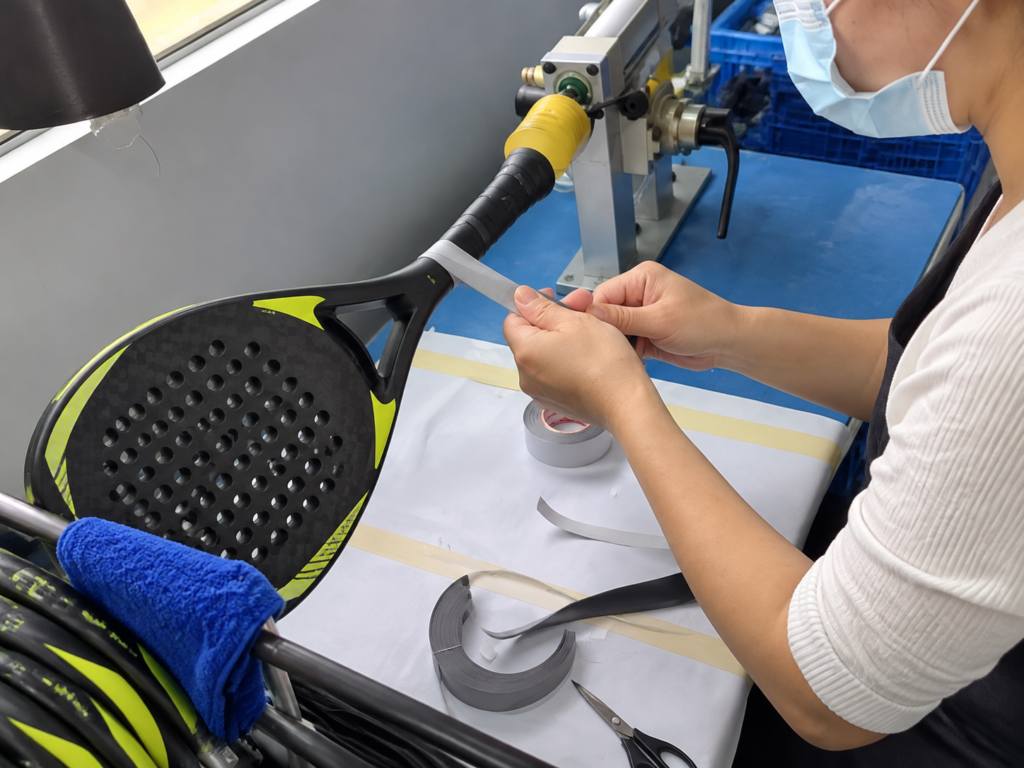
For many projects, an existing mold provides a starting point. The factory can review compatible changes to the hitting face, EVA core, and finish. A new mold becomes relevant when the design calls for a different outline, profile, or frame geometry.
At Padelico, a padel racket manufacturer in China, we help brands turn those decisions into a finished sample they can test on court and approve as the reference for bulk production.
Choose What You Want to Customize
“Custom padel racket” can describe a branded version of an existing model, a revised construction made in an existing mold, or a new racket shape. Define the scope before requesting prices. It affects the work required to prepare a sample and what the factory needs to confirm before accepting the bulk order.
| Customization route | What you can discuss | When it makes sense |
|---|---|---|
| Private label on an existing model | Logo placement, artwork, colors, and compatible grip, finish, or packaging options | You already like the model’s handling and need it to carry your identity |
| Custom construction on an existing mold | Compatible changes to face material, EVA core, finished weight, balance, or surface texture | The outline suits your product, and you want a different feel or response |
| New mold development | A new outline, revised dimensions, or structural changes that require different tooling | The geometry itself is part of what makes the product distinctive |
For a club order, private labeling can be enough. A finished sample with the club colors and a comfortable grip may meet the brief for lessons, rentals, or pro-shop sales. For a retail brand, the difference between two models should also be apparent on court. If the player can feel the difference between a softer recreational version and a firmer performance version, the product line has a distinction that staff can demonstrate.
Padelico’s factory page lists MC005, MC006, N1, and N3, among other models. Use these codes to begin a conversation about available frames. Ask for the proposed build sheet for the model you shortlist, including its shape, face, core, weight, balance, and compatible options. Explore Padelico’s padel racket manufacturer and factory page.
If you are commissioning a new mold, ask the factory to quote tooling separately and confirm its ownership, permitted use, maintenance, and availability for reorders. Those details matter when you are building a product line around a shape you expect to keep for several seasons. Write a Brief the Factory Can Build From
A detailed specification can come later. The first brief needs a clear user and a practical description of the response you want. “A comfortable control racket for adult beginners taking weekly lessons” tells the factory more than “premium carbon with maximum control.” Add the sales channel, target price, first-order quantity, and date you need stock in hand.
If you have a reference racket, explain what you want to carry over. You might like the way it prepares for a volley but want a firmer response at contact. You might want to retain its grip size while changing the balance. Send a physical sample if available, or provide photos and measurements with notes about which features matter most.
Shape and intended handling
A round shape is a common starting point for a forgiving racket with a more central hitting area. A teardrop can suit an all-round brief that calls for both manageable handling and support on attacking strokes. A diamond shape is often considered for a more attack-oriented design. The outline gives the project a direction. Check the balance and usable hitting area on the actual sample.
Face, frame, and core
Specify these as separate parts of the build. A fiberglass face may suit a softer, more flexible response. Carbon or a hybrid face can be used when the brief calls for a different level of firmness or feedback. Ask the factory to identify the agreed face and frame construction on the build sheet. A carbon weave designation on its own gives the buyer only part of that information. Padelico offers fiberglass and carbon construction options and different EVA densities and firmness levels. See Padelico’s custom padel racket process.
For the core, describe what players should feel on a small swing and when they hit with more pace. A softer EVA may suit a racket that should respond easily on blocks and controlled returns. A firmer option may suit players who prefer more direct feedback. When comparing cores, keep the mold, face, weight, and balance as close as practical. If you change all four at once, you can still choose the better racket, but you will have less information about which change produced the result.
Finished weight, balance, and grip
Set a finished weight target and an acceptable tolerance with the factory. Specify the balance point from the butt of the handle and agree on the measurement setup. For instance, both sides should know whether the reading includes the factory grip, wrist strap, and any fitted edge protector. Two samples with the same weight can feel different when more of the mass sits toward the head.
Confirm the handle length and grip circumference on the version you plan to sell or issue to members. For a club fleet, think about how staff will replace worn grips. For a retail product, check that the grip customers receive matches the one they tried on a demo racket.
Develop Artwork Around the Actual Racket
Ask for the artwork template for your selected model before finalizing the design. The racket’s outline, bridge, edge, and hole pattern affect what remains visible once the graphics are applied. A logo that looks centered in a flat mockup may sit too close to a hole or lose part of a letter on the finished face.
Send vector logos where possible, along with color references, font files or outlined text, and clear front- and back-face layouts. Mark the elements that must remain visible around the holes. If a sponsor logo or club crest has to sit in a specific area, show that placement on the template. Include the grip color, end-cap branding, and any text or model code that needs to appear on the frame.
Review color and finish on a physical sample. A matte coating, an exposed weave, or a textured surface can change how the same artwork looks. Check the racket under ordinary indoor lighting and in daylight. If you have two colorways, review them together to see whether they still read as part of the same range.
Packaging belongs in this discussion. A fleet delivered to one club may need protective packing and clear carton labels. A racket sold individually through a retailer may need a branded box, barcode, insert, or cover. Agree on what goes with each racket and what belongs on the master carton so the receiving team can identify the order quickly.
Use the Sample to Make Decisions Before Production
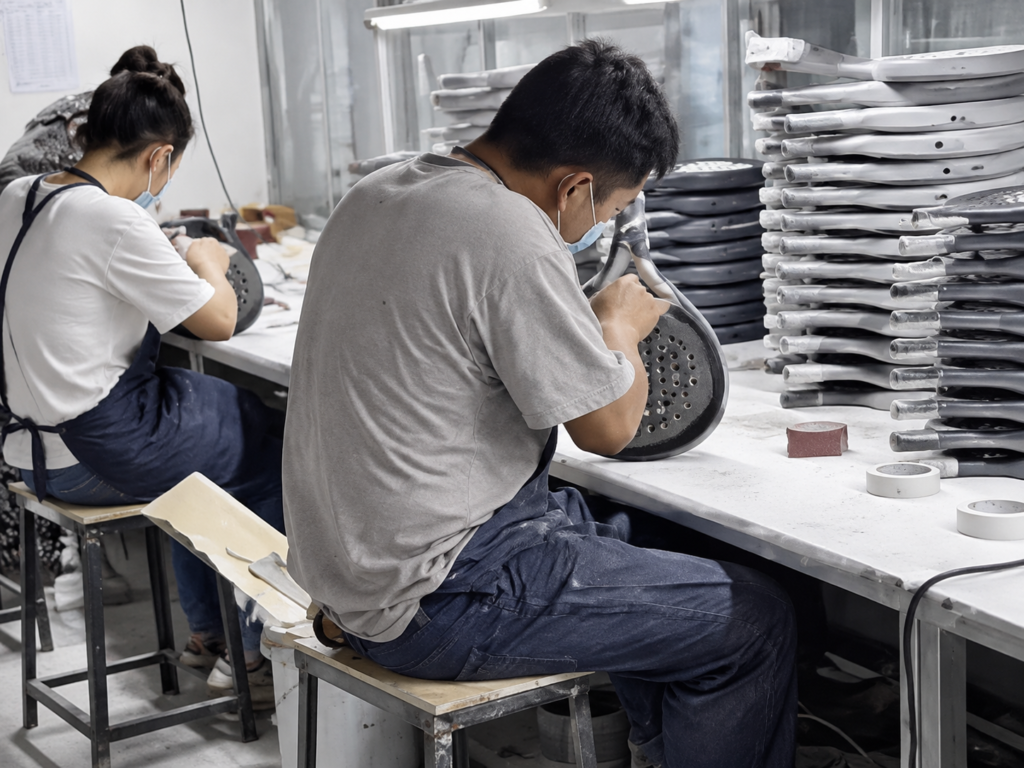
The sampling work depends on what you changed. A logo update on an established construction may call for a physical proof that confirms color, placement, and finish. A new core or balance target calls for a playable prototype. A new shape may require tooling and a geometry check before you can judge the racket on court.
| Sample stage | What you can approve |
|---|---|
| Digital proof or drawing | Artwork layout, logo position, color references, and the geometry shown on the drawing |
| Playable prototype | Handling, impact feel, core response, preliminary weight and balance |
| Finished pre-production sample | Final artwork, coating, texture, grip, wrist strap, finished measurements, and agreed packaging |
Take the playable sample onto the court with the people it was designed for. If the model is for a coaching program, ask a coach and a few recreational players to try controlled returns, lobs, and short volleys. If it is for a performance range, include faster exchanges and overheads. Use comparable drills when evaluating two builds and record the shots on which the difference was noticeable.
Give feedback the factory can translate into a change. “The racket feels heavy” could refer to total weight, balance, or how difficult it is to turn during a quick exchange. A more useful note would be, “The sample meets the weight target, but the head feels slow when switching to a backhand volley. Can we compare a version with a lower balance point?” Use the same test after the revision to see whether it addressed the original issue.
Once the final racket is approved, keep it alongside a dated specification. Record the model or mold, material construction, weight and balance tolerances, finish, graphics version, grip, accessories, and packaging. The finished sample gives both sides a physical reference. The written specification gives the production and inspection teams values they can check.
Confirm the Order Quantity and Schedule Together
Padelico’s published custom racket program lists a 100-racket minimum. Send the intended quantity for each model, artwork, and colorway so the factory can confirm how the minimum applies to the order. One hundred rackets with the same core and two graphics may be handled differently from one hundred rackets divided between two builds with different faces, EVA cores, and grip colors. Read Padelico’s guide to MOQ, samples, and lead times.
Ask for a quote that identifies sample costs, any new tooling, the bulk unit price, packaging, and the agreed shipping scope. If a branded box or grip is supplied separately, ask whether it has its own quantity requirement. Keep the same specification when requesting prices at different volumes so you can see what changes with quantity. Review the cost of custom padel rackets.
If the order is for a tournament, club opening, or retail launch, give the factory the date the rackets must arrive. Ask for a sample-ready date and a bulk goods-ready date, then allow time for reviewing samples, dispatch, and delivery. Padelico’s factory page publishes a bulk production cycle of 35–45 days after sample approval and deposit. Confirm the schedule for your configuration and destination in the quotation.
Check Production Against the Racket You Approved
After approval, the factory has to reproduce the agreed build across the order. The written specification should make the inspection criteria clear. For example, check weight and balance with the same components fitted as on the approved sample. Review logo position, paint and coating consistency, the edges and holes, grip assembly, and the condition of the packaged racket.
If the project requires structural or durability checks, agree on the test and acceptance criteria during sampling. For buyers taking delivery at a warehouse or club, retain the model codes and carton labels from the shipment. If a unit falls outside the agreed specification, the product code and batch information give both sides a starting point for investigating it.
Padelico’s factory page describes checks for weight, balance, surface appearance, frame structure, and bonding, along with procedures for maintaining the approved specification across production batches. See how our padel racket factory handles production and quality control.
What a First Order Can Look Like
Suppose a club wants rackets for weekly coaching sessions and a small pro-shop selection. It starts by testing one established frame with a soft EVA core and a grip the coaching team can replace easily. Coaches confirm that learners can prepare it in time on a backhand volley and get reasonable depth from a compact swing. The club then reviews two artwork options on the same build and asks whether the quantities can be combined. That gives it a way to distinguish lesson stock from retail stock while evaluating one construction.
A specialist retailer might make a different decision. It starts with one mold, then tests two constructions for customers with different preferences. The recreational version should produce an approachable response on slower returns. The second version should give clearer feedback during faster volleys. The retailer can approve each model against its intended use and give staff a simple way to explain the difference on court.
In either case, a focused request for quotation would include the intended player, preferred model or reference racket, required face and core, weight and balance, artwork, quantity by variant, packaging, and destination. If some details are flexible, say which ones. That gives the factory room to propose an available model or a compatible construction. Discuss your custom padel racket project with Padelico.
Frequently Asked Questions
Can I put my own logo on an existing Padelico racket?
You can discuss private labeling on an existing model, including artwork, colors, and logo placement. Confirm which areas and finishes are available for the selected racket, then approve the graphics on a physical sample.
Can I customize the core and weight without opening a new mold?
The selected mold and construction determine which changes are feasible. If an existing frame suits the brief, ask which EVA, face, and weight options can be sampled on it. A change to the outline or dimensions may require new tooling.
What is the minimum order for custom padel rackets at Padelico?
The published minimum is 100 rackets. Share the quantity by model, artwork, and colorway so Padelico can confirm the applicable minimum for the order.
Should I approve a finished sample before bulk production?
Approve a finished sample when you need to confirm both playability and appearance. Check the final grip, finish, branding, weight, and balance, and review any packaging included in the order. Record the approved configuration so it can be used for inspection and reorders.
How long does bulk production take?
Padelico’s factory page publishes a 35–45 day bulk production cycle after sample approval and deposit. Confirm the dates for tooling, sampling, production, and freight when planning around an event or launch.