Two padel rackets can weigh exactly 360 g and feel very different on a backhand volley. One comes around easily when the ball is close to your body. The other feels steadier when it meets a fast ball, but takes more effort to bring into position. Both can be well made. The better choice depends on which response you can use consistently.
To tell whether a padel racket is good, look for sound workmanship, handling that suits your game, and predictable contact on the shots you play most. Start with the edges, holes, grip and wrist strap. Compare weight and balance together. If you can test the racket, play a few blocks, lobs and returns off the back glass before judging it on a smash.
For club buyers and brands, there is one further test. Pick up several rackets from the same batch. They should handle like the approved sample and meet the agreed specifications. That is how a good prototype becomes a dependable product.
What a Good Padel Racket Feels Like on Court
You learn more from a sequence of ordinary shots than from the best shot in a test session. A clean smash shows what the racket can do when you have time and make good contact. A low return off the glass, a volley close to your body or a lob played under pressure shows how the racket fits the rest of your game.

Pay attention to preparation, contact and recovery. Preparation is how easily you can bring the face into position. At contact, notice whether you can judge the direction and depth of the return. Recovery is the time and effort it takes to get ready for the next ball. A racket that suits you should make those three parts of the shot feel repeatable at your usual pace.
When the ball lands slightly outside the preferred hitting area, notice how much pace you lose and how far the handle turns in your hand. Some drop in response away from the centre is normal. Compare the size of the change across two rackets using feeds of similar speed. The one that gives you more playable returns on a modest miss may suit you better than the one that produces the fastest clean strike.
The same standard changes with the player. A beginner taking group lessons may need quick preparation and a core that responds on a short stroke. An experienced defender may want enough stability to redirect a hard volley while keeping the racket easy to move. An attacker may prefer more mass through an overhead and firmer feedback when striking hard. Start with the shots you need the racket to handle.
What to Inspect Before You Hit a Ball
A new racket should arrive with a finished edge, cleanly drilled holes, a secure handle and a properly attached wrist strap. Take the racket out of its cover and turn it under good light. Check both faces, the perimeter, the bridge and the bottom of the handle. If the racket is used or has been a demo, ask about its condition and look for damage around the areas most likely to have contacted walls or the court.
| Area | What to look for | What to do with the observation |
|---|---|---|
| Face and frame junction | Visible gaps, lifted material, splits or an opening along the edge | Ask the supplier to assess the area before accepting the racket |
| Drilled holes and bridge | Sharp burrs, exposed splinters, chips or cracks around the openings | Inspect nearby holes and distinguish a rough finish from visible damage |
| Face finish and graphics | Uneven coating, lifting decals or a noticeable mismatch between units of the same finish | Compare against the agreed artwork or approved sample |
| Grip and end cap | Movement at the cap, an uneven wrap or an uncomfortable ridge under the hand | Check the assembled handle in your normal playing grip |
| Wrist strap | A secure attachment and a strap in good condition | Have a loose attachment or damaged strap assessed before use |
Read the marks in context
A mark in a clear coat and a gap between bonded parts have different implications. For a retail order, a decal that lifts at its edge may fail the agreed appearance requirement even when the racket feels fine on court. A visible opening at the face-to-frame junction deserves closer assessment because the bond may be affected. For a club receiving a large order, photograph the area, record the model and carton details, and ask the supplier how to classify it.
A visible carbon weave is an appearance feature as well as a clue to the surface construction. It tells you little about the layers underneath, how the frame was built, or how the face was bonded to the core. The factory specification and relevant test records are the appropriate evidence for those details. Treat a visual check as a way to spot issues you can see and identify areas for further inspection.
A new unfamiliar sound deserves context too. The ball, impact location, frame and core all affect how a racket sounds. If you hear a rattle, check for an obvious loose cap or component and ask the supplier to investigate. Comparing sound with another racket can help describe what you heard. Assessing the cause requires an inspection of the unit in question.
Weight, Balance and Swingweight Tell You Different Things
Weight is the mass you read on a scale. Balance point is the location along the racket where it balances, commonly measured as a distance from the butt of the handle. Swingweight measures how strongly the racket resists rotation around a point near the handle. Together, these properties help explain why two rackets of the same weight can behave differently on a volley.
Imagine two finished 360 g samples. One carries more mass near the head and takes more effort to bring around for a backhand block. The other is easier for you to move between sides. On a clean overhead, you may prefer the more substantial feeling of the first. When the ball is coming straight at your body, you may be able to prepare more comfortably with the second. Putting numbers next to those observations helps you describe which trade-off you want.
Balance and swingweight also differ from twistweight, which describes how strongly the racket resists twisting around its long axis. When a ball strikes to one side of the centreline, that resistance can influence how much the face turns. A racket can be easy to bring forward and still feel relatively stable during an off-centre block. Look at those movements separately during the trial.
Compare rackets as you intend to play them
A protector fitted at the top of the head puts its added mass farther from the hand. An overgrip adds mass close to the hand and changes the grip circumference. If one test racket has both and the other is bare, your comparison includes those accessories. Fit comparable grips and record any protective parts you plan to keep.
If a product sheet lists a weight range, ask what the measurement includes. For a bulk order, specify whether the factory grip, strap and fitted protector are installed when measuring. Agree on the condition of the racket, the measuring method and the allowable variation. A club can then compare a demo unit and replacement stock on the same basis.
Use the rest of the session as a check
A racket may feel comfortable during a minute of shadow swings in a shop. After several volleys and overheads, you can better judge whether you maintain your usual timing and grip pressure. If your preparation begins to lag, compare a configuration that is easier to move. If your short blocks feel unsettled and you have time to set the face, try one that feels steadier at impact. Make the second comparison after a similar amount of play.
How Shape Affects the Hitting Area
Round, teardrop and diamond describe the outline of the racket. The outline gives you a starting point for where you may prefer to strike the ball. Weight distribution, frame and face construction, and the core also influence the response you feel.
A round racket often suits someone looking for a more central contact area and straightforward preparation. It is a sensible shape to try for coaching, recreational play and control-focused models. Assess how the specific racket responds when you miss a little to either side of the centre.
A teardrop racket is commonly used for all-round designs. A player who defends often but still wants some presence on an overhead may prefer one. If you are deciding between a round and a teardrop, compare rackets with similar weight and impact feel. You will have a clearer sense of whether the outline and weight distribution contribute to your preference.
A diamond racket often favours contact higher on the face and can suit players who generate their own pace on overheads. Try it during low returns and quick volleys as well. If the racket suits your timing through a whole rally, its attacking qualities are easier to make use of in a match.
“Sweet spot” is a useful term in conversation. In a trial, make it specific. Ask whether contact feels comfortable, whether the ball keeps enough pace, and how much the racket twists when the strike moves away from the centre. The racket that best preserves the response you care about is the one with the more useful hitting area for your game.
What Face, Frame and Core Materials Can Tell You
The face contacts the ball, the frame supports the perimeter, and the foam core sits between the hitting faces. A manufacturer can use a carbon frame with a fiberglass face, a carbon face with a softer EVA core, or another combination. Read the specification by component. A label such as “carbon racket” leaves room for several constructions.
Fiberglass and carbon fiber
A fiberglass face can be used to develop a more flexible response. For a recreational racket, this can make it easier for a player to judge contact during shorter strokes. Carbon gives the manufacturer options for adjusting stiffness by changing the fiber and how the layers are arranged. A carbon racket can feel approachable when the face, frame and core are designed around that objective.
If you are deciding between two retail models, try both on the same low-effort return and on a fast incoming ball. If you are buying wholesale, ask for the agreed construction for the face and frame separately. A finished sample is the reference for how the components feel together. The build sheet records which components the supplier agreed to use.
What 3K, 12K and 18K actually mean
The K designation refers to the approximate number of filaments in a carbon-fiber bundle, also called a tow. A 3K tow contains about 3,000 filaments. A 12K tow contains about 12,000. Fiber grade, the number and orientation of layers, and the resin all contribute to the finished laminate. The K count describes one property of the material.
If two rackets carry different K designations, prepare a comparison that gives both a fair trial. Check handle fit and finished weight first. Use the same drills and note the feel on both centred and slightly off-centre contact. A brand that is choosing a carbon finish for its appearance should also confirm the weave direction and how much of it will remain visible under the graphics and coating.
Soft and firm EVA cores
EVA is a foam used inside many padel rackets. A softer formulation can contribute to a cushioned impact feel and an accessible response on slower strokes. Some players prefer a firmer setup because the feedback feels more defined when their swing is fast and contact is consistent. The face and core move together as the ball strikes the racket, so the same foam can feel different under a different face construction.
For an OEM comparison, order samples with the same mold, similar finished weight and balance, and the same face if feasible. Change the core as the main variable. Feed gentle balls and ask players to compare the effort needed to reach a target depth. Then feed harder balls and check how naturally they can control a short block. If a sample is easier on slow returns and harder to judge against pace, you have a specific observation to discuss with the manufacturer.
A club or retailer may use terms like “soft” on a product sheet because they are easy for buyers to understand. Keep the exact approved core designation on the production specification. If a hardness number is used to compare two supplier options, agree on the scale and how the test is carried out. The physical sample still gives you the best reference for the intended feel.
Check the Grip, Surface and Fitted Components
The handle is the first part of the racket you experience and the easiest to overlook in a specification sheet. Hold the racket in your regular ready position, turn the face from forehand to backhand, and block several feeds on each side. Notice whether you can keep a secure grip without squeezing. A handle that feels comfortable while you stand still may feel too thick when you try to change the face angle quickly.
Grip circumference and handle length are separate choices. An overgrip can change the circumference and the feel of the wrap. The usable length depends on the handle and the way the grip meets the throat and end cap. If you want more room for a two-handed stroke, check it on the assembled sample. Where the racket is for club use, choose a grip setup that staff can replace consistently and test that setup before approving the order.
Check how the texture feels on the shots you play
A textured face changes the interaction between the face and the ball. Its practical value depends on the shot and the way you strike it. Try a controlled slice or a volley where you brush across the ball, then play a flat block with the same racket. Note whether the finish helps on the first shot and whether the overall response remains predictable on the second.
For a private-label order, confirm whether the intended finish is smooth, coated with grit, or formed with a texture. Check coverage around drilled holes and across the transition between graphics and exposed material. Check the feel of the finished face and compare its appearance with the approved rendering. A physical sample gives the buyer and manufacturer something concrete to compare when the order arrives.
Use the wrist strap during play and check that its attachment remains secure. If a protector is supplied as part of the model, include it during the handling trial. On a branded order, record the agreed strap, cap, protector and grip as components of the finished racket. Small substitutions can change both appearance and the configuration you measured.
A Court Test You Can Repeat With Two Rackets
Try to use the same balls, comparable grips and the same partner or feeder. Give yourself a brief period to get used to both rackets. Then alternate them across drills, reversing which racket goes first during the next round. That gives each racket a chance to be used while you are fresh and again after you have made repeated movements.
Start at the net with compact blocks
Ask for a series of firm but manageable feeds. Play forehand and backhand blocks toward a clear target, such as a space on the opposite side of the court. Limit your backswing so the test reflects the kind of movement you would actually make against pace.
With each racket, note when you get the face into position and how much adjustment you need to control the return. If one racket comes around faster but turns more sharply when contact is slightly off-centre, record both observations. A player who prepares late may value quicker movement. A player who already sets the face early may prefer the more stable response.
Move back and play low returns off the glass
Have your partner feed balls that give you a predictable rebound. Wait for the ball to come off the back wall and play it with the compact movement you normally use. Choose a comfortable depth target and see whether you can get there with similar effort on successive returns.
If one racket repeatedly leaves the ball short, check whether your contact point and preparation are comparable. Then try a slightly fuller stroke. You may find that the racket works well with more effort, or that you prefer the other sample for a shot you play often. This drill is especially useful when a racket felt good in a warm-up made up entirely of clean, waist-high feeds.
Use lobs to compare depth control
Play both rackets from the same position. Aim for similar height and depth on each lob. When one goes long, shorten or soften the next swing and see how easy it is to bring the ball back to the target. You are looking for a relationship between the change you make and the result you get.
The most helpful feedback describes that relationship. “I needed to slow almost every lob with this sample” gives a coach or product developer more to work with than “too powerful.” The player may prefer the second racket. A buyer can also ask whether a change in the face-and-core combination would address the observation while retaining the handling they liked.
Add overheads and finish with live points
Play several controlled overheads and then some faster ones. Check whether you get the racket up smoothly and whether you recover comfortably when the next ball comes back. If you are considering a head-heavy racket, this is where you can judge whether the impact sensation is worth the additional effort on the shots you use to set up the overhead.
Finish with several live points on each racket. Afterwards, write a brief note on preparation, contact and depth control. For example, “Sample A came around earlier on the backhand and made low lobs easier. Sample B felt steadier against pace, but I needed more time to prepare it.” Those observations capture a choice that a single numerical score would hide.
For group trials, have players record their comments before discussing them. Label samples A and B and, where practical, withhold material names until after the first comparison. A player who expects a particular carbon weave to feel firmer can then describe the impact before seeing the specification. Keep the remarks tied to the intended customer. A coach, a beginner and a competitive player may all make accurate observations and still choose different rackets.
How to Assess Quality When You Cannot Demo a Racket
When buying online, look for a product description that identifies the shape, finished weight range, balance, face material and core. Check how the seller describes the intended player. A clear listing should give you enough detail to compare the racket with one you have already used or borrowed. Photos can help you see the grip length, bridge, hole pattern and surface finish. Ask for a closer view if a detail affects your decision.
Use measurements to narrow the shortlist. If a loan racket felt comfortable, record its actual weight with its grip and protector fitted. Find out where it balances and ask the seller which configuration their figures describe. You now have a reference that is more useful than choosing a racket just because it is labelled “control” or “pro.”
For a custom order, request a sample of the proposed construction. When you cannot test every candidate, choose the questions the initial sample needs to answer. A club that has already picked a frame may want to compare grip and core options. A retailer choosing between two platforms may begin with shape and handling. Order finished graphics after resolving structural changes that would alter the artwork or hole layout.
A photo, video or measurement sheet can support that work. If the supplier shows a balance reading on video, check whether the racket has the intended components fitted and whether the reference point appears in the measurement. For an appearance review, ask for photos under more than one angle so you can see texture and gloss. Reserve final judgements about impact feel for the physical sample and court trial.
What Brands and Clubs Should Check Before Bulk Production
A well-made sample shows what the factory can produce under the agreed setup. For a bulk order, the buyer needs a specification the production and inspection teams can use. “Good finish,” “soft core” and “easy to swing” describe the intent. The approved construction, agreed measurements and reference sample turn that intent into a purchase requirement.
| What to agree | How to document it | What it helps you verify |
|---|---|---|
| Model or mold and version | Model code, drawing or sample reference | The geometry and configuration approved for the order |
| Face, frame and core | Agreed material specifications and core designation | The construction used for the production batch |
| Finished weight and balance | Target values, tolerances and fitted accessories | Whether units fall within the agreed ranges |
| Appearance and components | Artwork revision, finish sample, grip, cap, strap and protector | Whether the received rackets match the approved product |
| Inspection and packing | Checks, sampling method, defect criteria, labels and carton configuration | How the factory and buyer will assess the shipment |
Measure more than the batch average
An average can conceal differences between individual units. Consider a hypothetical purchase specification of 355–365 g. If a set contains rackets weighing 352 g and 368 g, their average is 360 g. Both units fall outside the agreed range. Ask for individual readings or a report showing how many measured units fell within the limits. Agree first on whether each unit or a defined sample of the batch will be measured.
Apply the same reasoning to balance. Check it independently of weight. For a club fleet, note whether rackets with very similar masses feel noticeably different when handed to a coach or a repeat player. If so, compare their measurements with the limits and with the approved sample. Your specification may need a tighter balance range on a future order if the permitted variation produces a difference your users can feel. Discuss what the construction and production process can consistently support before changing the tolerance.
Define what counts as an acceptable finish
Place an approved racket beside two or three production units and inspect them under the same light. Compare color, graphic positioning and edge finish. Then look at the installed grip, cap and wrist strap. Separate observations that are visible at normal viewing distance from details that matter only under close inspection. The product’s intended market helps determine the appropriate acceptance criteria.
Have the supplier describe how it checks bonding and structural performance, including when the checks are done and which samples they cover. If impact or fatigue testing is part of your project, agree on the test method, result to be recorded and acceptance criteria before the run. A test label without those details gives a buyer little to compare across quotes. Padelico is a China-based padel racket manufacturer whose published quality checks cover weight, balance, surface appearance, frame structure and bonding.
Keep enough information to investigate a difference
Keep the purchase order, latest approved specification, sample reference and carton labels. If you find a recurring issue, record where it appears and how many units are affected. For a weight complaint, include the measured figures and whether the rackets had the same grip and protector. For a finish issue, photograph the approved sample and affected unit side by side under comparable light.
This also helps when placing a reorder. If the first run sold well, specify which parts should remain the same and identify any requested change on the new order. A new grip, coating or core can warrant a fresh check against the original approved build. For a branded retail line, keep the product description in step with any changes that affect what customers receive.
Evaluating Padelico Models for a Club or Retail Range
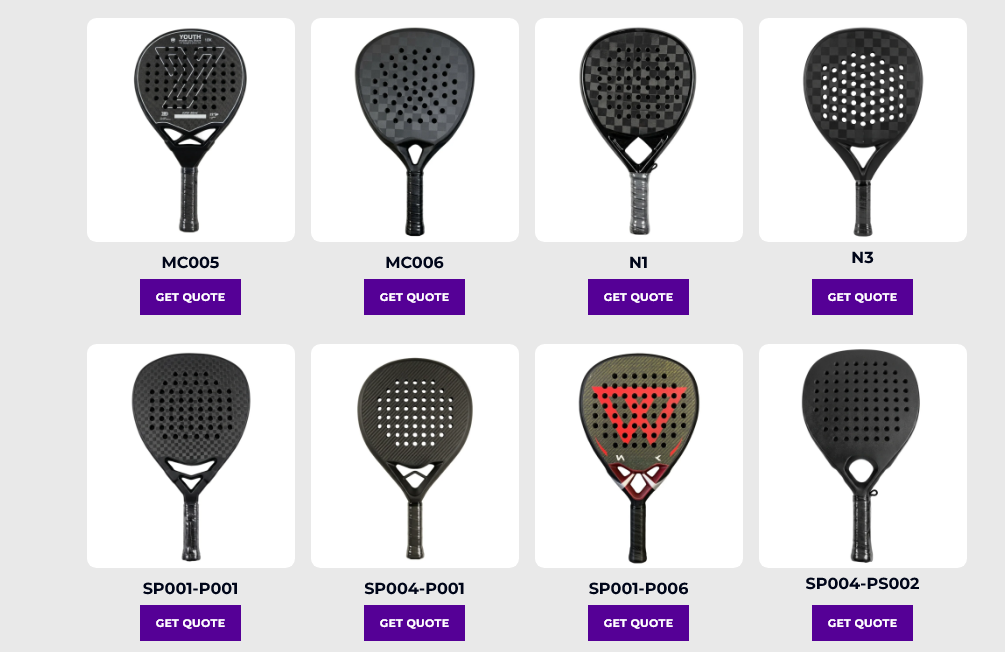
Padelico manufactures padel rackets in China for brands, clubs and distributors. Its factory catalogue lists MC005, MC006, N1 and N3, among other models. The codes identify available starting points for an OEM discussion. Request the build sheet for the specific model and configuration under consideration, then use the same inspection and court trial to compare samples. Confirm the shape, face and frame materials, core, finished measurements, and what comes fitted on the unit. Padelico custom racket collection
A club replacing its lesson fleet can begin with its current racket. Ask coaches which shots learners struggle to prepare for and whether the grip is easy to replace. Measure a familiar racket in its playing configuration and share those details with the manufacturer. Give the new sample to several coaches and players before approving the model. A replacement fleet should handle in a way staff can teach with and maintain across repeated sessions.
A retailer looking to stock two models can set a different brief for each. The first might serve recreational players who want easy preparation and controlled depth on short strokes. The second might serve regular players who prefer clearer feedback and a steadier response against pace. Have both models play the same drills. Then ask the sales team to explain the difference in a sentence using what the trial showed. If the descriptions come out nearly identical, reconsider whether the two products serve distinct needs.
For either project, confirm the order quantity by model, construction and artwork. Padelico’s custom program lists a 100-racket minimum. How that minimum applies to a proposed split depends on the project details. Confirm it alongside the sample scope and the finished specification before planning inventory. The minimum is listed in the custom padel racket specifications.
Frequently Asked Questions
How can I tell if a padel racket is good for a beginner?
Try a racket you can position easily for backhand blocks and use comfortably on short returns. A round shape, low to medium balance and a softer response make a sensible starting combination. Play several lobs and controlled volleys before buying. If you can repeat the depth and recover comfortably between shots, the racket is likely a better match for your current game.
Can you tell the quality of a padel racket from its weight?
Weight is one measurement. Compare it with the balance point, the intended tolerances and the configuration in which it was measured. A light racket can be well built, and a heavier racket can suit the player who prefers more mass at impact. For a batch, check individual readings against the agreed range so you can see how closely the factory reproduced the specification.
Is 18K carbon better than 3K for padel?
The numbers describe how many filaments are in a carbon-fiber bundle. Compare the fiber grade and laminate construction when those details are available, then compare the finished rackets on court. The player may prefer a more flexible face or firmer feedback depending on their swing and the shots they play most. Carbon fiber product specifications and tow sizes
How do I check a racket that has a visible crack or gap?
Photograph the area in good light and ask the supplier to inspect it. Include a wider photo showing the location and a closer one showing the detail. A split, lifted edge or opening at a bonded junction warrants assessment before the racket is returned to use. For a bulk order, record the batch or carton identification so the supplier can check whether other units show the same issue.
Can a soft EVA racket still suit an experienced player?
Yes. A softer core can suit an experienced player who likes cushioned contact or easy depth on compact strokes. The face construction and mass distribution also affect the result. Try the complete racket on both a firm block and a faster attacking shot. That shows whether the response works across the situations the player needs it for.
What should I ask for when comparing two supplier samples?
Request a build sheet for each sample, including its mold or model, face, frame, core, weight and balance. Ask whether the grip, strap and protector match the intended production order. Then use the same on-court drills and choose the sample that meets your product brief. Record the agreed tolerances and appearance standard before approving bulk production.
What does a good padel racket feel like on a slightly off-centre hit?
The handle should remain manageable and the ball should come off with enough response to make a playable return. The useful question is how much that response changes compared with centred impact. Try a few controlled feeds on each side of the centreline and compare rackets under similar conditions. A modest difference is easier to accommodate when contact varies during a rally.
Should a club test every racket on court before accepting a shipment?
Agree on the inspection plan before ordering. Some checks, such as visible assembly and weight, can be performed in a consistent setting. A club can use an agreed selection of rackets to compare handling and impact feel with its approved sample. Decide in advance how to extend the checks if a measured unit falls outside the limits or if several players notice the same difference.