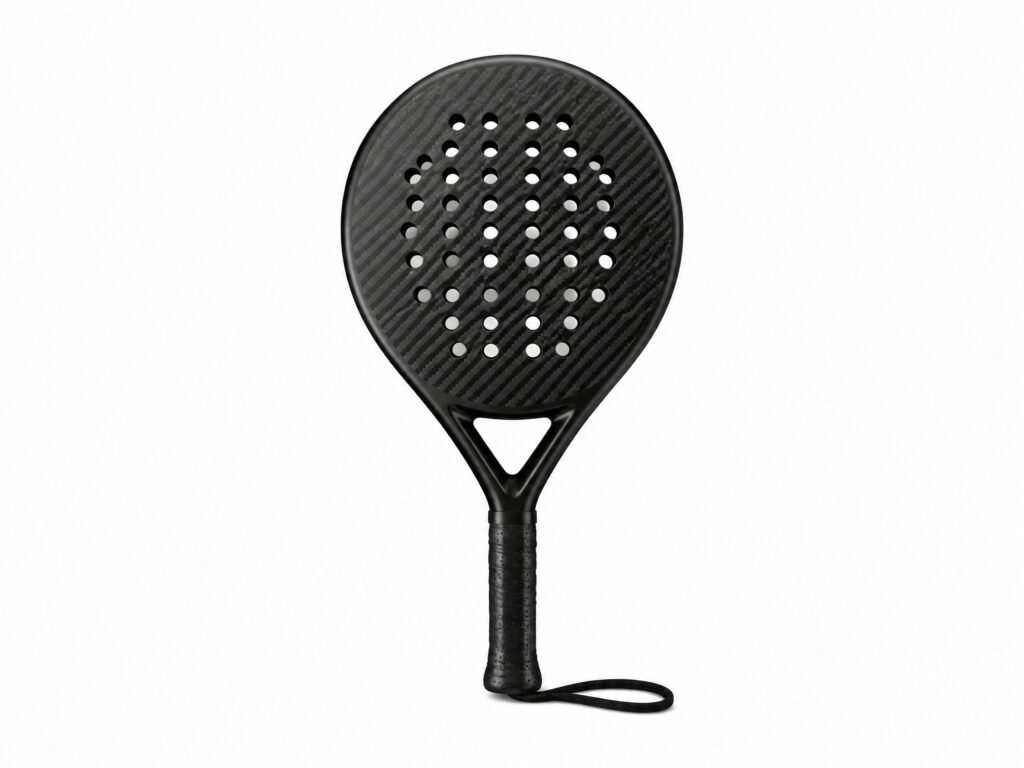
For most adult beginners, a round padel racket around 340–360 g, with a low to medium balance, a fiberglass face, and a soft EVA core, is a good first option to try. The aim is to find a racket that comes into position easily, feels comfortable on contact, and gives you enough depth on a short swing. The weight range is a starting point. The finished racket needs to suit your timing, grip, and preferred feel.
Picture a ball coming quickly toward your backhand at the net. You have time to turn the face and make a short block. A racket that you can position early gives you a chance to direct the return. At the back of the court, the demands change. You may be waiting for the ball to come off the glass, with very little room to swing. There, you want a face and core that give you a response you can judge with a compact stroke.
Those two shots tell you a great deal about a first racket. So does a lob. If you can lift the ball with a relaxed swing and repeat the depth, you have a useful indication that the racket suits the way you currently play. If every shot calls for a different adjustment, it is worth comparing another construction.
At Padelico, we manufacture padel rackets in China for brands, clubs, retailers, and distributors. This guide covers what a beginner should look for on court and how a buyer can turn those preferences into a specification for a club fleet or an entry-level retail range.
The Beginner Racket Specification at a Glance
Use this as a shortlist when you compare products or request a sample. Each feature has a practical purpose, and the last column shows what to check when you have the racket in hand.
| Feature | Starting point | What to look for during a trial |
|---|---|---|
| Head shape | Round | Useful response when contact lands a little away from the centre |
| Finished weight | Around 340–360 g for many adults | Comfortable preparation and recovery through repeated shots |
| Balance | Low to medium | A head that is easy to bring into position on both sides |
| Hitting face | Fiberglass or a suitably flexible hybrid | A response you can judge on blocks and short swings |
| Core | Soft EVA, with medium-soft worth comparing | Controlled depth at low effort and predictable feedback as pace increases |
| Grip | Secure, comfortable circumference | The ability to hold the racket lightly and change hand position without struggling |
The combinations matter. A round racket with a firm face and pronounced head weight may feel more demanding than a lighter teardrop. Two rackets marked “soft EVA” may also feel quite different because the face and frame contribute to the finished response. Read the specifications together, then use the court trial to decide which trade-offs suit you.
What a Beginner Actually Needs From a Racket
A Contact Area That Gives You Room to Learn
Early in your development, the ball will meet the face at different heights and distances from your body. You may prepare a little late, misjudge a rebound from the glass, or be forced to reach. A forgiving racket helps you keep some of those balls in play.
A practical way to assess forgiveness is to compare clean contact with contact slightly to either side of the centre. Watch how much depth you lose and notice how much the handle turns in your hand. A racket can feel excellent through the centre and lose a considerable amount of response when you miss it. For a beginner, the difference between those two shots matters more than the best shot of the session. Resistance to twisting is one of the measured properties that helps explain this difference.
Enough Response for Compact Strokes
Padel regularly asks you to play with a short swing. A low ball at the back of the court or a volley played close to the body gives you little space to build racket speed. In those situations, you want to feel that a modest movement sends the ball a useful distance.
Try both an active stroke and a passive block. A racket can be easy to use when you supply the pace and lively when it receives a hard incoming ball. If slow returns feel comfortable but blocks consistently run long, compare a sample with a slightly more defined response. Your preference should make sense across both situations.
Handling You Can Maintain Throughout a Session
A racket that feels manageable for three practice swings may feel different after a series of volleys, recoveries, and overheads. Notice whether you begin to prepare later, hold the grip more tightly, or use a bigger movement to get the same result.
Judge handling against your own play. A heavier sample may feel steady and easy to time for one person. Another player may return more balls with a lighter configuration because they can get the face into place sooner. A first racket should let you repeat your usual movements with confidence.
Round, Teardrop, or Diamond for a First Racket?
Round Shapes Are the First Option to Try
Round designs generally place their preferred contact area closer to the centre of the face. They are commonly available with a lower balance, which is helpful when you are learning to prepare the racket quickly. For a beginner who plays once a week, takes group lessons, or spends much of a session defending from the back, this is a practical place to start.
A central hitting area is useful for learning because it gives you a consistent place to aim for. You can practise directing a ball cross-court without also having to make contact high on the face. When you compare two round rackets, pay attention to their response outside that central area. The outline tells you where to begin looking. The finished construction tells you how much margin you have.
When a Teardrop Makes Sense
A manageable teardrop can suit a beginner who already strikes the ball consistently or brings experience from tennis, squash, or another racket sport. If you like a slightly more substantial feel on an overhead, a teardrop is worth comparing with a round racket of similar weight and firmness.
Keep the comparison close enough to learn something from it. If the teardrop is also heavier, firmer, and more head-heavy, you are comparing two complete rackets with several differences at once. That is useful when choosing which one to buy. It gives you less information about whether you prefer the outline itself.
When to Try a Diamond Shape
Diamond rackets often place the preferred hitting area higher on the face and carry more mass toward the head. That can appeal to a player who enjoys overheads and already gets the racket into position early. For a first purchase, try one after you have established how a manageable round or teardrop feels. Compare your blocks and defensive returns before judging the overheads.
For a club or retail buyer, the shape decision should follow the intended user. A beginner rental fleet needs to suit a wide range of players. A second model for regular league players can serve a narrower preference. Give each racket a job that a coach or sales adviser can explain in plain language.
How Much Should a Beginner Padel Racket Weigh?
Around 340–360 g is a reasonable trial range for many adults. Start with a couple of rackets within or close to that band. One may feel quick and comfortable on the first volley. Another may feel steadier when you receive more pace. Those are differences you can test. Your height, strength, previous experience, and preferred timing will influence where you settle.
Weight and Balance Answer Different Questions
Static weight tells you what the racket weighs on a scale. The balance point tells you where the racket balances along its length. Swingweight describes how strongly the racket resists rotation around an axis near the handle. These properties help explain why two rackets with the same stated weight can feel different in motion.
Take two 355 g samples as an example. If one carries more mass toward the head, it may feel more substantial through an overhead. The other may be easier to move between forehand and backhand blocks. If you are consistently late to the ball with the first sample, that extra presence through an overhead may be a poor trade for the way you play most points.
A lower balance is often a useful starting point for players who want easier preparation. A moderate balance can feel steadier to players who prefer some weight behind contact. Compare these sensations in a rally. Swinging a racket in a shop gives you a first impression, while receiving an incoming ball shows how it behaves when you have to react.
When to Try a Lighter or More Substantial Option
Try the lighter option if you have difficulty getting the face in position, especially on backhand volleys or balls played close to your body. You may find that earlier preparation makes the response easier to control. Compare it against a slightly heavier racket if it turns in your hand on routine blocks or feels unsettled when the ball arrives quickly.
If you already move the racket comfortably and prefer a steadier impact, try the upper end of the range or a little beyond it. Pay attention to the final part of the session. You want enough mass for the feel you prefer and enough freedom to recover between shots.
Compare the Rackets With Their Playing Accessories Fitted
A factory grip, wrist strap, overgrip, or edge protector can affect the configuration you play with. An overgrip puts its additional mass near your hand. A protector puts it farther away, where even a small change may be noticeable in the swing.
If you expect to use an overgrip, try the racket with a similar setup. For a club order, write down which accessories are included in the finished weight. Otherwise, a sample weighed with an edge protector and a batch weighed without one can produce different readings even when the underlying build matches.
Fiberglass, Carbon Fiber, or a Hybrid Face?
Fiberglass is worth trying first if you prefer a softer response at impact. Its flexibility can help make a beginner construction feel approachable on compact volleys and slower returns. Carbon fiber gives manufacturers options for a firmer response, and hybrid designs can combine fiberglass and carbon to target a particular feel. The result depends on the complete racket.
For a player choosing between two rackets, the useful comparison is what happens on the same shot. If a fiberglass sample gives you comfortable depth on a slow return, try a firmer sample with the same effort. You may prefer the clearer feedback of the second racket, or find that it takes more of a swing to achieve the same result. Both observations are more informative than the material name by itself.
Check Which Part of the Racket the Material Describes
The frame surrounds the racket. The face is the hitting surface. A manufacturer can build a racket with carbon in the frame and fiberglass on the face, so a listing that mentions both materials can describe a deliberate combination. Ask for the face and frame specifications separately if you are comparing quotations or preparing a retail product sheet.
This distinction is especially useful when you commission a beginner model. A request for “carbon and fiberglass” leaves the manufacturer with several possible constructions. A brief that identifies a fiberglass hitting face and explains the desired flex and impact feel gives the sample team more direction. Ask which frame options can support the intended response and price.
How Much Attention Should a Beginner Pay to 3K or 12K?
The K designation refers to the number of filaments in a bundle of carbon fiber. It is one description of the material used. The grade of the fiber and how the layers are arranged also influence the finished construction. For a beginner deciding between two rackets, compare weight, balance, and impact feel before making a choice based on weave.
For a brand buyer, specify the carbon option if it is part of the agreed construction or appearance. Record what you approved on the sample so that the finished product sheet describes the racket accurately.
What Does a Soft EVA Core Do for a Beginner?
EVA is a foam used inside many padel rackets. When a ball strikes the face, the face and core deform and recover together. A softer core can contribute a cushioned sensation and an accessible response at lower swing speeds. That can be useful for a player learning to block, guide the ball low over the net, or lift it from the back of the court.
A medium-soft configuration may give a player clearer feedback when volleys become faster or swings become more assertive. The better fit depends on the rest of the construction and what the player can control consistently. The word “soft” describes part of the brief. A stiff face over a softer core can produce a different feel from a flexible face over the same foam.
If you are selecting a retail racket, test the core on a short return first, then on a firmer volley. Notice whether the ball comes away at a pace you can judge. During the lob drill, see if a similar swing produces a similar length. These comparisons are more useful for a first racket than trying to assess rebound from a single hard strike.
For a custom order, ask for two samples with the same shape, face construction, and similar finished weight and balance, with the core as the main variable. If the lighter racket also has the softer core and a different face, the group can still pick a favourite. It will be harder to tell which specification to carry into a revision.
Padelico offers EVA options in different densities and firmness levels for custom projects. Describe the finished feel you want and use a sample to confirm it for the selected construction. Explore Padelico’s OEM materials and sampling options.
Grip and Surface Finish Deserve a Short Check
Find a Grip You Can Hold Comfortably
Pick up the racket and hold it in your usual ready position. Then play a few forehand and backhand blocks. Pay attention to whether you can keep the handle secure with a relaxed hold. If it tends to move in your hand, try an alternative circumference or fit an overgrip before judging the racket again.
A handle can feel comfortable while you are standing still and awkward during quick changes. Check it once your hands are warm and you are moving. Players coming from another racket sport may also have a strong preference about handle length or the amount of space they have below their hand.
For a club fleet, grip specifications should be easy to maintain. Decide which grip comes on the racket and what the club will use when it needs replacing. A repeatable grip setup helps coaches make consistent comparisons across demo rackets and gives a returning player a familiar feel.
Choose a Surface You Can Assess on Ordinary Shots
A smooth or lightly textured face is a reasonable starting point. If you prefer a grittier finish, compare it on regular blocks and controlled volleys as well as shots where you deliberately brush the ball. A beginner still developing timing will learn more from a response they can repeat across those situations.
For a brand order, examine the finish on the approved sample. Look around the holes, edges, and areas where graphics meet the texture. Agree how the surface should look and feel before approving the production artwork. That gives the factory and your receiving team a physical reference when evaluating the order. Padelico offers surface finish and texture options through its OEM program.
Choose Around the Kind of Beginner You Are
If This Is Your First Racket Sport
Start with the round, low-to-medium balance setup and a comfortably soft response. During a trial, ask for slowly fed balls and try to send them to a consistent depth. Include several balls that you have to play from close to the body. A racket that feels easy to guide on those shots will give you a practical starting point for lessons.
If you are comparing two models, choose the one that gives you more successful ordinary returns over the session. Keep a simple note on which racket lets you prepare calmly and which one gives you a clearer sense of where the ball will go.
If You Are Moving From Tennis or Squash
You may be able to generate pace comfortably from the start. Spend part of the trial on padel-specific situations where a long swing is difficult, particularly low balls off the back glass and close-range blocks. A racket that feels familiar on a full forehand may behave differently when you have less room.
Compare a round racket with a manageable teardrop and include a soft and medium-soft feel if available. Assess the change on volleys and lobs before deciding whether the extra firmness or head presence is something you can use. A familiar sensation is helpful when it supports the strokes you will actually play.
If You Take Lessons and Play Regularly
A balanced first racket can stay useful as your game develops. Look for enough feedback to notice where you struck the ball and enough comfort to practise repeated shots. If you already block and lob confidently, include a sample with a little more definition through the face and core. See whether the change gives you better control on the shots you are learning now.
Ask your coach to feed the same drill to both rackets. A coach can observe whether you prepare earlier, strike in front more consistently, or shorten your backswing with one option. Those observations can explain a preference that is difficult to put into words on your own.
If You Are Buying for a Club or Coaching Programme
The first sample should work for the mix of players who will actually borrow it. Ask a coach, a complete beginner, and a regular recreational player to try it. Their priorities may differ. The beginner can tell you how easily they make contact. The coach can judge whether the racket is easy to teach with. The regular player can help establish whether it also suits someone who is ready for a quicker rally.
Record where opinions agree. If several players say the head feels slow at the net, check balance and compare another sample. If one player wants a firmer response while the rest prefer the current feel, that feedback may belong in the brief for a second model. It need not drive a revision to the main club racket.
How to Compare Two Beginner Padel Rackets on Court
Use the same balls, court, and drills if possible. Alternate rackets after each drill so that one gets the early, fresh part of the session and the other gets the later, more tiring part as well. The goal is to make a fair comparison you can remember afterward.
Begin With Controlled Returns
Hit several forehands and backhands at a comfortable pace. Aim for a similar target with each racket. See how much swing you need to produce useful depth. Note the contact feel when the ball meets the centre and when it lands a little to either side.
If you consistently leave the ball short with one racket, try one or two shots with a slightly fuller movement. You may find that the racket responds well but calls for more effort than you want during routine play. If a short swing sends the ball long, check whether you can reduce the pace without losing control of direction.
Test Blocks and Quick Changes at the Net
Ask your partner to feed a series of balls on both sides. Keep the movement short and return to your ready position between feeds. On each racket, notice how quickly you can present the face and how steady it feels when the incoming ball has some pace.
This is a useful test for two rackets with similar static weights. You may find that one changes direction more easily but that the other is steadier on a firm block. Decide which difference matters more in your usual sessions. A defensive player who spends time countering pace may value the steady contact. Someone still learning to prepare early may value the easier movement.
Include Lobs and Balls off the Glass
Practise a few lobs from a comfortable position and then try some after the ball comes off the back glass. Look for a repeatable flight and depth. Because the swing is often compact, this drill can show whether the racket responds predictably when you have less time to prepare.
When a lob runs short or long, observe how much you need to change the next swing. A racket with which you can make small, understandable adjustments is easier to learn with. If several lobs go wrong with both rackets, slow down the feed and compare again under conditions where you can make clean contact.
Finish With a Short Rally and Write Down the Difference
Play a short rally with each racket at the end of the session. By this point, you will have more information than the first impression from picking it up. Write down one sentence for each racket on preparation, contact, and depth control.
A useful comparison sounds like this. “Sample A was easy to position on the backhand and let me keep lobs deep with a relaxed swing. Sample B felt steady on hard blocks, but I was slower changing sides.” This tells you what you would gain and what you would give up. A general description such as “A felt better” is harder to act on, especially if you need the manufacturer to revise a sample.
Where Padelico’s Rackets Fit Into the Selection
Padelico’s published catalogue includes the MC005, MC006, N1, and N3 platforms. The catalogue groups these model codes with OEM options. To shortlist one for a beginner range, send us the playing requirements and ask for the proposed build sheet for the model you are considering. Include the shape, intended finished weight and balance, face material, core feel, and handle requirements. View Padelico’s padel racket catalogue.
For example, a retailer might ask for a round racket around 350 g with a low-to-medium balance, a fiberglass hitting face, and soft EVA. A club might use a similar starting construction but ask for a grip that is easy to replace and a finish suited to repeated handling. An OEM brief should explain the reason for those choices so the sample can be evaluated against the intended use.
You can also share a reference racket that works well for your customers. Describe the qualities you want to keep, such as easy preparation or a cushioned contact feel, and any changes you want, such as a more secure grip or a steadier response on blocks. A physical reference or measured specification helps the team suggest a compatible platform.
For a project that needs branded graphics, a different grip, or retail packaging, include those requirements before the finished sample is made. Padelico’s custom program allows discussion of materials, colours, artwork, grips, and packaging for the selected model. The dedicated customization page lists a 100-racket minimum. Provide the quantity per model and design when asking how that minimum applies to your order. View Padelico’s customization options.
How Clubs and Retailers Can Approve a Beginner Racket for Bulk Orders
Write the Brief in Terms a Sample Can Answer
“Comfortable and easy to control” is a useful objective. To turn it into a sample brief, add the target users, normal playing conditions, and expected construction. A club introducing adults to padel might specify a round shape, an approachable response on low-effort shots, a defined finished weight range, a manageable balance point, and an easily replaced grip.
A retailer might need two distinct products. The first could serve people taking their first lessons, with an emphasis on comfort and easy preparation. The second could serve players who have progressed to regular sessions and want a more defined response. The sample trials should show a difference that staff can describe to a customer holding both rackets.
If the buyer and manufacturer agree on the role of each model early, the conversation about materials becomes easier. You can decide whether a change to the face, core, weight, or balance serves the brief and avoid paying for specifications that offer little benefit to the intended player.
Agree on Finished Weight, Balance, and Their Tolerances
Record the target weight and balance of the approved sample. Ask the manufacturer how both measurements will be taken and what variation is acceptable for the proposed construction. State which accessories are fitted at the point of measurement.
This matters in a club fleet. If a player tries a demo racket and later uses a different unit of the same model, the two should feel reasonably familiar. Agreeing measurable limits gives the factory and the buyer a common way to check consistency. The same approach helps retailers publish a weight range that matches the rackets customers receive.
Balance can be specified as a distance from the butt of the handle. If you describe the target as “low balance” in the brief, add the agreed measurement once the sample is approved. That number is easier to verify during production than a broad category.
Review the Sample in Its Intended Retail Configuration
A prototype is useful for early decisions about shape, core, and balance. The final sample should have the finish, grip, wrist strap, and other agreed components that the buyer expects to receive. If an edge protector or branded packaging is part of the order, review it at this stage.
Use the approved sample and written specification together. The sample is a reference for feel, appearance, and assembly. The written brief records the materials, dimensions, tolerances, artwork, and packing requirements. If a later order changes the grip colour, finish, or core, record the change and decide whether it needs another sample.
Padelico’s OEM process includes prototype evaluation, sample refinement, and production checks covering dimensions, weight, surface finish, printing, and assembly. See Padelico’s OEM sampling and production process.
Keep the First Assortment Easy to Explain and Reorder
If the first order is for lessons or club demos, a single well-defined construction may cover most needs. It gives the coaching team one reference racket and makes it easier to compare later feedback. For retail, a second option can make sense if it serves a visibly different customer. Set out that difference in the product descriptions and sample tests.
Where the same construction will carry several graphics, share the quantities for each artwork in the quote request. Ask the factory which versions can share a production run and how the minimum applies. A clearly defined split makes it easier to plan the first order and to reproduce the models customers prefer.
How to Tell Whether Your First Racket Still Fits
As you improve, the shots you use and the feedback you prefer may change. You might start preparing earlier for volleys, hit overheads more regularly, or develop a more compact defensive swing. Those changes give you a better basis for choosing your next racket.
Keep using your current racket while it supports the shots you are learning. When you try an alternative, identify the improvement you want. A player who feels rushed at the net can compare handling. A player who wants more defined feedback on faster volleys can compare face and core feel. Someone who needs steadier contact against pace can compare how the racket behaves on blocks.
Use the same drills you used for the first purchase. A new racket should show a clear advantage in the situations that prompted the change, while remaining comfortable on the rest of the shots you play. If you prefer the response of your original racket across a full session, that is a good reason to keep it.
Frequently Asked Questions
What is the best padel racket for a complete beginner?
A round racket with low-to-medium balance, a fiberglass face, and a soft EVA core is a sensible starting point. Many adults can begin by trying rackets around 340–360 g. Use a few controlled returns and net blocks to see whether the racket feels easy to prepare and gives you a response you can repeat.
Is 360 g too heavy for a beginner?
It depends on the balance and the player. A 360 g racket with manageable weight distribution can feel comfortable to a beginner. Try it alongside a lighter racket during a series of forehand and backhand volleys. Pay attention to preparation and recovery as well as the steadiness of contact.
Can a beginner use a teardrop racket?
Yes. A teardrop with manageable weight and balance can suit someone who already makes consistent contact or prefers a more versatile feel. Compare it with a round model on lobs and defensive returns. Those shots show whether it remains approachable when you have less time to prepare.
Should I choose fiberglass or carbon for my first padel racket?
Try fiberglass if you prefer a flexible, cushioned response. A carbon or hybrid racket can also work if the finished build gives you comfortable handling and predictable depth on a compact stroke. Ask which material is used on the face and which is used in the frame when comparing product descriptions.
Is soft EVA the right choice for every beginner?
Soft EVA is a useful starting point. Some players prefer the clearer feedback of a medium-soft build, especially once they play faster volleys or strike with more confidence. Compare complete rackets under similar conditions because the face construction also contributes to the feel.
What is the best way to choose between two rackets that feel similar?
Play the same short drill with both and repeat it later in the session. Compare how early you can prepare, how often you reach the intended depth, and how stable the face feels on slightly off-centre contact. If the differences are small, consider grip comfort and which setup you can use consistently for a full session.
Which Padelico model should I request for a beginner range?
Start with the intended construction and use. Ask Padelico which catalogue platform can meet your shape, finished weight, balance, face, and EVA targets. The catalogue includes MC005, MC006, N1, and N3. Confirm the proposed specifications for the chosen model and compare the sample before approving the order. Discuss your beginner racket project with Padelico.
What is Padelico’s minimum order for a custom beginner racket?
Padelico’s custom racket program lists a 100-racket minimum. Send the quantity for each model, construction, and artwork so the team can confirm how the minimum applies to your project. Review Padelico’s custom padel racket options.