A tennis racket and a padel racket differ in shape, materials, weight, stroke mechanics, and playing purpose. Tennis rackets use a stringbed and long handle for full swings, while padel rackets use a perforated carbon surface and EVA core designed for short, controlled strokes in an enclosed court.

This comparison supports brand owners, distributors, retailers, clubs, and manufacturing partners when explaining product categories or developing both tennis and padel equipment lines.
How Do the Shapes and Structures Differ?
Tennis and padel rackets are built with entirely different construction philosophies.
Tennis Racket
- Has strings
- Larger head size
- Longer handle
- Open-frame design
- Designed for long, powerful swings
Padel Racket
- No strings
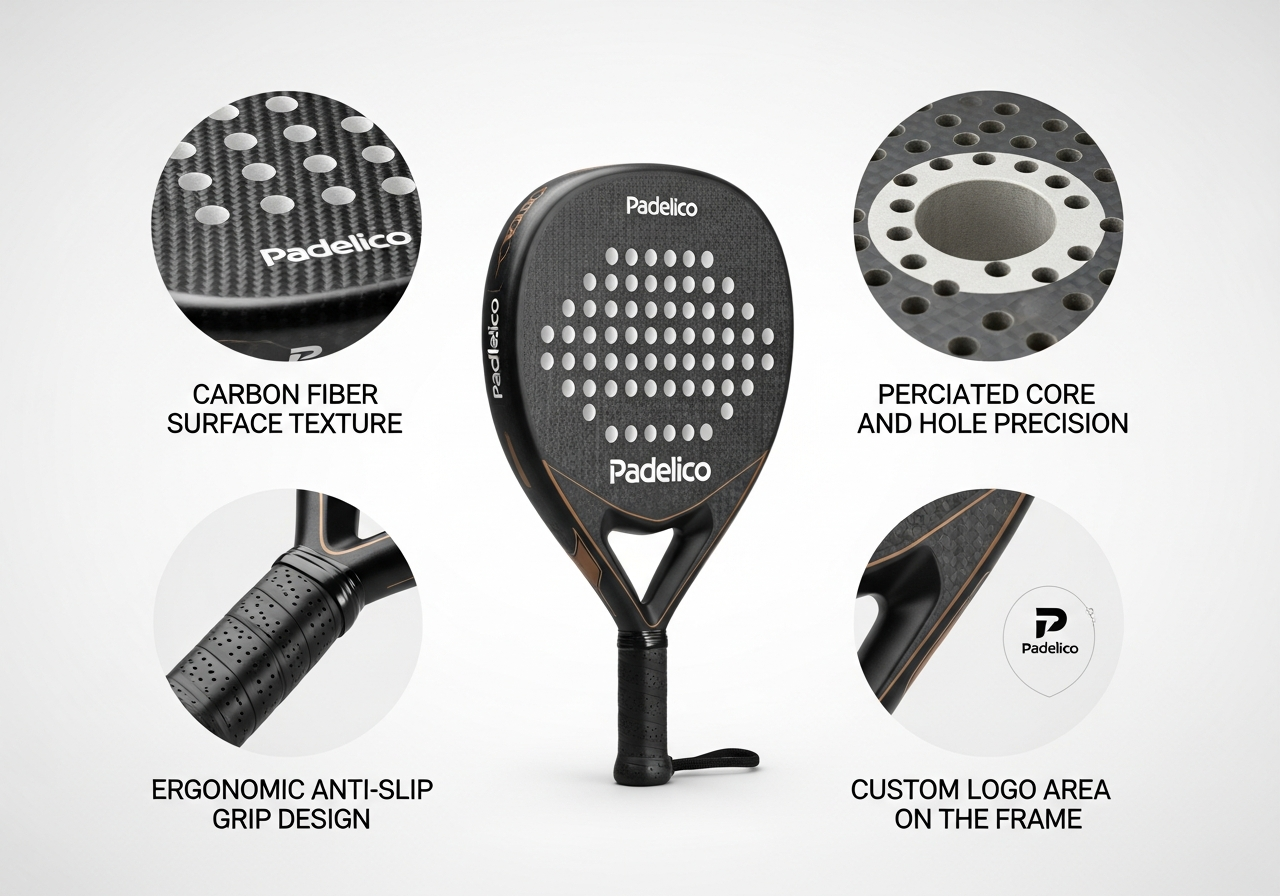
- Solid carbon face with EVA core
- Short handle
- Round/teardrop/diamond shapes
- Optimized for control, maneuverability, and wall play
Factories use CNC molds to shape padel cores, while tennis frames require carbon tubes and string-pattern drilling.
How Do Materials Differ?
Material selection changes performance expectations dramatically.
Tennis Rackets:
- Graphite, carbon, or composite frames
- Stringbed made from polyester or multifilament
- Flexible shaft variations for power/control tuning
Padel Rackets:
- Multi-layer carbon (3K / 12K / 18K / 24K) or fiberglass faces
- EVA core inside the frame
- Structural reinforcements for vibration control
- Molded one-piece design
Padel racket performance depends on EVA density and carbon stiffness, while tennis rackets rely on string tension and frame flex.
Factories calibrate padel EVA rebound and carbon layering differently than tennis string-bed engineering.
Conclusion
The difference between a tennis racket and a padel racket comes from construction, materials, weight, sweet-spot design, and intended swing mechanics. Tennis rackets rely on a stringbed and longer frame for power and spin, while padel rackets use a solid EVA–carbon structure engineered for control, maneuverability, and wall-based gameplay. With advanced factory processes—CNC molds, calibrated curing, EVA density testing, carbon orientation control, and precision drilling—padel rackets achieve performance characteristics impossible in tennis designs.
These insights support brand owners, distributors, retailers, clubs, and manufacturing partners when developing both tennis and padel product portfolios for international markets.