A padel racket may be described as “carbon” or “fiberglass,” but neither term explains its complete construction. Beneath the finish is a combination of reinforcing fibers, resin, and a foam core. How those materials are arranged determines much of the racket’s stiffness, impact response, and playing feel.
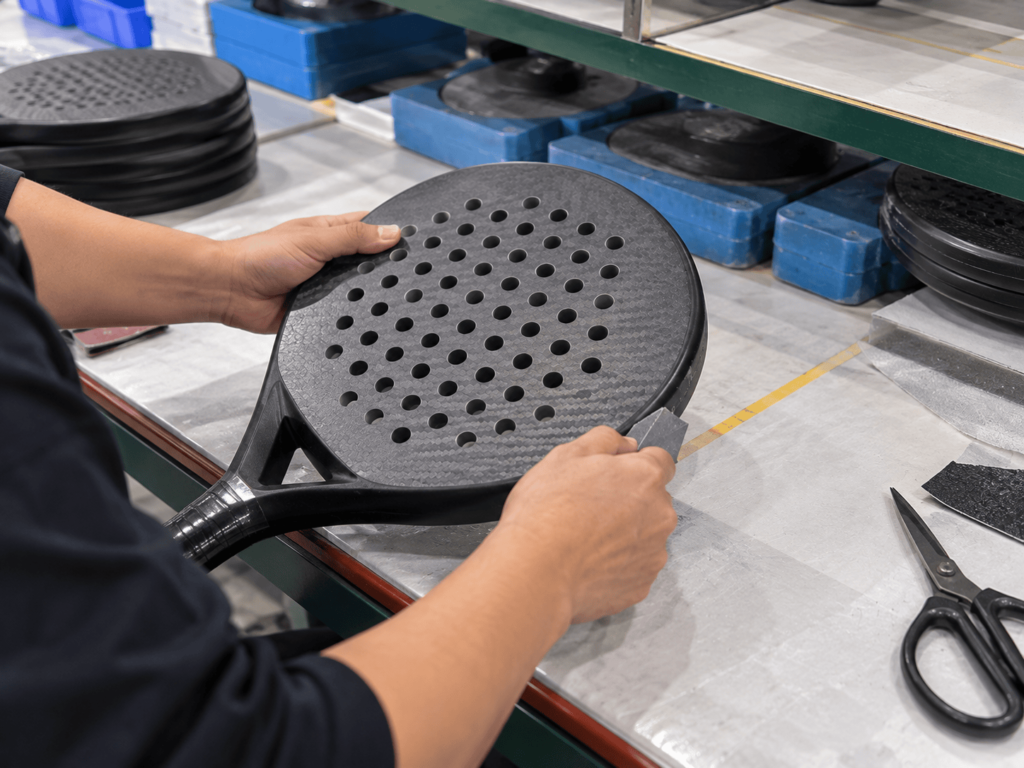
Most padel rackets use carbon fiber or fiberglass in the faces and frame, with EVA or another foam material inside the head. Epoxy resin binds the reinforcement into a composite structure. Selected constructions also incorporate aramid fibers or combine different reinforcement materials.
At Padelico, material selection forms part of the custom racket development process, alongside shape, weight, balance, and finish. For brands developing a product range, understanding how these choices interact is the starting point for a useful specification.
Understanding the Structure Before Comparing Materials
The three main structural elements of a padel racket are its frame, hitting faces, and core.
The frame surrounds and supports the head. It is commonly tubular and may contain carbon fiber, fiberglass, aramid, or hybrid reinforcement. The hitting faces sit on either side of the core, forming the surfaces that receive the ball. Inside, the foam core contributes to the racket’s compression and rebound behavior.
| Component | Common materials | Main contribution |
|---|---|---|
| Frame | Carbon fiber, fiberglass, hybrid reinforcement | Structural support and stiffness |
| Hitting faces | Carbon fiber, fiberglass, blended constructions | Face flex and impact response |
| Core | EVA foam, polyethylene foam, layered combinations | Compression, rebound, and feel |
| Resin matrix | Commonly epoxy | Binding the reinforcement into a composite |
| Exterior finish | Paint, protective coatings, textured treatments | Appearance, surface protection, and texture |
The material description should identify these components separately. A carbon face does not establish the composition of the frame, and an EVA core does not tell a buyer how the face is constructed.
Carbon Fiber: A Stiff, Lightweight Reinforcement
Carbon fiber is widely used where designers want stiffness without excessive weight. In racket faces, it can create a firm, responsive impact sensation. It is also used in frames to support a rigid structure.
However, dry carbon fabric does not become a racket face on its own. It must be combined with resin to form a rigid composite. The finished laminate therefore depends on the fibers, resin, and construction together.
This helps explain why two carbon rackets can feel different. Fiber orientation, resin content, and the lay-up schedule affect the finished structure, even when the product descriptions use the same broad material name.
What Do 3K, 12K, and 18K Mean?
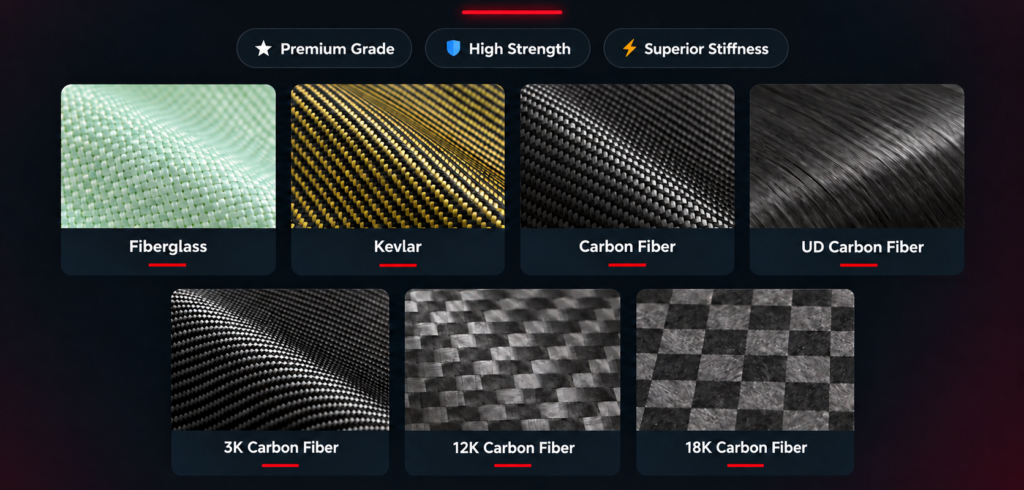
The “K” number identifies the number of thousands of individual filaments in a carbon fiber bundle, or tow.
- 3K: approximately 3,000 filaments per bundle.
- 12K: approximately 12,000 filaments per bundle.
- 18K: approximately 18,000 filaments per bundle.
It is a description of bundle size, rather than a universal quality grade.
From an engineering perspective, K count alone is insufficient to predict racket performance. A meaningful comparison also needs information about the fabric and the complete laminate. A higher number should not automatically be interpreted as greater power, better durability, or a more advanced product.
For a sourcing specification, record the agreed carbon construction and evaluate a finished sample. Our guide to carbon fabric specifications for OEM padel rackets provides a starting point for that discussion.
Fiberglass: Flexibility and a Softer Response
Fiberglass offers a more flexible alternative to carbon fiber. In a hitting face, that flexibility can produce a softer sensation and help generate ball speed with shorter swings.
That response is relevant during defensive blocks and compact exchanges, where the player has little time to accelerate the racket. At higher impact speeds, the trade-off can change: a flexible construction may feel different from a firmer face when the player commits to a full swing. Manufacturer descriptions distinguish between fiberglass’s accessible response and its lower power potential on fast shots in certain constructions.
Carbon and fiberglass can also be combined. Hybrid faces allow designers to balance flexibility and stiffness instead of relying entirely on either reinforcement.
EVA Foam: The Material Inside the Head
EVA stands for ethylene-vinyl acetate. Commonly called EVA rubber in the padel industry, it is available in formulations intended to produce different levels of firmness, comfort, and response.
Softer formulations generally create a more yielding impact sensation. Firmer formulations are used where a more solid response is wanted, including constructions intended for faster attacking strokes. The result still depends on the face surrounding the core.
“Soft” and “hard” are useful descriptions, but they should not replace sample evaluation. Control, for example, can mean absorbing an opponent’s pace, placing a slow ball accurately, or keeping a fast volley predictable. One construction may feel easier for the first task and less suitable for another.
When discussing a core specification, it is useful to distinguish three properties:
- Density: mass per unit volume.
- Hardness: resistance to indentation under a specified test.
- Rebound behavior: how the material responds after compression.
These describe different aspects of the material. For procurement, a hardness value is most useful when its test method and conditions are also identified.
Why Use a Multilayer Core?
A multilayer core combines materials or formulations with different properties. Published racket technologies use layers of different densities to target easier ball exit on slower shots while preserving a firmer response for attacking play.
Padelico offers EVA density and hardness options as part of its custom padel racket process. The appropriate specification depends on the intended player and the rest of the racket’s construction.
Polyethylene Foam and Alternative Cores
Polyethylene, or PE, is another material used in padel racket cores. EVA–PE combinations also exist, giving manufacturers additional ways to adjust internal construction.
The terminology deserves attention. “Foam” describes a cellular material structure; it does not identify a single polymer. An “EVA versus foam” comparison is therefore incomplete unless the second material is specified.
For a clear product brief, identify the core material, its construction, and the intended response. That is more informative than a generic “soft foam” label.
Epoxy Resin: Essential to the Composite
The visible weave receives most of the attention, but resin is essential to the racket’s structure. Epoxy binds the reinforcing fibers into a composite and contributes to the integrity of the finished assembly.
Processing is equally important. In compression-molded production, heat and pressure cure the resin and consolidate the components. Lay-up consistency and curing control influence bonding, thickness, and the repeatability of the finished product.
For a brand owner, this means that specifying a premium reinforcement is only one part of development. The approved construction also needs to be reproduced consistently in production.
Aramid Fibers and Hybrid Reinforcements
Aramid fibers are another option for selected racket structures. Their combination of strength, stiffness, and toughness makes them useful reinforcement materials, including in hybrid composites.
Those properties should be evaluated at the finished-product level. The presence of aramid alone does not establish how a racket will withstand repeated impacts or accidental contact. Its contribution depends on where it is used and how it is integrated into the laminate.
Surface Finishes: Separate from the Structural Face
A rough exterior and a carbon face describe different parts of the racket. The carbon identifies reinforcement beneath the finish; the texture describes the surface treatment.
Textured finishes can be produced using molded features or applied treatments such as silica-based coatings. Protective finishes serve another purpose by helping shield the exterior from wear and minor damage.
Padelico’s padel racket manufacturing options include different exterior finishes. During development, the appearance and surface feel should be assessed alongside the structural specification, rather than used as a substitute for it.
Choosing Materials for a Custom Padel Racket
A useful development brief starts with the intended player and the desired playing response. From there, the face, frame, and core can be considered together.
Weight and balance also need attention. Research into padel racket maneuverability identifies total mass, center of mass, and moment of inertia as relevant factors. Material names alone cannot explain how easily a racket moves through a swing.
For sample approval, compare the complete racket across defensive blocks, volleys, placement shots, and full swings. Record the specifications and acceptance criteria that matter to the product range, including weight, balance, finish, and branding.
Padelico supports custom racket projects from material selection and design through sample development and production. To discuss a new model, contact our team with your target player level, preferred playing feel, budget, and estimated quantity. These details provide a practical basis for reviewing suitable constructions.