Small manufacturing defects can become expensive after shipment. Cracks, delamination, uneven surfaces, and paint problems can lead to complaints, returns, and damaged brand reputation.
Most padel racket defects come from poor material control, incorrect layup, unstable molding, weak bonding, or inconsistent finishing. Prevention requires process control from carbon preparation and EVA positioning to pressing, curing, sanding, painting, and final inspection.
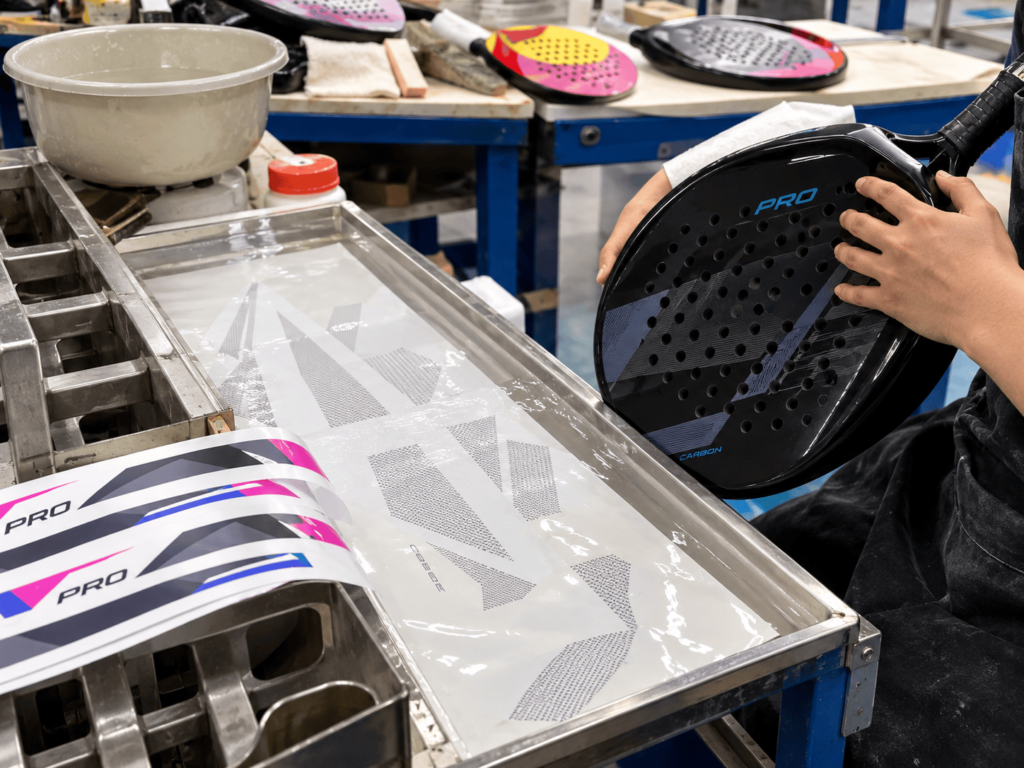
For brand owners, distributors, clubs, and professional purchasing teams, quality problems are rarely limited to one defective racket. A visible crack may point to weak reinforcement. Delamination may indicate bonding or curing problems. Surface imperfections may reveal poor finishing control. A reliable factory needs to find the root cause before mass production continues. With in-house design, R&D, production, sales, and quality-control teams, problems can be traced faster and corrective actions can be applied directly to the manufacturing process.
What Causes Cracks in Carbon Fiber Padel Rackets?
Cracks are one of the most serious racket defects because they can affect both appearance and structural strength. Some appear during production, while others develop after repeated impacts.
Common causes include insufficient reinforcement, poor carbon placement, excessive resin variation, incorrect curing, weak frame areas, and impact damage around the edge or holes.
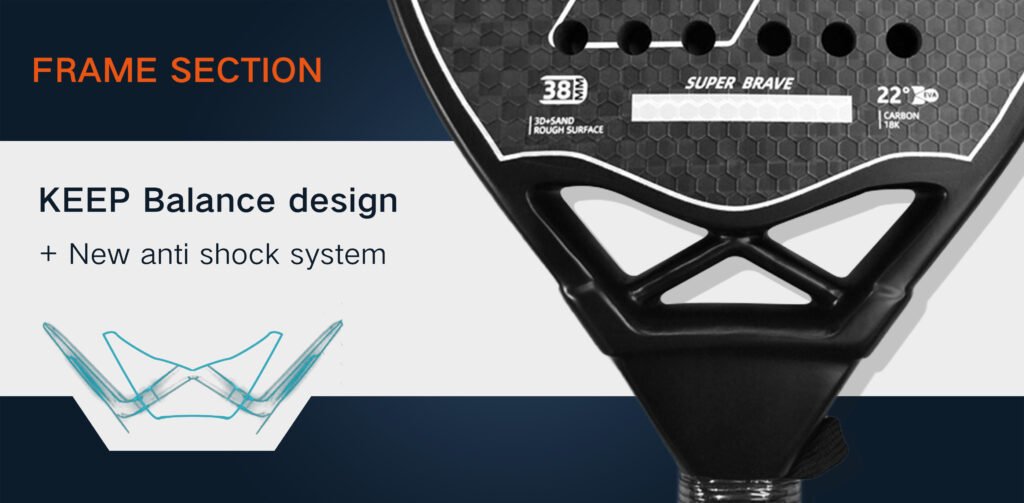
Not every crack has the same root cause.
| Crack Location | Possible Manufacturing Cause |
|---|---|
| Outer frame | Insufficient reinforcement or weak molding |
| Around holes | Drilling damage or local stress concentration |
| Throat | Structural weakness or poor carbon placement |
| Handle connection | Weak bonding or insufficient reinforcement |
| Surface face | Resin or laminate problem |
Carbon Layup Problems
Carbon fiber needs to be positioned correctly before molding.
If layers move, wrinkle, overlap incorrectly, or leave weak areas, the finished racket may have uneven structural strength.
Insufficient Reinforcement
High-stress areas require additional support.
Adding carbon everywhere is not the solution because excessive material increases weight and changes balance. Reinforcement should be placed strategically.
Poor Curing Control
Incorrect temperature, pressure, or curing time can reduce composite strength.
A racket may look normal after production but fail earlier during actual play.
Drilling Damage
Padel rackets require multiple holes through the hitting surface. Poor drilling tools, incorrect speed, or inaccurate positioning can create small cracks around hole edges.
These small defects may grow after repeated ball impacts.
A professional factory should therefore inspect both the external surface and critical structural areas after molding and drilling.
Why Does Delamination Happen in Padel Rackets?
Delamination occurs when layers inside the racket begin separating from each other. The surface may appear raised, hollow, soft, or unstable.
The main causes include poor bonding, contamination, insufficient resin, trapped air, incorrect pressure, and incomplete curing.
A carbon fiber racket is a laminated structure.
Different layers need to bond correctly with:
- Carbon fabric
- Resin
- EVA core
- Reinforcement layers
- Frame structure
If adhesion between these layers is weak, separation can occur.
Surface Contamination
Dust, oil, moisture, or foreign particles can reduce bonding quality.
This is why material preparation and workplace cleanliness matter.
Incorrect Resin Control
Too little resin may create weak bonding.
Too much resin can increase weight and create inconsistent structure.
The goal is controlled resin distribution, not simply more resin.
Trapped Air
Air pockets between layers can become weak points.
Under repeated impact, these areas may begin to separate.
Inconsistent Pressure
During molding, pressure needs to remain stable enough to compress layers and maintain contact.
If pressure distribution is uneven, some sections may bond correctly while others remain weak.
For large orders, delamination risk is especially important because defects may not always be obvious immediately after production.
A strong quality system focuses on preventing the problem during lamination and molding rather than relying only on final inspection.
What Surface Imperfections Commonly Appear on Padel Rackets?
Surface defects may not always reduce structural strength, but they can quickly make a premium racket look cheap.
Common issues include pinholes, bubbles, uneven carbon patterns, sanding marks, paint defects, rough edges, inconsistent textures, and poorly finished holes.
Typical surface problems include:
| Defect | Possible Cause |
|---|---|
| Pinholes | Air trapped in resin or coating |
| Bubbles | Poor coating or curing |
| Uneven Carbon Weave | Carbon movement during layup |
| Sanding Marks | Poor finishing technique |
| Paint Runs | Incorrect coating amount |
| Color Difference | Unstable paint control |
| Rough Hole Edges | Poor drilling or finishing |
| Uneven 3D Texture | Mold or coating inconsistency |
Surface defects matter because appearance is part of perceived product quality.
A premium carbon racket with visible pinholes or misaligned carbon fabric creates immediate customer doubt, even when structural performance remains acceptable.
This is especially important for exposed carbon finishes.
3K, 12K, 18K, and 24K carbon surfaces make weave quality highly visible. Misalignment, resin marks, or inconsistent gloss levels are easier to notice.
A professional factory should inspect appearance under controlled lighting before packaging.
Why Do Paint and Logo Defects Occur?
Graphics are often one of the first things customers notice. Poor logo position, uneven color, peeling paint, or printing defects can damage the entire product presentation.
These problems usually result from poor surface preparation, incorrect coating thickness, weak adhesion, unstable curing, or inaccurate printing processes.
Before painting, the racket surface needs proper preparation.
Dust, grease, sanding residue, or uneven surfaces can reduce coating adhesion.
Common visual defects include:
- Logo misalignment
- Color inconsistency
- Paint peeling
- Uneven gloss
- Overspray
- Scratches
- Dust trapped under coating
- Uneven matte finish
Matte Finishes
Matte coatings require consistent application. Uneven coating thickness can create patchy areas.
Glossy Finishes
Glossy surfaces show defects easily because reflections make small imperfections more visible.
3D and Sandy Textures
Texture density should remain consistent across the hitting surface. Poor application can create sections that feel noticeably different.
For customized brand products, graphics should be checked against approved artwork before mass production begins.
An in-house design team can also help ensure files are prepared correctly for the manufacturing process.
How Can Incorrect Molding Create Quality Problems?
Molding is one of the most important stages in padel racket production. Small process errors can affect shape, stiffness, weight, bonding, and durability.
Poor control of temperature, pressure, mold alignment, or curing time can create defects that are difficult to correct later.
Important molding variables include:
| Process Variable | Possible Problem if Uncontrolled |
|---|---|
| Temperature | Incomplete or excessive curing |
| Pressure | Voids or poor bonding |
| Mold Alignment | Incorrect racket geometry |
| Curing Time | Weak composite structure |
| Material Position | Uneven thickness or balance |
Temperature
Too low a temperature may prevent proper curing.
Too high a temperature can damage materials or affect resin behavior.
Pressure
Insufficient pressure can leave voids.
Excessive or uneven pressure can move materials or distort the structure.
Mold Alignment
Poor alignment may create asymmetric rackets or inconsistent frame thickness.
Material Placement
Carbon and EVA need to stay in the intended position during molding.
If materials move, racket balance and structural consistency can change.
A professional factory should record and control key molding parameters rather than relying entirely on operator experience.
How Can EVA Core Problems Affect Racket Quality?
The EVA core strongly influences touch, rebound, comfort, and structure. Core defects can create inconsistent playing feel even when the exterior looks perfect.
Common EVA-related problems include uneven thickness, incorrect density, poor positioning, deformation, and weak bonding with surrounding layers.
Possible EVA problems include:
| EVA Problem | Result |
|---|---|
| Uneven Thickness | Inconsistent response |
| Wrong Density | Incorrect hardness |
| Poor Positioning | Balance changes |
| Deformation | Irregular surface |
| Weak Bonding | Delamination risk |
For brands producing several racket categories, EVA identification is especially important.
Soft, medium, and hard EVA should not be mixed accidentally during production.
Material storage, labeling, cutting, and production records need clear controls.
A control-focused model may require soft or medium EVA, while an attacking model may require a firmer core.
Mixing these specifications can create products that look identical but play completely differently.
In-house R&D and production coordination helps reduce this risk because the approved sample specification can be communicated directly to manufacturing teams.
Why Do Weight and Balance Variations Happen?
A racket can pass visual inspection and still disappoint customers when weight or balance varies too much between units.
Variations can result from resin amount, carbon placement, EVA differences, paint, edge protection, grip components, and finishing materials.
Finished weight should be controlled within an agreed range.
Balance should also be checked because two rackets with similar weight can feel very different.
| Variation Source | Possible Effect |
|---|---|
| Extra Resin | Higher weight |
| Carbon Placement | Balance shift |
| EVA Variation | Weight and feel change |
| Paint Thickness | Additional weight |
| Frame Protection | Head-heavy feeling |
| Grip Components | Balance adjustment |
For premium racket collections, stable weight and balance help customers trust repeat purchases.
A sample may perform perfectly, but mass production needs to reproduce the same characteristics.
This requires measurements during final inspection.
For custom projects, weight and balance tolerances should be defined before production begins rather than discussed only after problems appear.
How Can Factories Prevent Defects Before Mass Production?
Final inspection alone cannot guarantee quality. Defect prevention needs to begin with materials and continue through every production stage.
A reliable factory uses incoming inspection, process controls, sample approval, production records, in-process checks, and final testing to reduce quality risks.
A practical quality system can include:
Incoming Material Inspection
Carbon, EVA, resin, paint, grips, and accessories should match approved specifications.
First Article Approval
The first production units should be checked before the full batch continues.
In-Process Inspection
Problems should be found during layup, molding, drilling, and finishing.
Final Inspection
Finished rackets should be checked for:
- Weight
- Balance
- Surface appearance
- Hole quality
- Frame condition
- Graphics
- Grip assembly
- Packaging
Root-Cause Analysis
When defects appear, replacing one racket is not enough.
The production team should identify why the problem occurred and prevent the same issue from repeating.
For example, repeated cracks around holes may require changes to drilling parameters or reinforcement rather than additional final inspection.
This approach reduces rework, delays, and customer complaints.
What Should Buyers Ask About a Factory's Quality-Control System?
Supplier selection should include more than product photos, certificates, and quotations.
Technical questions can reveal whether a factory truly understands defect prevention or only reacts after problems occur.
Important questions include:
| Question | What It Reveals |
|---|---|
| Which processes are completed in-house? | Level of production control |
| How is carbon layup inspected? | Structural consistency |
| How are molding parameters controlled? | Composite quality |
| How is EVA identified? | Material management |
| How are weight and balance checked? | Performance consistency |
| How are surface defects classified? | Appearance standards |
| What happens when defects repeat? | Root-cause capability |
| How are repeat orders controlled? | Long-term consistency |
A supplier should be able to explain these processes clearly.
Vague answers such as "quality is always good" do not provide enough confidence for serious customized projects.
Factories with experience supporting established brands through OEM and ODM cooperation generally understand that quality discussions need measurable standards and corrective actions.
Fast communication also matters.
When a defect appears close to a launch date, slow communication can turn a manageable issue into a shipment delay.
Why Is Direct Factory Cooperation Important When Defects Occur?
Quality problems become more difficult when technical information must pass through several intermediaries.
Direct factory cooperation allows buyers, sales teams, engineers, production managers, and quality-control staff to communicate faster when defects need investigation.
A professional factory should be able to move through a clear corrective process:
- Identify the defect.
- Isolate affected production.
- Determine the root cause.
- Adjust materials or process parameters.
- Produce verification samples.
- Confirm the solution.
- Resume controlled production.
Padelico operates as a custom carbon fiber racket factory with in-house design, R&D, production, sales, and quality-control coordination.
This factory-direct structure helps technical feedback reach the responsible teams faster.
OEM and ODM experience with established brands also creates familiarity with sample approval, production tolerances, appearance standards, delivery schedules, and corrective actions.
For purchasing teams, the goal should not be finding a supplier that claims defects never happen.
The stronger manufacturing partner is the factory that controls risk, detects problems early, communicates clearly, and solves root causes before products reach the market.
Conclusion
Cracks, delamination, surface imperfections, weight variation, and finishing defects usually come from weak material or process control. Strong factories prevent these problems through disciplined layup, molding, finishing, inspection, and root-cause management. Send an inquiry and leave contact details to discuss customized carbon fiber padel racket manufacturing and quality-control requirements.