A new carbon racket mold often fails at the design stage, not the production stage. Poor frame proportion, weak triangle structure, and slow revision cycles can turn a promising idea into a costly delay.
A successful new carbon racket mold starts with clear shape planning, accurate CAD development, repeated structural review, and professional mold manufacturing. The most critical areas are the frame and triangle section because they affect appearance, balance, strength, and brand identity.
A new mold is more than a tooling project. It is the starting point of product positioning, performance control, brand differentiation, and long-term manufacturing efficiency. That is why every stage matters.
Why Is a New Carbon Racket Mold So Important?
A weak mold creates problems long before the first racket reaches the market. Bad proportions can damage visual appeal. Inaccurate dimensions can affect balance and feel. Poor structural planning can lead to instability in later production.
A new carbon racket mold defines the shape, dimensions, and structural logic of the final racket. It directly affects product consistency, appearance, playing performance, and production stability. A well-made mold also reduces defects, shortens development time, and supports future customization.
Mold Development Is Product Development
In the racket industry, mold creation is not just a technical step. It is closely tied to market strategy. A racket shape influences product positioning. A longer grip may fit one player group, while a different frame profile may fit another. Small dimensional changes often lead to major differences in weight distribution and user experience.
For brands, distributors, purchasing managers, and club-related buyers, a custom mold is also a way to build originality. Off-the-shelf shapes are easy to copy. A dedicated mold creates a clearer product identity and gives stronger control over future product lines.
Padelico handles this process as a factory with a complete supply chain, covering mold design, mold manufacturing, and racket production. This is important because communication becomes faster and technical decisions become more accurate when design and production stay connected. A separate trading process often slows problem solving. A factory-based system allows drawings, revisions, mold testing, and production planning to move in one line.
Another key point is confidentiality. New mold projects often involve exclusive commercial plans, fresh visual language, or unique triangle design concepts. NDA support helps protect that value during development.
Which Parts of a New Racket Mold Are the Hardest to Design?
Many mold projects look simple on paper, but the hardest work usually sits in two areas: the frame and the triangle. These parts decide both visual harmony and structural logic.
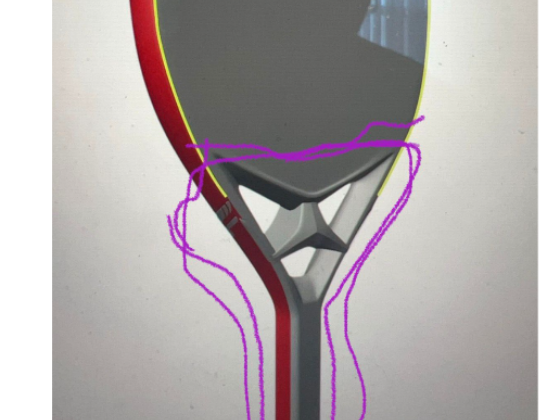
The frame and triangle area are the most difficult parts of a new carbon racket mold. The frame affects overall proportion, balance, and appearance. The triangle area affects originality, structural connection, and brand recognition.
The Frame Controls Harmony and Balance
The frame is not only an outer line. It shapes the whole visual proportion of the racket. The head shape, grip length, width, and curve transitions must work together. If one element looks right alone but not in relation to the others, the racket may appear awkward or unbalanced.
The frame also affects performance planning. Shape changes can influence sweet spot distribution, aerodynamic feel, and material layout in later production. That is why experienced mold designers pay close attention to ratio and transition.
The Triangle Area Controls Identity
The triangle area is often where originality becomes visible. This section is closely linked to brand style, aesthetic recognition, and structural detail. It is also one of the easiest places for a design to become too ordinary or too complicated.
A sketch, reference picture, or even a rough idea can help move this stage faster. Once a concept direction is clear, experienced designers can convert that concept into workable CAD geometry. This saves time and reduces misunderstandings in early communication.
At Padelico, the mold department includes dedicated designers with rich experience in racket development. That makes it easier to turn a visual idea into a manufacturable mold plan while keeping the original design intention.
How Does the Mold Design Process Usually Work?
Many buyers worry that a custom mold project will become messy, slow, or hard to control. In reality, a structured process makes the project much easier to manage.
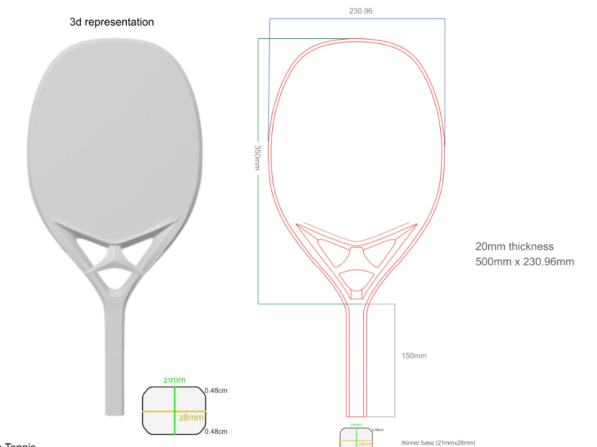
A standard carbon racket mold process includes concept confirmation, CAD drawing, dimensional review, 3D visualization, revision rounds, final approval, and then mold manufacturing. Each stage helps reduce later production risk.
Step 1: Define the Basic Concept
The first stage normally covers racket shape, grip length, frame profile, and triangle direction. At this point, even a simple draft can be useful. A complete technical file is not always necessary in the beginning.
Step 2: Build the CAD Structure
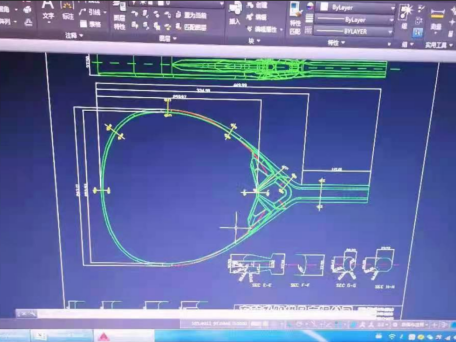
New mold development requires CAD work. This is the stage where the concept becomes a real engineering file. Compared with common document work, CAD development needs more time and precision. Every curve, angle, and dimension must be checked carefully.
Step 3: Review 3D Mold Images and Size Charts
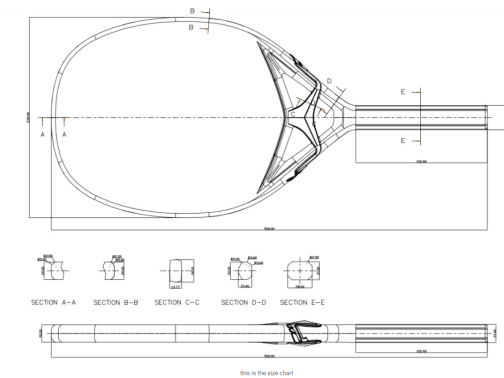
After CAD development, 3D mold images and dimensional charts help show how the mold will look. This stage is very valuable because changes are still possible. Problems found early are much cheaper to solve.
Step 4: Revise Until Final Confirmation
If shape or size needs adjustment, the designer usually needs to redraw the mold file. That is why patience matters in mold development. Revision is not a sign of failure. It is a normal part of building the right final result.
A careful process is often the difference between a mold that merely exists and a mold that supports stable, scalable racket production.
Why Do Patience and Technical Communication Matter So Much?
Some projects fail because the idea is weak. Many more fail because the communication process breaks down. New mold development needs detail, patience, and repeated checking.
Patience matters because even a small change in shape or dimension can require a new CAD drawing. Strong technical communication reduces errors, protects product intent, and helps avoid delays later in production.
Detail-Driven Projects Need a Different Approach
Some clients pay extreme attention to dimensions, symmetry, or structural transitions. That level of detail is common in premium racket development. In such cases, every millimeter matters. A slight adjustment around the frame or triangle area may affect appearance, drilling layout, or future material placement.
This is where an experienced factory-side mold team creates real value. A patient design team can study the requirement, identify possible issues, and suggest practical solutions instead of simply copying a rough concept without analysis.
That approach is especially useful for buyers who understand the market well but may not have deep mold engineering knowledge. Strong technical support helps bridge that gap. It also prevents repeated back-and-forth between separate suppliers.
Padelico’s mold design and manufacturing system supports this type of detailed development. Because mold design, mold production, and racket production are connected in one supply chain, technical questions can be solved more directly. That improves efficiency, especially when strict dimension control is required.
What Happens After the Design Is Confirmed?
Many people think the hard part ends after the drawing is approved. In fact, the manufacturing stage is just as important because material quality and machining accuracy affect mold life and production stability.
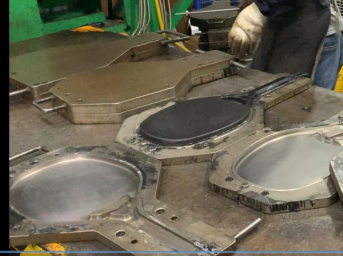
After final design approval, the mold enters manufacturing. High-quality steel, accurate machining, and reliable maintenance support are essential for mold durability, dimensional stability, and long-term production performance.
Mold Material Quality Affects Long-Term Value
A high-grade steel choice helps the mold stay stable during use. Tough steel with good anti-deformation performance supports longer service life and better consistency. This matters even more in repeated production runs, where tooling fatigue can slowly affect final product quality.
Padelico uses 708 steel for mold production. This material helps improve toughness, reduce curling-edge risk, and extend mold lifespan. That creates practical value for brands and buyers planning long-term production instead of short trial orders.
Maintenance Support Reduces Future Risk
Another overlooked point is mold repair and maintenance. Even a good mold may need servicing after long use or unexpected issues. Fast support reduces downtime and protects production schedules. Free repair or maintenance support adds another layer of cost control and reliability.
For companies building a serious racket line, this is not a minor detail. It is part of total project security.
How Can a Factory Partner Make New Mold Development Easier?
A custom racket mold project becomes much smoother when design, engineering, and production stay connected. That reduces communication loss and helps turn ideas into finished products faster.
A factory partner with in-house design, R&D, mold making, and racket production offers better coordination, stronger quality control, and faster problem solving than a fragmented sourcing model.
One Connected System Creates Better Results
A factory with its own design department can review ideas from both an aesthetic and manufacturing angle. An in-house R&D team can evaluate whether a concept is practical. An internal sales and technical team can keep communication clear through each revision stage. Mold makers can then produce tooling based on the latest confirmed structure without unnecessary information loss.
This integrated method is especially helpful for brand owners, distributors, purchasing teams, and factories seeking a reliable development partner for carbon fiber rackets. It supports faster response, stronger confidentiality control, and smoother movement from concept to mass production.
Padelico is positioned as a comprehensive manufacturer, not only a product source. Mold design, mold manufacturing, and racket production are all part of the same complete chain. That structure helps support custom development projects with better consistency and better control.
Conclusion
A strong carbon racket mold begins with smart design and ends with reliable manufacturing. Padelico supports custom mold development with in-house design, R&D, production, and OEM/ODM experience for serious racket projects.