Many padel racket projects look strong at the sample stage but lose control in mass production. The real risk is not one bad racket. The real risk is batch variation that damages trust, increases complaints, and weakens repeat orders.
Consistent padel racket quality depends on a full factory control system covering incoming materials, in-process inspection, final QC, and batch-level tracking of weight, balance, structure, and surface finish.

In carbon padel, quality problems rarely come from one single point. Market complaints usually show a pattern: one batch feels too hard, some rackets arrive too head-heavy, some surfaces chip too early, and a few pieces develop cracks much sooner than expected. This is why serious production control cannot depend on final inspection alone. A reliable factory system must control the full process from raw materials to finished goods.
Why Is Consistent Quality So Important in Padel Racket Mass Production?
Many brands focus heavily on sample approval, but the market judges the real product by consistency across the whole order. A good sample means very little if the mass production batch performs differently.
Consistent quality protects brand reputation, reduces after-sales friction, and makes the product line easier to scale across markets and customer groups.

The padel market is very sensitive to visible and repeatable defects. Based on the complaint patterns in the insights, recurring issues include early cracking, chipped paint, edge damage, unstable balance, unusual vibration, and mismatched weight. These issues create a much bigger problem than one single return. They create a feeling that the brand cannot control production.
This matters even more in carbon padel because users often connect performance directly to manufacturing quality. If one racket feels comfortable and stable while another piece from the same order feels too stiff, too heavy at the top, or rough in finish quality, confidence drops quickly. The same happens when paint chips early on dark surfaces, when edge protectors loosen, or when the sweet spot response feels different from one batch to another.
For this reason, consistent quality is not only a factory issue. It is a brand growth issue. A factory that can keep weight, balance, hardness feel, finish quality, and structural reliability inside controlled limits creates a much stronger foundation for private collections, OEM development, and long-term product expansion.
Quality Control Systems for Consistent Padel Racket Mass Production?
Many factories still rely too much on end-of-line inspection. That approach is too late because most serious problems start much earlier in the process.
A strong quality control system should begin before production starts and continue through raw material control, process control, finished goods inspection, and batch traceability.
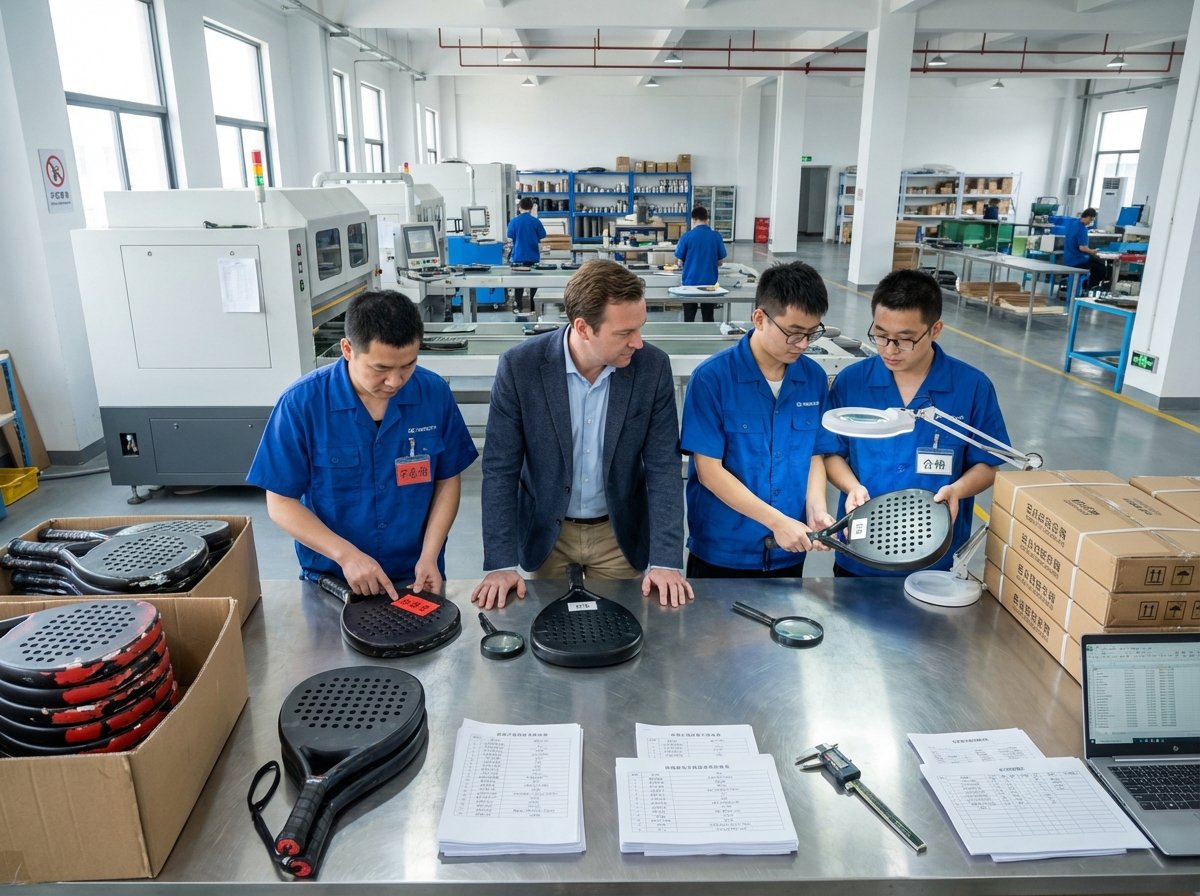
A complete factory QC system should be built in layers. The first layer is specification control. Every project should define clear limits for weight, balance, surface appearance, hardness target, drilling consistency, and cosmetic standards before production begins. Without that, inspection teams only judge by feeling, and results become inconsistent.
The second layer is material verification. Carbon cloth, resin, EVA, paint, adhesives, edge protectors, handle parts, and packaging materials all affect the final product. If incoming material variation is not controlled, the finished racket will vary even when the process looks correct.
The third layer is in-process control. This is where most mass production stability is won or lost. Layup sequence, resin application, molding conditions, trimming quality, drilling precision, painting consistency, and curing stability all need checkpoints.
The fourth layer is final QC. This stage confirms that the finished racket meets the approved standard, but it should never be the only control point. Final QC must verify both appearance and function.
The fifth layer is traceability. If a problem appears in the market, the factory should be able to trace the batch, the process window, the material lot, and the operator group. Without traceability, the same mistake often repeats across future orders.
A real factory with in-house design, R&D, and sales teams can build stronger QC systems because technical development, commercial requirements, and production control can be aligned from the start.
How Factories Reduce Variation in Weight, Balance and Surface Finish Across Large Orders?
Variation in large orders usually does not come from one dramatic error. It comes from many small shifts that accumulate during production.
Factories reduce variation by controlling material consistency, molding repeatability, trimming precision, painting stability, and finished-goods measurement against defined ranges.
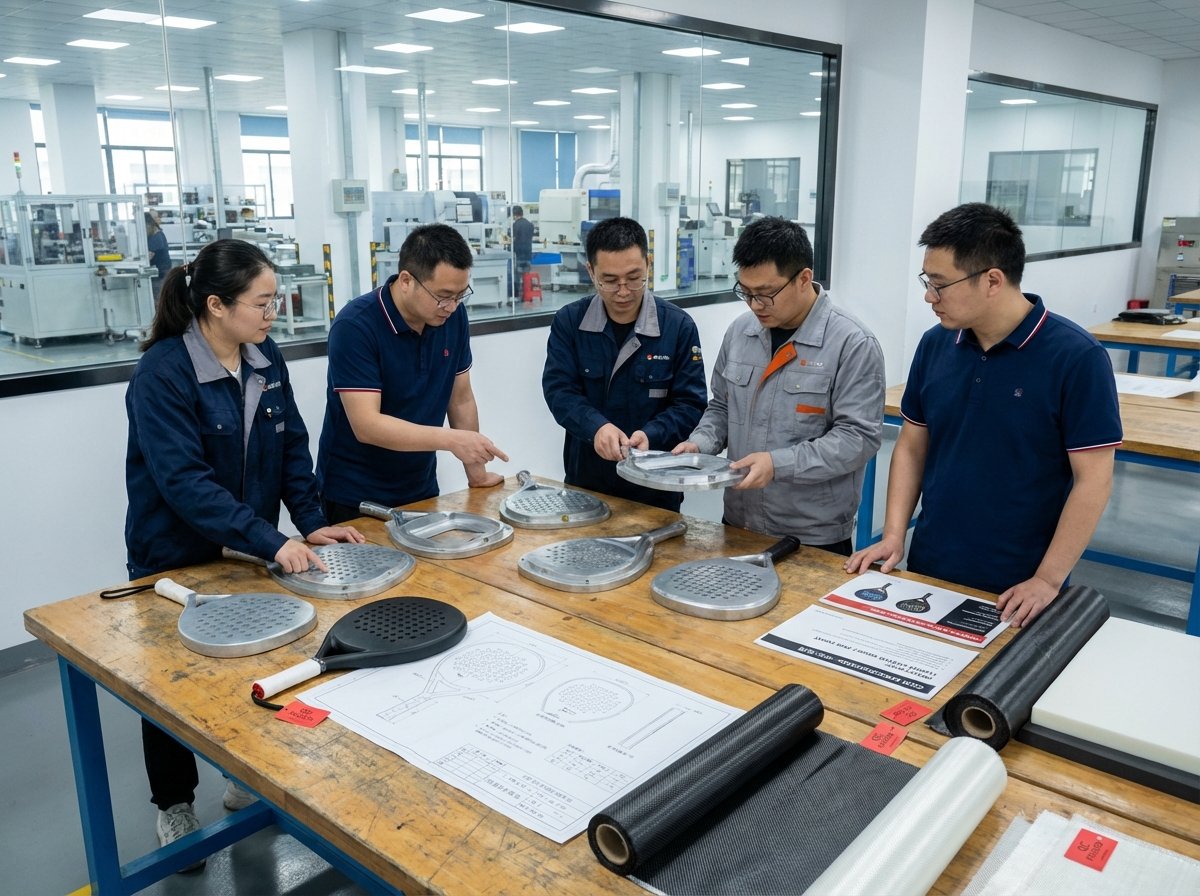
Weight variation often starts with carbon cloth cutting accuracy, resin pickup, EVA density stability, and handle assembly consistency. If each step is allowed to drift slightly, the final racket can easily move outside the target range. In the market, that becomes a serious problem because even a few grams can change swing feel, especially when paired with a balance shift.
Balance variation is even more sensitive. Many buyers still ask only about total weight, but actual player feedback often shows that balance matters more than a small static weight difference. A racket that is technically within weight range can still feel tiring if the balance point is too high. This is why a serious factory should measure not only weight, but also balance point for each production lot and key samples within each batch.
Surface finish variation usually comes from prep quality, primer adhesion, paint thickness, curing control, and edge protection detail. The insights showed that chipped paint, early flaking, and rough edge condition are repeated complaint points across many markets. These are not random cosmetic issues. They are signs that finish control is too loose.
A stronger factory system should therefore include:
Weight control
Pre-set weight windows for unfinished and finished rackets, with step-by-step checking during production.
Balance control
Defined head-light, even-balance, or head-heavy targets, measured during final assembly instead of guessed from total weight alone.
Surface finish control
Appearance standards for paint adhesion, gloss or matte consistency, edge smoothness, logo clarity, and high-risk impact areas.
This is especially important for OEM projects because the product promise often depends on feel consistency. A comfort model that becomes too head-heavy or too stiff in production can create immediate mismatch with the intended player group.
Incoming Materials, In-Process Inspection and Final QC in OEM Padel Racket Production?
Quality in OEM padel racket production is built in three linked stages. If one stage is weak, the whole order becomes unstable.
Incoming material inspection, in-process inspection, and final QC should work together as one system rather than three isolated checks.
Incoming materials inspection
This stage sets the foundation for consistency. Carbon fiber materials must be checked for spec accuracy and stable quality. EVA or core materials should be controlled for density and compression behavior. Resin and adhesive systems need stable performance. Paints and coatings should be checked for compatibility, adhesion behavior, and finish stability. Handle materials, edge protectors, and packaging parts also matter because weak accessory quality can damage the product’s overall perceived value.
This point is very important because many market complaints are not only about performance. They are also about loose edge parts, poor handle quality, low-grade accessory feel, and cosmetic disappointment. A factory that ignores these supporting materials often creates a good-looking sample but an unreliable mass-production product.
In-process inspection
This is the key stage for preventing hidden defects. Layup accuracy must be checked so reinforcement zones remain consistent. Molding pressure and curing conditions must stay stable. Drilling and trimming need precision, because poor hole distribution or weak edge finishing can increase stress concentration and later lead to cracking. Painting, coating, and protector attachment must also be checked during production, not only after everything is finished.
In-process inspection is also where structural and cosmetic risks should be separated clearly. Crack resistance and paint durability are not the same issue. Structural reliability comes from layup, resin toughness, reinforcement design, and process discipline. Cosmetic durability comes from coating system, adhesion, curing, and surface protection. A mature factory controls both tracks independently.
Final QC
Final QC should confirm overall compliance before shipment. This includes weight, balance, appearance, logo position, edge condition, drilling cleanliness, protector attachment, handle finishing, and packaging integrity. Final QC should also include random functional checks such as sound testing, pressure feel review, or vibration abnormality screening where needed.
For larger OEM orders, final QC should never be reduced to simple visual sorting. It should confirm that the product matches the approved sample standard and the defined production tolerances.
How Can a Factory Prevent Structural Problems Like Cracks, Delamination and Early Failure?
The most damaging complaints in padel are usually structural. A chipped paint area can hurt product perception, but a cracked racket destroys trust much faster.
Factories prevent structural problems by controlling layup direction, reinforcement zones, resin toughness, curing stability, drilling stress, and fatigue testing before mass production release.

The insights show repeated complaints about edge cracks, mid-surface cracks, cracks between holes, failure near the handle junction, and rackets breaking after only a few sessions. These are clear signs that structural control needs to be systematic.
A stronger factory response should include several actions:
Reinforcement in high-risk zones
The edge, throat, handle junction, and drill-hole zones should all be reviewed carefully because these are frequent failure points in real market feedback.
Resin toughness control
A brittle resin system may create a hard and crisp racket at first, but it can also increase the risk of early cracking under repeated impact or normal play.
Layup consistency
Even a good layup design can fail if layer placement is inconsistent in production. Structural repeatability matters as much as the design itself.
Fatigue and impact testing
Some defects do not appear in static inspection. They only show up after repeated use. This is why a serious factory should run simulated use tests for impact, repeated hitting, edge contact, and early-life durability.
Internal abnormality screening
Sound checks or pressure-response checks can help identify hidden delamination or weak internal bonding before shipment.
For brands building long-term collections, this type of structural prevention is one of the most important parts of factory selection.
Why Should Surface Finish and Cosmetic QC Be Controlled Separately From Structural QC?
Many factories and buyers still treat appearance defects as secondary issues. In the market, that is a mistake because cosmetic defects shape quality perception very quickly.
Surface finish QC should be managed as a separate system because cosmetic failure and structural failure come from different causes and require different solutions.

The complaint patterns in the insights are very clear. Paint chipping, flaking graphics, visible white chips on dark rackets, early wear on the edge, and decorative layer loss are repeated issues across different countries and selling channels. These may not always stop play, but they make the product look cheap and unstable.
A better cosmetic QC system should control:
Primer and topcoat adhesion
Poor bonding between layers is one of the main reasons for early paint loss.
Curing consistency
Even a good paint formula can fail if the curing process is unstable.
Edge finishing
Many visible defects start at the edge because this is where contact, wear, and trimming sensitivity are highest.
Color and contrast risk
Dark rackets with bright underlayers often show chips more obviously, so the appearance system should be planned with real-use wear in mind.
Protector and edge part attachment
Loose or uneven edge parts create both cosmetic and trust problems.
Separating cosmetic QC from structural QC helps the factory solve the right problem with the right method. It also makes communication with brand customers much clearer during development and after-sales support.
How Does Standardization Help OEM Buyers Get Better Batch Consistency?
Mass production becomes unstable when too many important details are left open to interpretation. Standardization is what turns a good sample into a repeatable production result.
OEM buyers get better batch consistency when the factory uses clear technical standards, approved sample references, and measurable acceptance limits at every main production step.
standardization for oem padel racket batch consistency
A good OEM production standard should define more than just artwork and packaging. It should include weight range, balance range, finish criteria, acceptable cosmetic level, hardness target, protector fit standard, packaging condition, and defect classification. Once these points are written clearly, factory teams can inspect objectively instead of relying on personal judgment.
This is also where in-house capabilities matter. A factory with its own design, R&D, and sales departments can turn market feedback into standardized production rules faster. If customers report that one model feels too hard, chips too visibly, or tends to crack near a specific zone, that information can be converted into revised material specs, layup changes, or QC checkpoints.
Experience with OEM and ODM projects for well-known brands is also useful here. It usually means the factory understands how to build systems, not only products. That includes documentation, sample approval control, change management, and production traceability across repeated orders.
For distributors, brand owners, and sourcing teams, this kind of standardization reduces surprises. It also makes future product line expansion easier because each new model starts from a more disciplined quality framework.
What Should Buyers Ask a Factory Before Placing a Large Padel Racket Order?
A large order should never be placed based on appearance and price alone. The safest projects begin with detailed quality discussions before production starts.
Buyers should ask about raw material control, process checkpoints, weight and balance tolerance, structural testing, cosmetic QC, and traceability before confirming mass production.
Several questions are especially important:
What are the weight and balance tolerances?
This reveals whether the factory truly controls playing feel or only controls static appearance.
How are incoming materials checked?
This shows whether consistency starts at the raw material stage or only at final assembly.
What process inspections are used during layup, molding, drilling, painting, and assembly?
This helps separate system factories from simple assembly-focused suppliers.
How are structural risks tested?
A factory should be able to explain how it checks crack resistance, reinforcement zones, impact reliability, and early-life durability.
How is cosmetic durability controlled?
Paint adhesion, edge finish, protector bonding, and packaging condition should all be covered.
Is there batch traceability?
Without traceability, recurring defects are much harder to correct.
PDK operates as a factory with in-house design, R&D, and sales teams, focused on carbon fiber rackets for padel and beach tennis. This structure supports better coordination between product development, process control, and production consistency. For OEM and ODM projects, that creates a stronger path toward stable quality, more reliable bulk production, and better product confidence in the market.
Conclusion
Consistent quality in padel racket mass production does not come from one final check. It comes from a full system that controls raw materials, process discipline, weight and balance consistency, structural reliability, and cosmetic finish across the entire order. When a factory can manage incoming inspection, in-process control, final QC, and batch traceability together, large-volume production becomes much more stable and much more suitable for long-term brand growth.
For companies planning OEM padel racket projects, the strongest approach is to work with a real factory that can combine manufacturing, design, R&D, and quality control into one connected system. That kind of production model reduces variation, lowers complaint risk, and creates a stronger foundation for repeat orders, product line expansion, and a more trusted market reputation.