Many padel brands fail after choosing the wrong factory. The real problem is not only price. It is poor quality control, weak communication, and hidden production risks that appear too late.
A reliable padel racket manufacturing partner should be checked through audit points such as quality control, production consistency, certifications, testing ability, sampling logic, and factory transparency. Strong supplier selection reduces complaint risk, protects brand reputation, and improves long-term product stability.
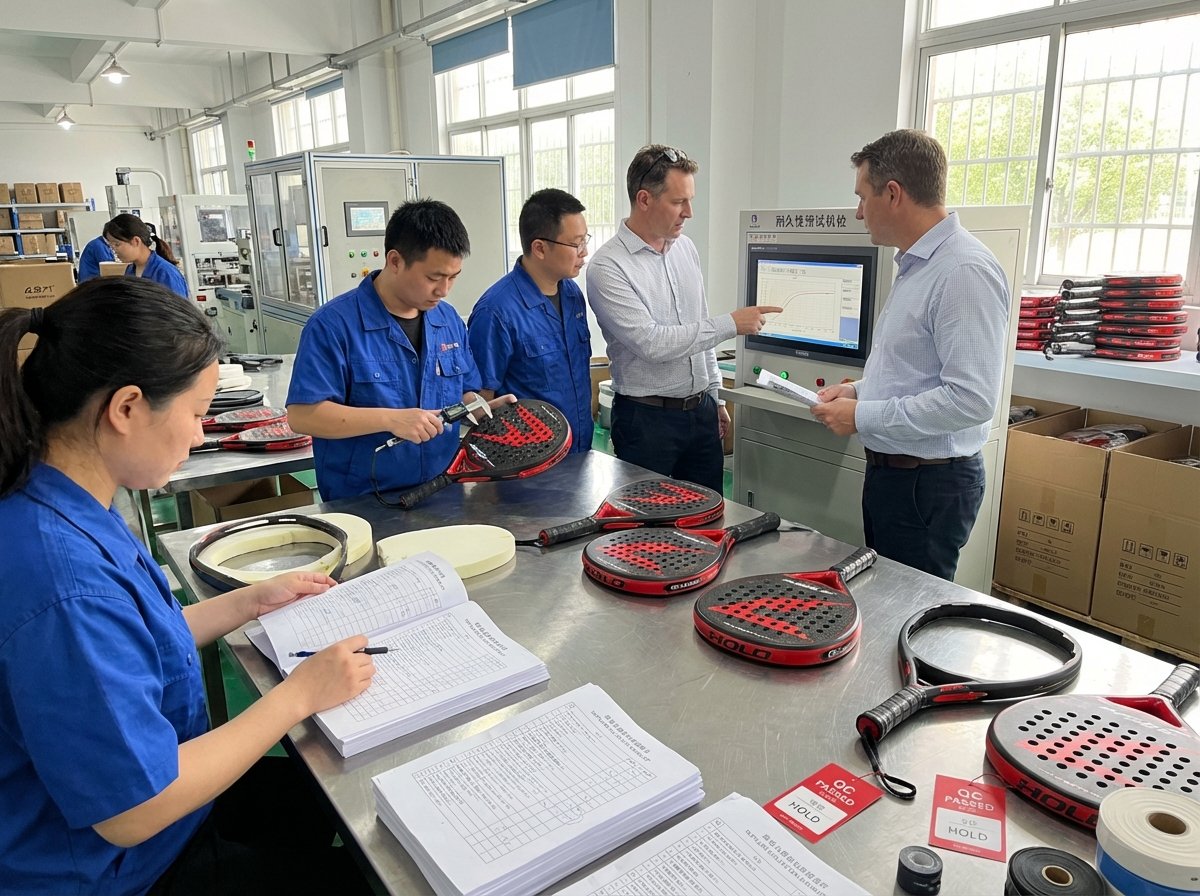
In padel racket manufacturing, a good-looking sample is never enough. Many supplier problems only appear later, when mass production begins or after products reach the market. That is why factory selection should be based on a clear audit process, not only on quotation, photos, or fast replies. For brands, distributors, importers, and sourcing teams, the right manufacturing partner is the foundation of product quality, stable delivery, and lower after-sales risk.
Why Is Choosing the Right Padel Racket Manufacturing Partner So Important?
In this category, supplier mistakes become expensive very quickly. A weak partner can create problems that affect almost every part of the business: product quality, delivery schedule, customer complaints, return rates, and brand trust.
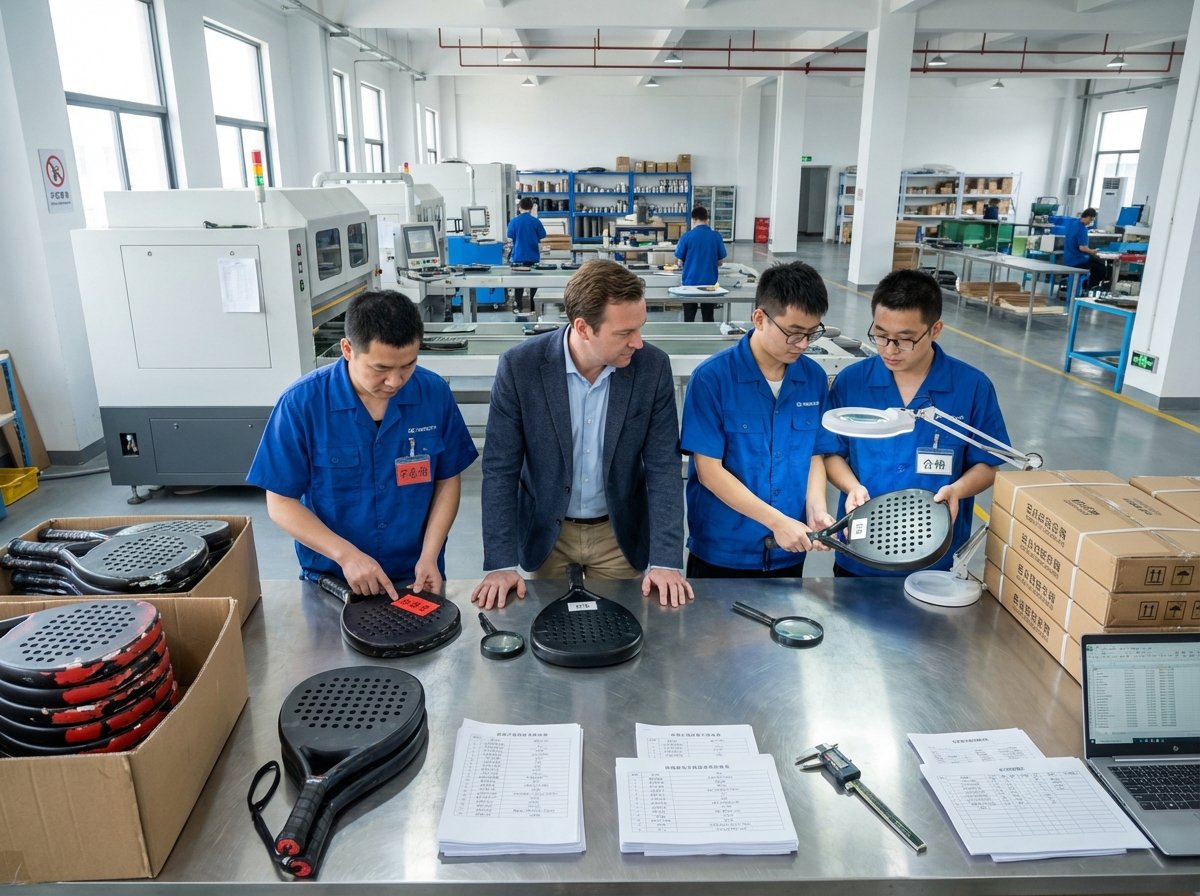
The padel racket market already shows what goes wrong when factory standards are too low. Complaints often repeat the same patterns: cracking after first use, paint chipping too early, edge areas coming apart, head-heavy products that feel wrong in play, handle structures that break too easily, and products arriving with cosmetic defects or poor packaging. These issues do not only damage the product. They also damage confidence in the brand behind it.
That is why factory evaluation must go deeper than product appearance. A supplier may present carbon, EVA, attractive graphics, and low pricing, but still fail in the areas that matter most during real cooperation. The real test is whether the factory can control quality in mass production, not only in a small sample batch.
For any company building a custom padel racket line, the goal should be to choose a factory that can consistently deliver the right feel, the right structure, the right finish quality, and the right production discipline.
Supplier Audit Checklist for Choosing a Reliable Padel Racket Manufacturing Partner
A proper supplier audit should follow a checklist instead of depending on general impressions. The strongest evaluation usually includes six core areas.
Factory Identity and Real Production Control
The first point is simple: confirm whether the supplier is a real factory or only a trading company. This matters because real production control affects quality, lead time, sampling, and technical adjustment. A trading office may communicate well, but if it does not control production directly, problem solving becomes slower and less precise.
A reliable partner should be able to explain:
- factory location and production scope
- whether molding, layup, finishing, and assembly are handled in-house
- which processes are outsourced
- how sampling and mass production are connected
Product Development Capability
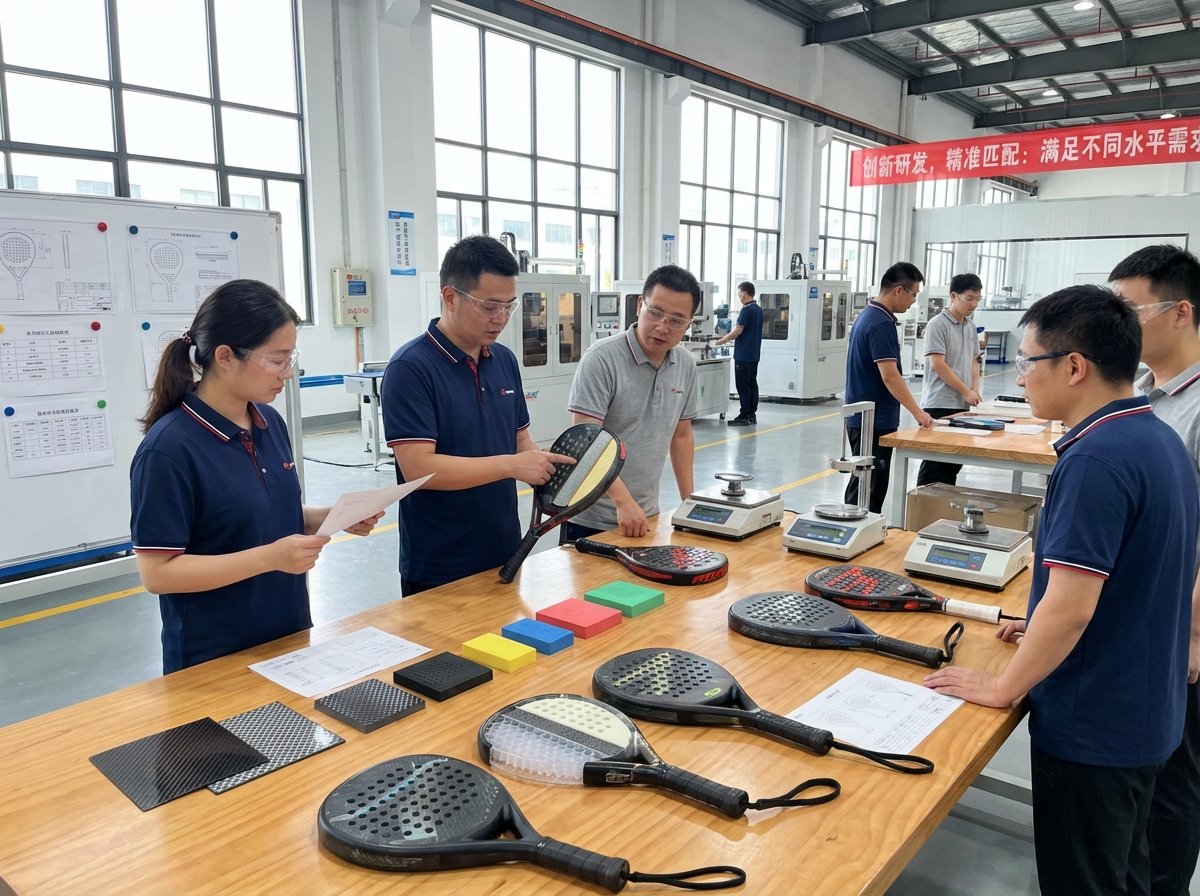
A strong factory should not only manufacture standard models. It should also support development. In padel, this is very important because many market problems come from poor player-product matching. If all carbon rackets are built too hard, too head-heavy, or too advanced, the result is more complaints and more returns.
The factory should be able to discuss:
- soft, medium, and hard feel segmentation
- balance range options
- sweet spot tuning
- vibration control
- arm-friendly product direction
- structural reinforcement for durability
Quality Control System
A supplier without a real QC system is a major risk. Visual checks alone are not enough. In padel rackets, hidden issues such as internal weakness, unstable weight, poor balance consistency, weak edge construction, and poor coating adhesion can appear even when the product looks fine.
The factory should have checkpoints for:
- raw material incoming inspection
- layup consistency
- weight and balance control
- curing and finishing checks
- final appearance inspection
- packaging inspection before shipment
Testing Ability
A good supplier should not rely only on factory experience or “market standard” language. It should be able to explain how products are tested and what failure points are monitored. This is especially important because the most common complaints in the market are very specific: early cracks, edge damage, loose protector parts, paint chipping, handle failure, and uneven feel.
Testing should cover:
- impact resistance
- fatigue durability
- handle pull or twist strength
- edge protection performance
- coating adhesion
- basic structure consistency
Production Capacity and Delivery Stability
A supplier may produce good samples but still fail when volume increases. This is why production capacity must be verified early. The goal is not only knowing monthly output. The more important question is whether the factory can maintain quality when production scale grows.
Communication and Documentation
A weak supplier often shows the same pattern: vague replies, inconsistent specifications, poor version control, and no clear written process. This becomes dangerous in OEM and ODM cooperation because misunderstanding can easily affect mold, material, balance, graphics, packaging, and delivery timing.
A reliable factory should provide:
- clear specification sheets
- sample confirmation records
- quality standards
- production lead time logic
- packaging standards
- after-sales handling process
How to Verify Quality Control, Certifications and Production Capacity Before Cooperation?
Verification should always be based on evidence, not only on promises. Many suppliers sound professional at the quotation stage. The real difference appears when details are checked.
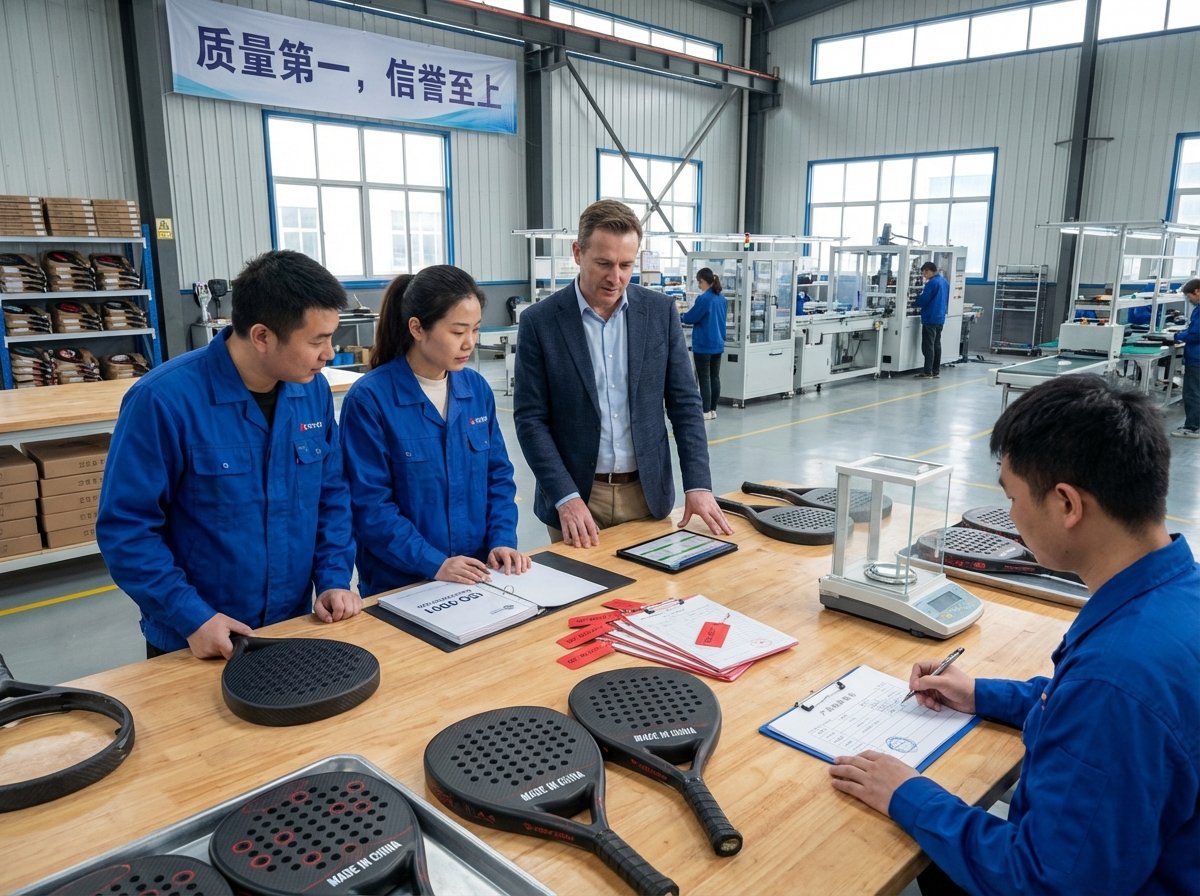
Quality control should first be verified through process visibility. A supplier should be able to explain where inspection happens and how non-conforming products are handled. For example, if a racket shows paint defects, edge damage, balance deviation, or abnormal sound during inspection, the factory should have a clear method for rejection, repair, or segregation. A supplier that cannot explain this clearly is already showing a weakness.
Certifications also matter, but they should be treated correctly. Certifications are not the same as real product quality, yet they still show whether the factory has some formal system and customer requirement awareness. It is important to verify which certifications are factory-level and which are product-level. It is also important to check whether the supplier understands the certification expectations of the target market rather than simply sending generic files.
Production capacity should also be verified in a practical way. A supplier may mention large monthly output, but capacity without control is not a real advantage. Better questions include:
- how many production lines are running
- how many workers or teams handle key processes
- whether peak season affects delivery
- how many days are needed for repeat orders
- how sample approval connects to bulk schedule
- how the factory handles urgent adjustments or rework
The safest approach is to review not only capacity claims, but also process stability. A factory with controlled output and stable quality is usually a better partner than a factory with large numbers but weak discipline.
What Quality Signals Should Be Checked in Sample Evaluation?
Sample evaluation is one of the best ways to uncover supplier strength before mass production begins. But the sample should be reviewed with the right logic.
The first check is consistency between the requested specification and the actual sample. This includes weight, balance, feel, finish, grip area, drilling, and cosmetic execution. If the supplier cannot match the requested direction during sampling, the risk becomes even higher during mass production.
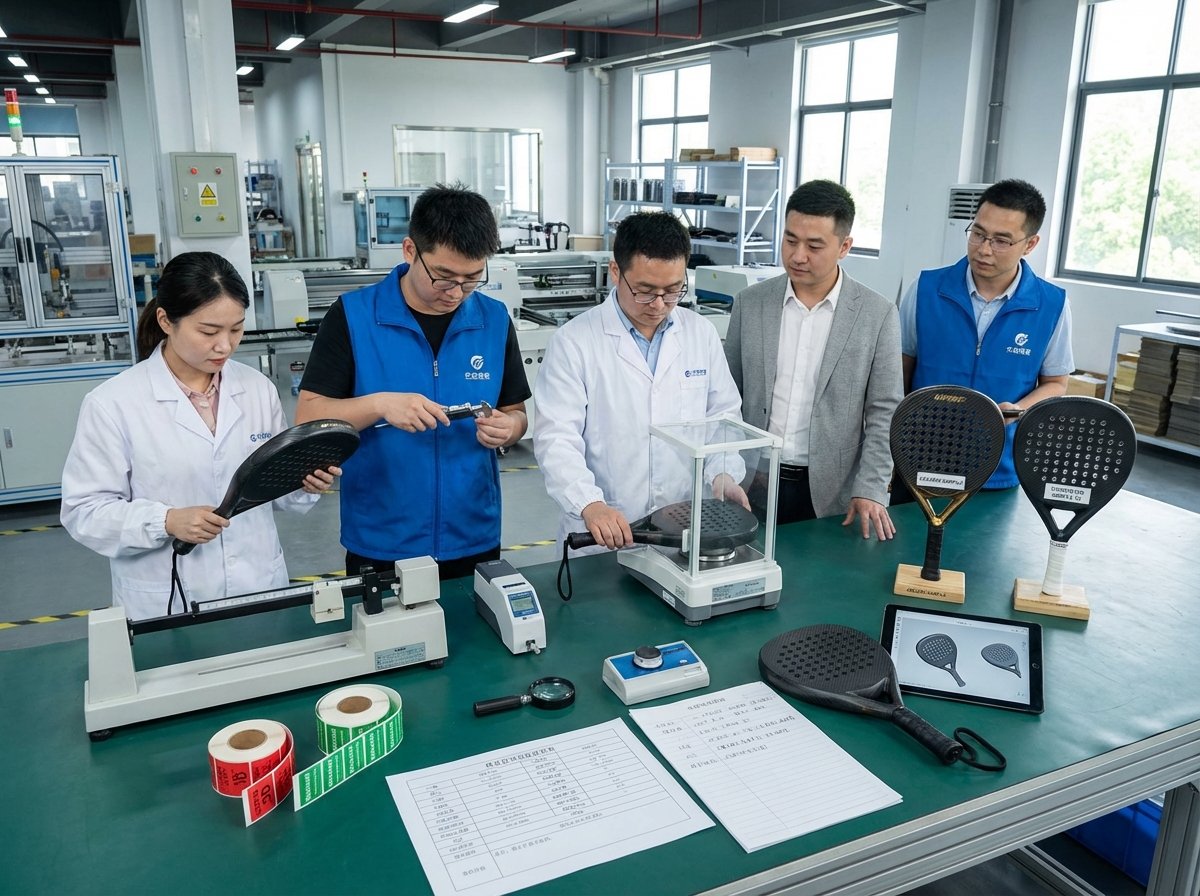
The second check is whether the sample only looks attractive or also feels commercially correct. In padel, many products fail because they are built too much for image and too little for usability. Samples should be reviewed for:
- comfort level
- vibration feedback
- ease of control
- forgiveness on off-center shots
- sweet spot positioning
- overall player fit
This is important because market insights already show repeated complaints around overly hard carbon rackets, head-heavy designs, and products that are too advanced for average users.
The third check is finish quality. Early warning signs include weak paint adhesion, rough trimming, poor edge closure, loose decorative parts, inconsistent surface texture, and visible flaws near the frame or hole area. These issues often become worse in mass production if they are already visible at sample stage.
The fourth check is durability logic. Even if full formal testing is not possible at the sample stage, the factory should still be able to explain how the structure is designed to reduce cracking, edge failure, and handle weakness.
Red Flags to Watch When Evaluating a Custom Padel Racket Factory
Some warning signs appear very early and should not be ignored.
One red flag is overfocus on price without enough discussion of structure, balance, feel, or durability. A supplier that only pushes price usually creates quality problems later.
Another red flag is unclear product language. If the factory cannot explain the difference between soft, medium, and hard feel, or cannot clearly describe balance options, sweet spot logic, and player fit, the development process will remain shallow.
A third warning sign is mixing structural issues and cosmetic issues as if they are the same. In padel, a crack and a paint chip are completely different problems. A factory that does not separate them probably also does not solve them correctly.
A fourth red flag is lack of consistency in documents. If quotation, sample spec, and discussion records do not match, confusion in bulk production becomes likely.
A fifth warning sign is weak response to complaint scenarios. A strong supplier should be able to explain what happens if products arrive damaged, if a batch shows abnormal cracking, or if weight deviation exceeds tolerance. A weak supplier will usually answer in vague and reactive language.
A sixth warning sign is no clear understanding of market pain points. Current complaint patterns show clear factory priorities: arm comfort, durability, finish quality, edge reliability, and accurate product positioning. A supplier that still sells only “3K,” “12K,” or “power carbon” without deeper explanation is likely behind the market.
How Can Brands Audit Whether a Factory Understands Market Trends and End-User Complaints?
A supplier should not only know how to produce. It should also understand why products fail in the market.
This matters because many returns do not happen because the product is completely unusable. They happen because the product does not match the buyer’s expectation. A racket may be technically “carbon,” but if it feels too hard, too harsh, too head-heavy, or too difficult for the target player, complaints will still rise.
A strong factory should show awareness of these trends:
- growing demand for arm-friendly carbon rackets
- need for clearer soft, medium, and hard segmentation
- stronger focus on balance, not only total weight
- separation between structural anti-crack design and cosmetic anti-chip design
- better explanation of player level and use case
- more importance placed on finish quality and packaging consistency
This kind of understanding is important because it shows whether the factory is only producing generic models or whether it can help build a stronger product line for real market demand.
What Should Be Discussed Before Final Cooperation Starts?
Before cooperation starts, both sides should lock down more than price and design.
The discussion should include specification tolerances, quality acceptance standards, sample approval process, packaging method, production lead time, inspection logic, warranty handling, and complaint classification. This is especially important in padel racket projects because many disputes begin with unclear definitions.
For example, it should be clear how the factory classifies:
- structural crack
- paint chip
- minor cosmetic defect
- transport damage
- balance deviation
- weight tolerance
- handle issue
- edge protector detachment
Without this level of clarity, even a good supplier relationship can become difficult later.
Why Does a Real Factory Partner Create More Long-Term Value?
A real factory partner adds value beyond production. It supports product development, technical adjustment, quality control, and faster problem solving.
For custom padel racket projects, this is a major advantage. A factory with in-house design, R&D, production, and sales coordination can respond faster when a product needs lower vibration, better durability, improved balance, or stronger finish quality. It can also support clearer OEM and ODM paths depending on the stage of the brand.
PDK works as a real factory with in-house design, R&D, sales, and production support, and has OEM and ODM experience serving established brands. This helps create stronger communication, more reliable quality follow-up, and better alignment between market needs and actual product execution. For brand owners, distributors, buyers, and sourcing teams, that kind of direct factory support reduces risk and improves long-term cooperation value.
Conclusion
The right padel racket manufacturing partner should meet standards in quality control, testing, transparency, capacity, and technical understanding, not only in price or appearance. Strong supplier evaluation protects product quality, reduces complaint risk, and creates a more stable foundation for custom racket development.
For brands, distributors, importers, and sourcing teams planning a new project or reviewing current factory options, a structured audit is the best starting point. A reliable manufacturing partner should be ready to discuss specifications, QC logic, testing standards, and production support in detail. For padel racket projects that require stronger factory control, OEM and ODM support, and better long-term consistency, sending an inquiry and starting with an audit checklist is the most practical next step.