Many padel brands want better quality, faster lead times, and lower complaint rates at the same time. The challenge is that old production logic can no longer support all three.
The future of padel racket production will be shaped by smarter automation, material innovation, stronger quality control, and more practical sustainability. Brands that understand these changes early can improve product consistency, reduce after-sales problems, and build stronger collections with the right factory partner.
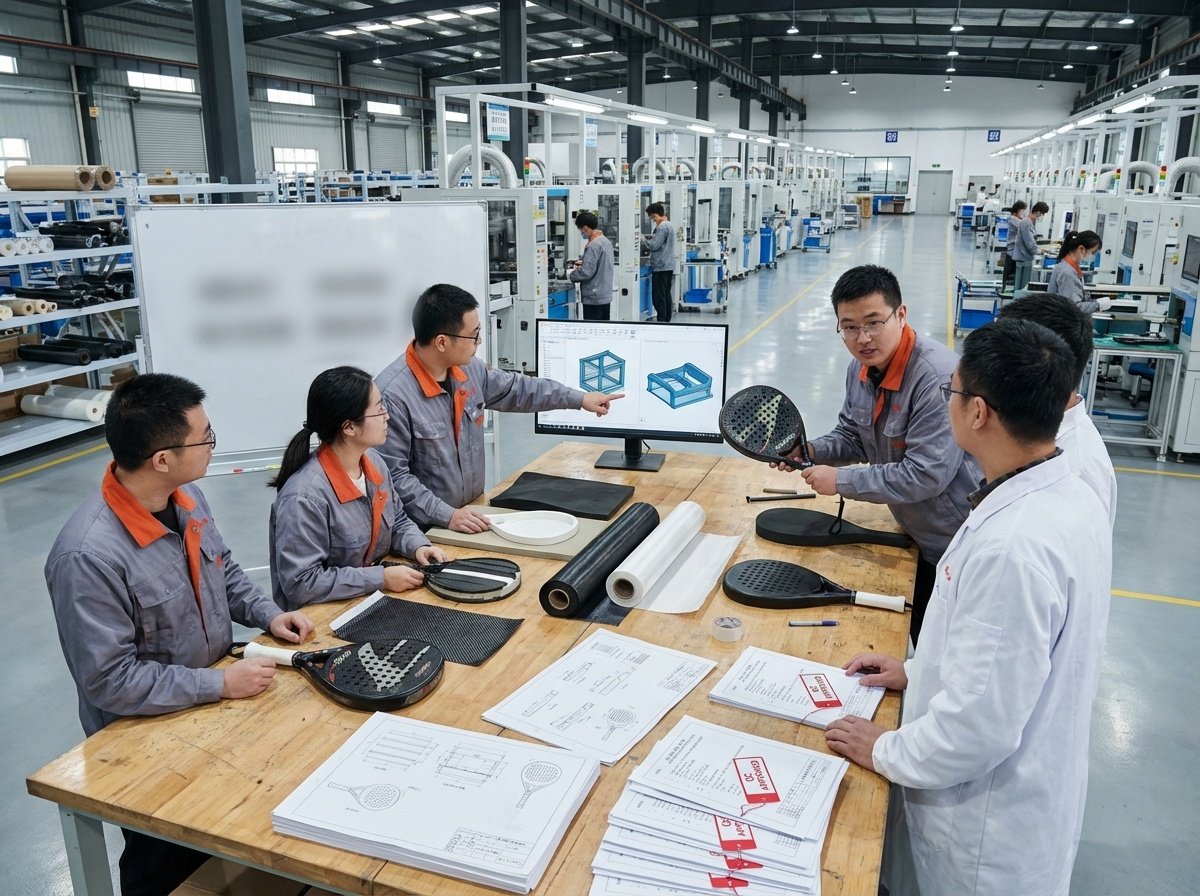
Padel racket production is no longer only about making carbon products look premium. The market is becoming more demanding. Buyers care more about comfort, durability, finish quality, lead time, and whether the product really matches the target player. That shift is changing how serious factories design, test, and manufacture the next generation of rackets.
Why Is Padel Racket Production Entering a New Phase?
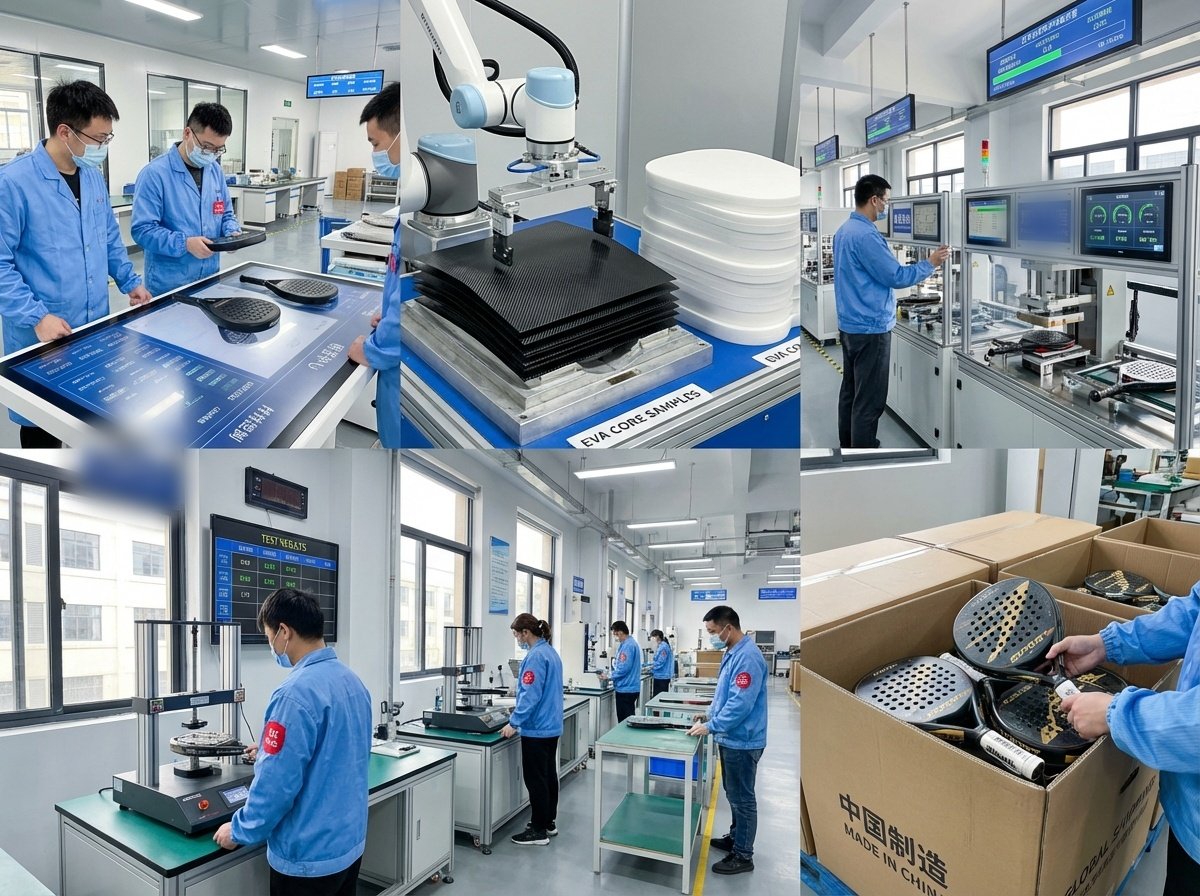
For many years, a large part of padel racket production followed a simple path. Add carbon, push a premium look, and compete on appearance and price. That model is becoming weaker.
The reason is clear. The market is now more sensitive to real product problems. Complaints around elbow discomfort, harsh vibration, head-heavy handling, early cracking, paint chipping, edge damage, weak handles, and poor consistency are appearing again and again. These are not small cosmetic issues. They affect reviews, returns, repeat orders, and brand trust.
This means the future of production cannot focus only on output volume. It must focus on better performance matching, stronger structural reliability, and clearer spec control. Factories that still produce carbon rackets as if all users want hard, advanced, aggressive products will face more pressure. Factories that can build softer, more forgiving, better-segmented products will have a stronger position.
In other words, the next phase of production is not just about making more rackets. It is about making more suitable rackets with fewer quality risks.
Automation, Material Innovation and Sustainability Trends in Padel Racket Production?
The future will be shaped by three connected changes: automation, materials, and sustainability. These trends are not separate. In a strong factory system, they support each other.
Automation will help improve consistency. In padel production, many quality issues come from unstable manual steps such as layup positioning, resin control, drilling accuracy, trimming, coating application, and final inspection. Smarter automation can reduce variation between batches. It can also improve repeatability in weight, balance, finish, and structural assembly.
Material innovation will focus less on “more carbon” and more on “better use of carbon.” That means more careful pairing of face material, EVA density, resin toughness, and layup structure. The market has already shown that many users do not want hard carbon only. They want better comfort, less vibration, and a more forgiving sweet spot. This creates room for softer carbon systems, hybrid carbon-fiberglass structures, tougher resins, improved edge protection materials, and more stable handle-core structures.
Sustainability will also become more practical. In this category, sustainability is not only about using greener materials in marketing language. It is also about reducing waste, improving yield, extending product life, and lowering failure rates. A racket that cracks too early, flakes after a few matches, or fails in normal use is not sustainable no matter what label is printed on the box. So the future of sustainable production includes longer-lasting products, more controlled raw material use, improved curing efficiency, and cleaner finishing processes.
How Will Automation Improve Padel Racket Quality and Consistency?
Automation matters most where inconsistency creates expensive problems.
In padel racket production, one of the biggest hidden issues is variation. Two rackets from the same model may look almost identical, but if layup position shifts, resin distribution changes, or curing is not fully controlled, the final feel can be very different. One racket may feel stable and comfortable, while another feels harsh, uneven, or weak in certain zones.
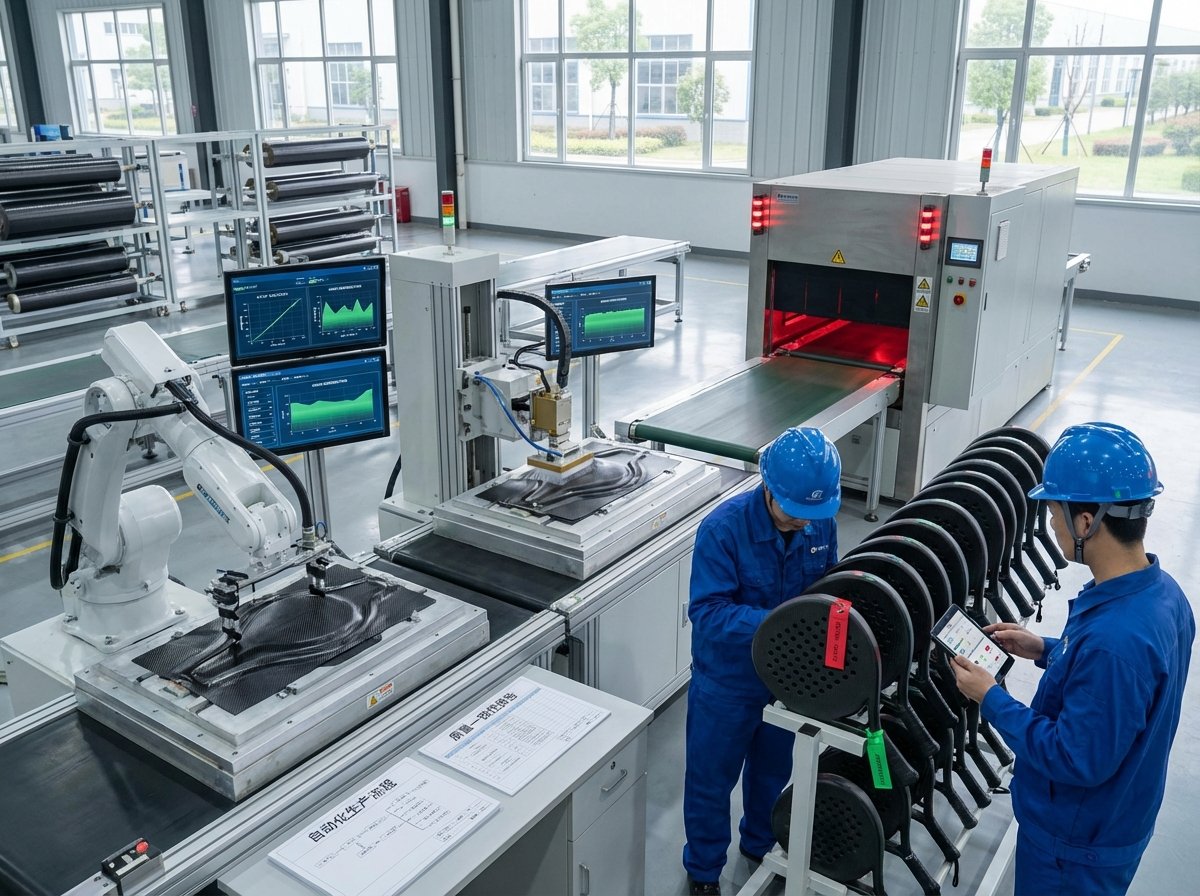
That is why the future factory will use automation more selectively in the most sensitive steps. These include carbon cloth cutting, preform positioning, drilling accuracy, paint application, edge finishing, and spec checking. Better automation in these areas can help reduce the common complaints seen across the market: weight inconsistency, unbalanced feel, soft spots in the face, edge weakness, and visible finishing defects.
Automation will also improve traceability. A stronger next-generation factory will not only say that quality is controlled. It will be able to link batch, process, operator, material lot, and inspection result more clearly. This helps when problems appear in the market. Instead of guessing, the factory can track patterns and fix root causes faster.
For brands, this matters because consistent products are easier to sell and easier to scale. Retailers and distributors do not want one batch that plays well and another that creates claims. Automation, when applied correctly, supports that stability.
Which Material Innovations Will Matter Most in Future Padel Racket Production?
The next material trend is not about one miracle fabric or one new carbon code. It is about more intelligent material combinations.
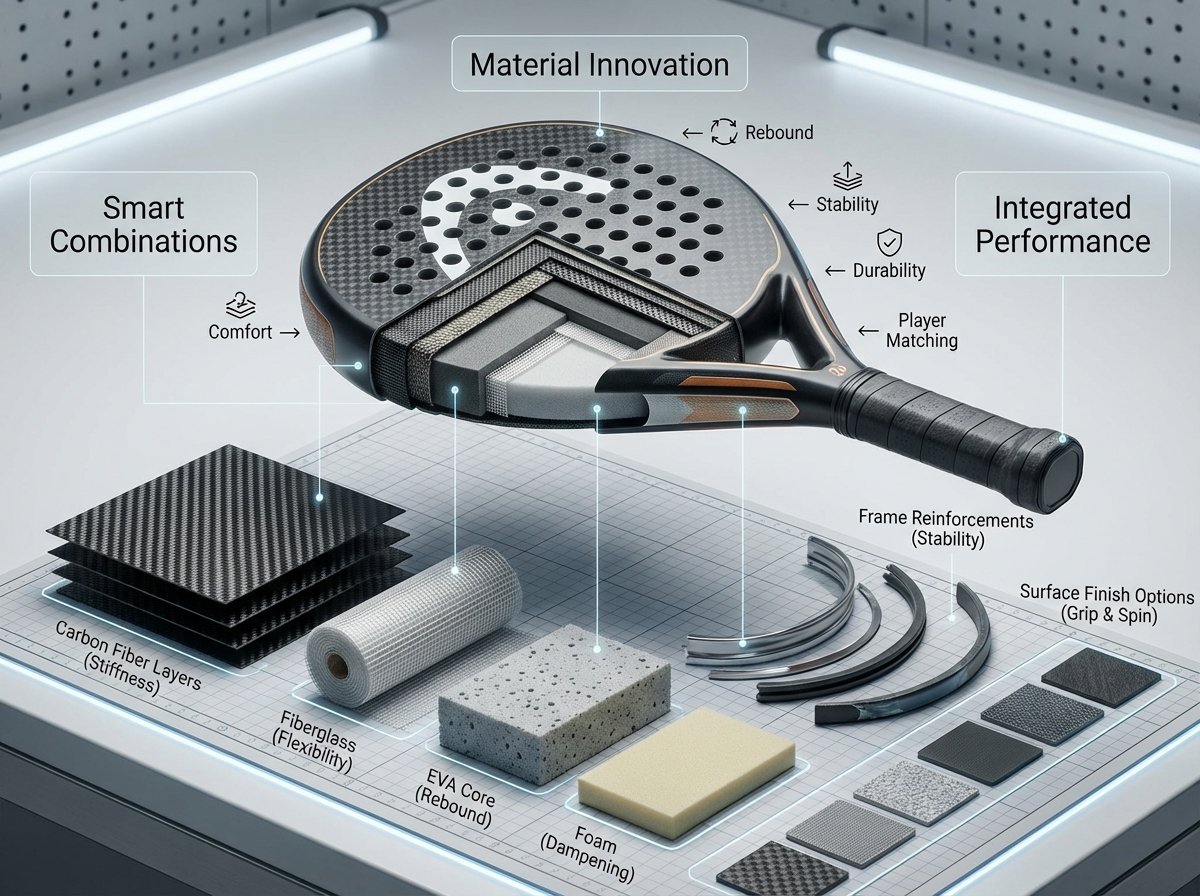
A major change will be the move toward player-focused material engineering. Many market complaints show that full hard-carbon constructions are often too demanding for average users. They can feel stiff, transmit too much vibration, and create discomfort in the wrist, elbow, or shoulder. This is why future production will likely favor more layered material logic.
Several directions are especially important.
First, softer-feel carbon constructions will become more valuable. These give the premium image of carbon but reduce harsh feedback. This matters because many players still want carbon, but not the pain or difficulty that often comes with overly hard builds.
Second, hybrid constructions will become more common. Carbon-fiberglass combinations can improve comfort, help on slower balls, and create a larger effective sweet spot. For many brands, this is a smarter commercial choice than pushing every product toward a high-response pro feel.
Third, resin systems will matter more. Tougher resin can help improve crack resistance, especially in the frame, bridge, edge, and face transition areas. Since early cracking is one of the clearest market complaints, better resin toughness is not just a technical improvement. It is a business necessity.
Fourth, EVA tuning will become more precise. Factories will need clearer soft, medium, and hard segmentation instead of vague descriptions. The future winning structure is likely to combine face material, EVA density, and layup response in a more coordinated way so the final product matches a real player level.
How Future Manufacturing Changes Will Affect Cost, Quality and Lead Time in Padel OEM?
Future manufacturing will not change only the product. It will change the cost-quality-lead-time balance.
At first glance, more automation, better materials, and stricter testing may appear to increase cost. In some cases, they will. But the more important question is total cost, not unit quotation alone. A lower-priced racket that creates cracking claims, paint complaints, or high return rates is often more expensive in the end.
Better manufacturing systems can improve quality and reduce hidden costs in several ways. Stronger process control can reduce rework. Better finish stability can reduce cosmetic rejection. More accurate layup and curing can reduce structural failure. Faster process visibility can shorten problem-solving time. This means that a more advanced factory is often better at protecting brand margin even when the initial quote is not the lowest.
Lead time can also improve when factory systems are stronger. In many older models, delays happen because of manual bottlenecks, unstable finishing, repeated corrections, and inconsistent batch output. A next-generation factory with better process flow, in-house coordination, and smarter inspection can reduce that friction.
For OEM projects, this is especially important. A brand that wants reliable product launches needs more than production capacity. It needs a factory that can move from development to sampling to mass production with fewer surprises. That is why factories with in-house design, R&D, production, and sales coordination will become more valuable. Internal alignment shortens communication loops and helps technical changes move faster into production.
Why Will Durability Engineering Become More Important Than Pure Marketing Claims?
One of the clearest lessons from market complaints is this: brands can no longer rely on appearance and carbon labels alone.
Complaints across the market show strong concentration around structural failure and finish failure. Rackets crack after one use, two uses, or a few matches. Paint chips early. Edge guards loosen. Fibers fray near the edge. Handles break. Soft spots appear in the middle. These are not rare problems. They are repeated signals that durability engineering must become central to production.
The future factory must treat structural durability and cosmetic durability as two separate engineering tasks.
Structural durability includes:
- stronger layup direction
- tougher resin systems
- reinforcement in bridge, edge, throat, and handle junction areas
- better fatigue testing
- impact and misuse tolerance
Cosmetic durability includes:
- better coating adhesion
- improved curing control
- stronger edge finishing
- wear-resistant protective layers
- cleaner visual standards
This separation matters because the market reacts differently to each issue. Structural cracks create safety concern and immediate distrust. Paint loss creates a low-quality image even if performance is still acceptable. Both harm the brand, but both require different production solutions.
This is why next-generation factories will need more test logic, not just more design language.
What Brands Should Expect from Next-Generation Padel Racket Factories?
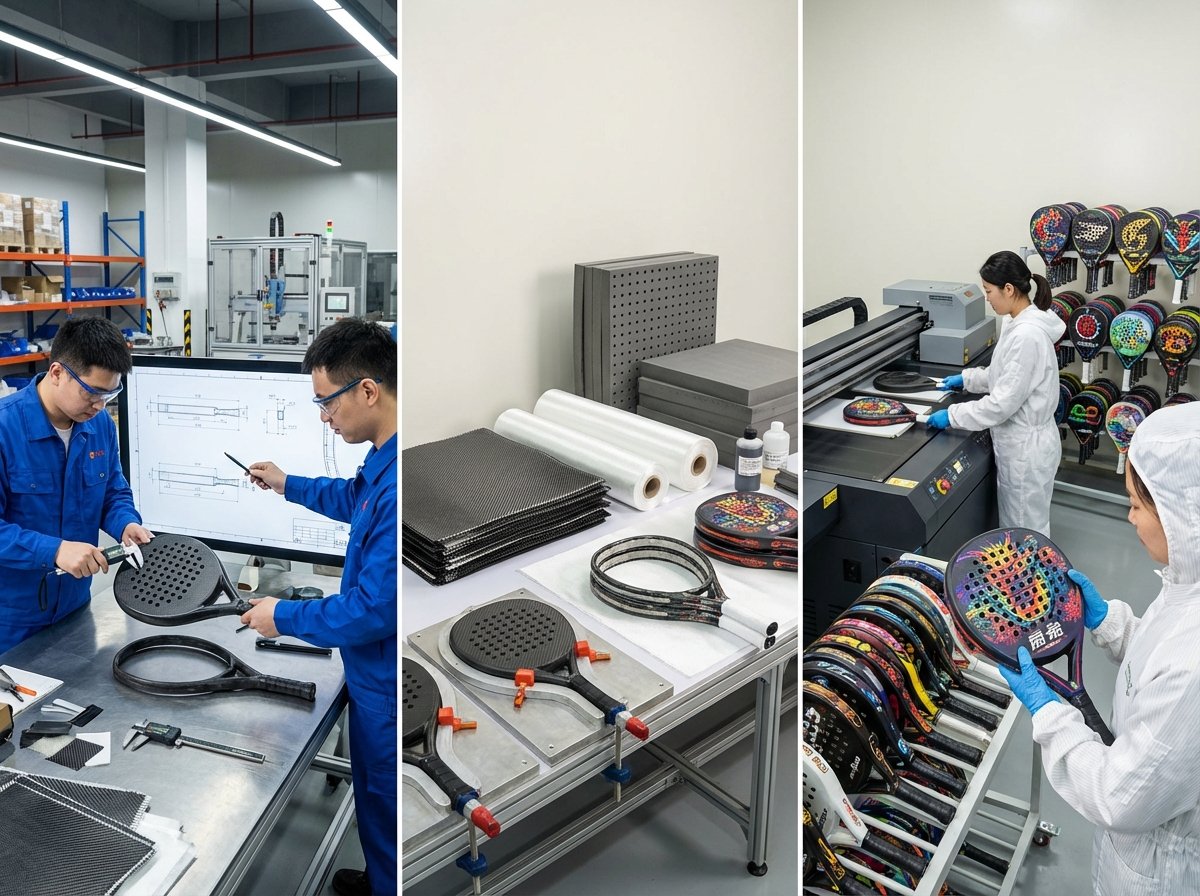
Brands should expect more than manufacturing capacity. They should expect development capability, quality logic, and market understanding.
A next-generation factory should be able to help with product segmentation first. That means not only offering a list of carbon rackets, but helping structure products into soft, medium, and hard feels, different balance types, different player levels, and different use cases. This is important because one of the biggest causes of complaints is wrong player-product matching.
Brands should also expect better sampling support. Future factories should test with different player levels, not only advanced hitters. Intermediate users often reveal the most useful truth about comfort, forgiveness, vibration, and balance.
Another expectation should be clearer spec language. Raw material codes alone are no longer enough. Factories should help translate technical build into real sales language such as arm comfort, sweet spot size, feel, balance, control level, and recommended player type.
Most importantly, brands should expect stronger quality systems. That includes batch traceability, crack-risk control, weight and balance consistency, finish inspection, and more disciplined packaging protection. In the market, “arrived damaged” and “used-looking product” complaints damage trust almost as much as product failure. So packaging, final inspection, and warehouse discipline will also become part of the future factory standard.
How Will Sustainability Become More Practical in Future Padel Production?
Sustainability in padel production will move away from vague promises and toward measurable factory actions.
A more practical view of sustainability starts with making products that last longer. A racket that fails early wastes carbon, resin, paint, labor, freight, packaging, and customer trust. That is why durability itself is part of sustainability.
The next step is process efficiency. Better material cutting reduces waste. Better curing control reduces rejected output. Better coating systems reduce overuse and rework. Better batch control lowers scrap. These improvements may seem operational, but they directly affect the environmental footprint of production.
Packaging will also evolve. More efficient inner protection, stronger shipping logic, and cleaner outer packaging can reduce transit damage and unnecessary replacement shipments. Since “arrived cracked” and “damaged out of the box” remain serious market problems, packaging improvement is both a quality issue and a sustainability issue.
For brands, the practical message is simple: sustainability should not sit outside quality. It should be built into product life, process stability, and waste reduction.
Why Will Factory Partnership Matter More in the Future?
As padel production becomes more technical, the value of the right factory partner becomes much higher.
A basic supplier may still be able to produce standard rackets. But future competition will depend on who can improve comfort, reduce cracking, control finish quality, shorten development cycles, and support clearer product segmentation. That kind of work needs real factory capability, not only order handling.
A factory with in-house design, R&D, production, and sales departments can respond much faster to this new market environment. Product adjustments do not need to pass through too many external steps. Sampling can be improved with better feedback loops. OEM and ODM projects can be managed with stronger logic. Quality issues can be traced and corrected more effectively.
This is also where experience with established brands becomes important. Working with recognized brands usually requires stricter consistency, better communication, and more mature production management. That experience helps support newer and growing brands that want more reliable long-term cooperation.
PDK operates as a real factory with in-house design, R&D, production, and sales support, along with OEM and ODM experience developed through cooperation with well-known brands. This kind of structure is well aligned with what the next generation of padel manufacturing requires: faster development, better quality control, stronger customization support, and more practical production problem-solving.
Conclusion
The future of padel racket production will be defined by smarter automation, more useful material innovation, stronger durability engineering, and more practical sustainability. The factories that lead in the next stage will not simply make carbon rackets faster. They will make better-matched, more consistent, and more reliable products for a more demanding market.
For brands, importers, distributors, and buyers planning the next generation of padel products, the key is to work with a factory that understands both manufacturing detail and market complaint patterns. A stronger production partner can help turn future trends into better sampling, better quality, better lead time, and better long-term product performance. For new projects or next-season development, sending an inquiry and starting with target market, player level, and product direction is the most practical next step.